

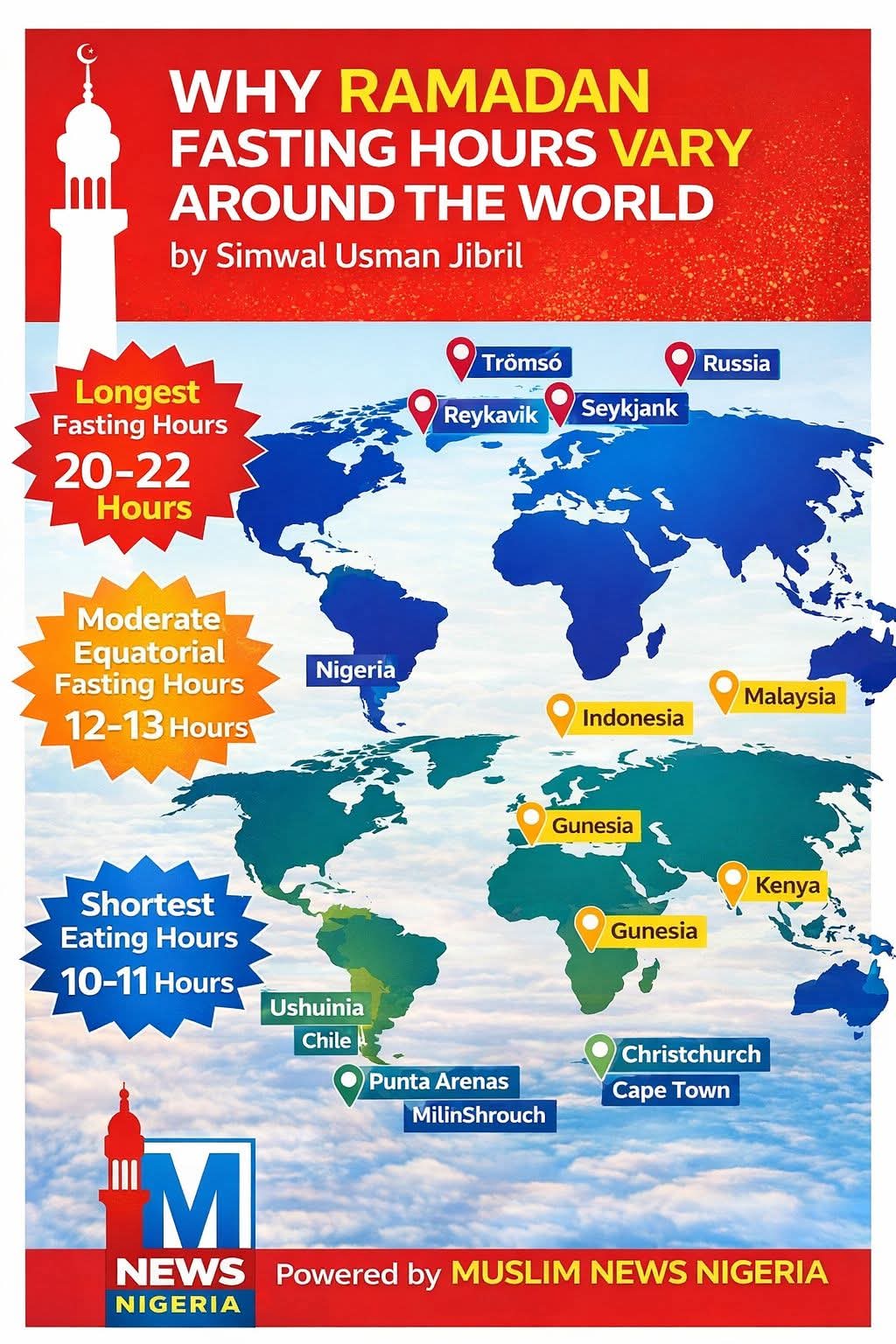
As Muslims around the world observe the holy month of Ramadan, they fast each day from the appearance of Fajr until sunset. While the obligation is universal, the length of the daily fast varies widely, depending on geography and the time of year.
In some parts of the world, Muslims may fast for more than 20 hours a day, while in others the fast can last little more than 10 hours.
The Longest Fasting Hours
The longest fasting days are experienced in Northern Europe and Arctic regions, where daylight stretches late into the evening during spring and summer.
Cities with some of the longest fasting hours include Tromso, Norway (around 20–22 hours), Reykjavik, Iceland (20–21 hours), Murmansk, Russia (20 hours or more), and Stockholm , Sweden (18–19 hours).
These cities lie at high latitudes, far from the Equator, where daylight hours increase significantly as summer approaches. When Ramadan falls close to the summer solstice, the sun remains visible for much longer periods, extending fasting times.
Because Ramadan follows the Islamic lunar calendar, which is around 10 to 11 days shorter than the solar year, the month shifts earlier annually. This means fasting hours change from year to year.
In extreme cases where the sun barely sets, some Islamic scholars allow Muslims to follow alternative fasting schedules, such as the timetable of Makkah or that of the nearest location with a normal day-night cycle.
The Shortest Fasting Hours
By contrast, Muslims in parts of the Southern Hemisphere experience much shorter fasting days during the same period.
Cities with shorter fasting hours include Ushuaia, Argentina, and Punta Arenas, Chile (both around 10–11 hours), Christchurch, New Zealand (around 11 hours), and Cape Town , South Africa (11–12 hours).
When Ramadan falls in March or April, it coincides with autumn in the Southern Hemisphere, when days are becoming shorter. These regions are also located at moderate latitudes, avoiding the extreme daylight variations of polar areas.
Consistent Fasting Near the Equator
Near the Equator, fasting hours remain relatively stable throughout the year.
Cities such as Abuja, Nigeria, Jakarta, Indonesia, Kuala Lumpur, Malaysia, and Nairobi, Kenya typically see fasting times of around 12 to 13 hours.
This is because areas close to the Equator experience nearly equal daylight and darkness year-round, with minimal seasonal variation in sunrise and sunset times.
What Determines Fasting Length?
The key factors influencing fasting duration are latitude, season, hemisphere, and the Islamic lunar calendar.
While fasting hours may differ greatly, Ramadan remains a shared spiritual experience for Muslims worldwide, centred on fasting, prayer, charity and reflection regardless of how long the day lasts.
Simwal Usman Jibril is a Member National Moon sighting committee of the Nigerian supreme council for Islamic affairs Abuja.
Nigerian Muslim Personalities of the Year 2024/2025

Global Muslim Personalities of the Year 2024/2025




Sponsored