

* Raises alarm over media bias, INEC election timetable
* Prof. Oloyede urges unity, prayer and vigilance
The Nigerian Supreme Council for Islamic Affairs (NSCIA) has directed Muslims across the country to search for the crescent of Ramadan 1447 A.H. immediately after sunset on Tuesday, February 17, 2026, corresponding to 29th Sha’aban 1447 A.H.
In a statement issued on Sunday, February 15, 2026, and signed by its Secretary-General, Prof. Is-haq Oloyede, the apex Islamic body congratulated the Muslim Ummah on the forthcoming fasting season while outlining the moon sighting procedure and drawing attention to pressing national concerns affecting Muslims.
Prof. Oloyede, who also serves as the Registrar of the Joint Admissions and Matriculation Board (JAMB), stated that if the crescent is sighted on Tuesday evening, His Eminence, Muhammad Sa’ad Abubakar, CFR, mni, the Sultan of Sokoto and President-General of the NSCIA, will declare Wednesday, February 18, 2026, as the first day of Ramadan.
He explained that if the crescent is not sighted, Thursday, February 19, 2026, will automatically become the first day of Ramadan 1447 A.H., in line with Islamic jurisprudence.
Speaking further, the Secretary-General, who holds the traditional title of Kuliyan Sokoto, said the National Moon Sighting Committee (NMSC) has already put facilities in place nationwide to ensure a credible observation process.
According to him, the committee works in consultation with the National Space Research and Development Agency (NASRDA) to provide scientific guidance and ensure accurate reporting.
He advised Muslims to promptly report verified sightings to designated traditional rulers, religious leaders and NMSC members, whose contact details are available on the Council’s official website.
Council raises alarm over Islamophobia
Beyond the moon sighting announcement, the Council described the past year as a particularly trying period for Muslims in Nigeria.
Prof. Oloyede said Muslims face heightened Islamophobic narratives that seek to criminalise them through what the Council termed distorted interpretations of Nigeria’s security challenges.
According to the statement, Muslims increasingly find themselves under pressure to denounce actions they neither endorsed nor supported, while criminals operating in the country are framed as representatives of Islam.
The Council stressed that Muslims remain among the major victims of insurgency, banditry and other violent crimes, even as public discourse often portrays them as aggressors.
The Council warned that such narratives entrench inequality and erase Muslim suffering, particularly in communities affected by Boko Haram and other armed groups.
Media accused of selective framing
The NSCIA also accused sections of the media of failing to uphold the principles of fairness and objectivity in reporting incidents involving Muslims.
The Council noted that crimes committed by individuals identified as Muslims are frequently generalised and attributed to Islam as a religion.
However, it observed that when individuals from other faith communities commit similar offences, media reports rarely attach religious labels or indict their entire faith.
The Council said this selective framing fuels prejudice, deepens mistrust and undermines national unity.
INEC election schedule sparks complaints
The Council further confirmed that it has received numerous complaints following the announcement by the Independent National Electoral Commission (INEC) that the 2027 presidential election will hold during Ramadan, with gubernatorial elections projected to coincide with a probable Eid al-Fitr period.
Describing the decision as audacious, the Council said it is closely monitoring developments and expects an immediate review. It expressed hope that the electoral body will demonstrate sensitivity to the religious obligations of millions of Muslim voters and election officials.
Call for steadfastness and prayer
Despite the concerns raised, the Council urged Muslims to remain resolute in their faith during Ramadan.
Prof. Oloyede called on the Ummah to demonstrate sincerity, calmness and moral discipline, drawing inspiration from the endurance of early Muslims who faced severe trials.
Quoting the Qur’an, the Council reminded believers that Ramadan is a month of guidance and ease, not hardship, and emphasised justice and righteousness toward others regardless of religious differences.
The statement concluded with prayers for peace, protection and stability for Nigeria, and for Allah to grant Muslims the opportunity to witness, observe and outlive Ramadan 1447 A.H. in sound health and tranquility.
Sponsored Event
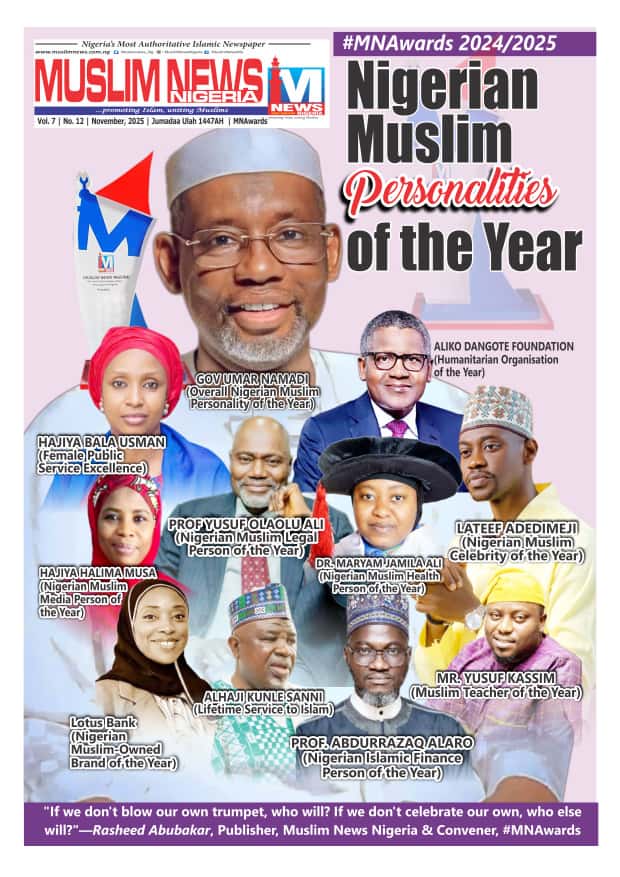
Nigerian Muslim Personalities of the Year 2024/2025
Global Muslim Personalities of the Year 2024/2025