

By Rasheed Abubakar
* Observing Ramadan and the legacy of centuries-old traditions
President Recep Tayyip Erdoğan and his wife, Emine, hosted families of martyrs, veterans, and related associations at the first iftar of the ongoing blessed month of Ramadan. In posts on his verified social media handles, he referred to them as “the esteemed relatives of our martyrs” and prayed for Allah’s mercy upon all those who sacrificed their lives for the homeland, the nation, the flag, and the values they held dearer than life. “I remember our veterans with gratitude,” he added.
In Türkiye, the term şehit, meaning martyr, carries both Islamic and patriotic weight. It primarily refers to soldiers, police, gendarmerie, and coast guard personnel killed while fighting terrorism, conducting cross-border operations, or protecting national security. Civilians who died in terrorist attacks or those killed resisting the 2016 coup attempt, known as the July 15 martyrs, are also recognised under this designation.
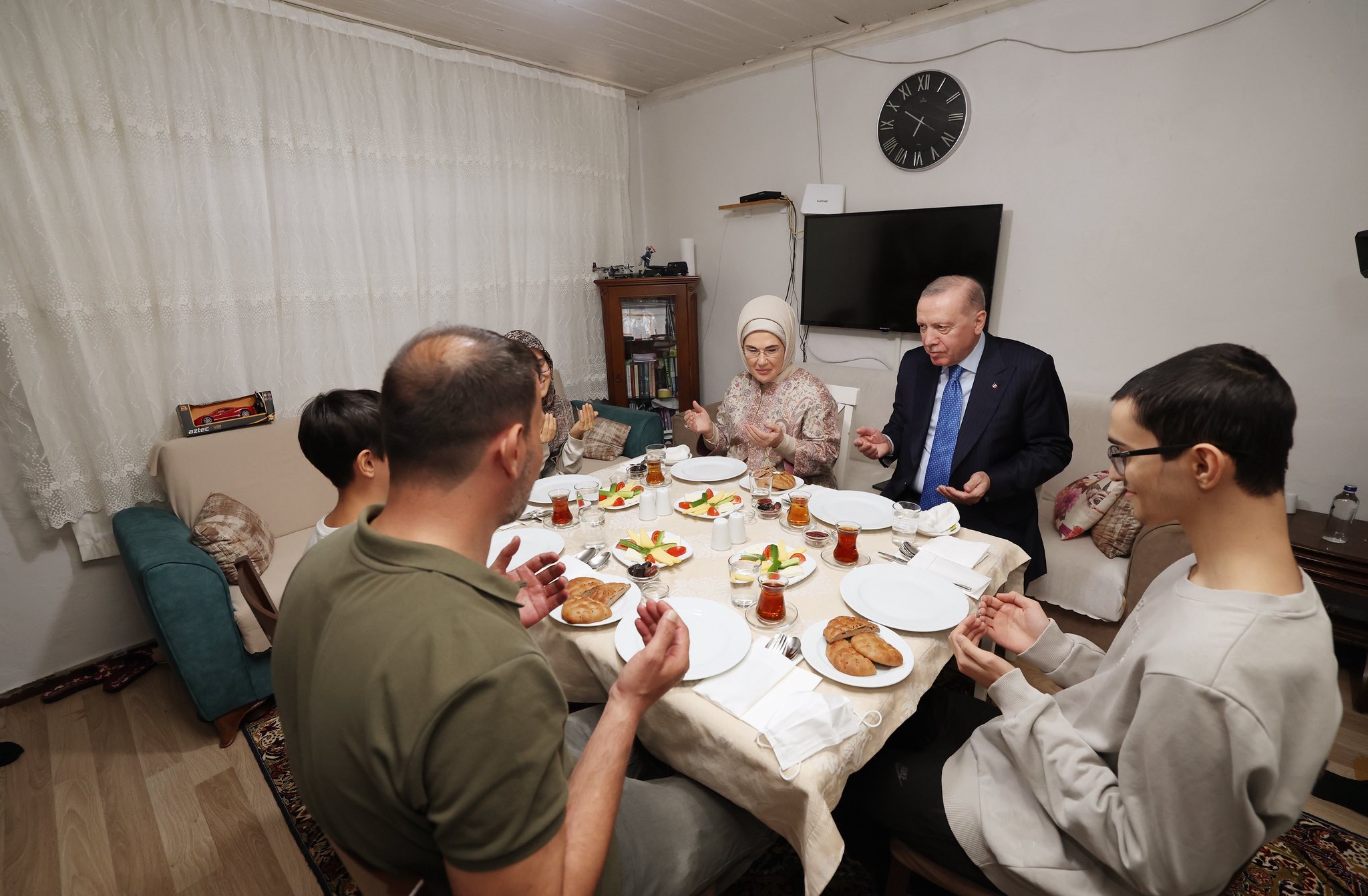
Following this gathering, President Erdoğan, who turned 72 on Thursday, February 26, and his wife attended an iftar dinner at the home of Ali and Miyase Kayacık in Beyoğlu, Istanbul. The Kayacık family are ordinary residents, and their home was chosen as part of President Erdoğan’s Ramadan tradition of visiting regular citizens for iftar, rather than prominent figures.
Sharing a meal with citizens, especially during Ramadan, is both symbolic and practical. It builds trust, demonstrates empathy, and bridges the gap between leadership and the populace. In the first of the three parts of Ramadan, President Erdoğan has held iftar programs with dormitory students, athletes and youth, workers and labor groups, esteemed members of the police, gendarmerie, and coast guard, as well as security personnel. He personally expressed gratitude to each for their service to the nation.
These programs will continue until the end of Ramadan and beyond, reflecting that President Erdoğan’s concern for citizens is not limited to the holy month. Leadership is a continuous responsibility: leaders must be present, understand the daily realities of citizens, and act to address their challenges.
A Tradition Institutionalized
Since rising to national prominence, President Erdoğan has made Ramadan iftars a hallmark of his leadership. Even from the very beginning of his political career, particularly as Mayor of Istanbul in the 1990s, he emphasized community engagement during the holy month. After the Justice and Development Party came to power in 2002, Ramadan gatherings became a visible feature of his style. From 2003 onward, as Prime Minister, he regularly broke fast with citizens, civil servants, security personnel, and disadvantaged groups across Türkiye.
Upon assuming the presidency in 2014, he institutionalised the tradition at the Presidential Complex in Ankara, hosting families of martyrs, veterans, security forces, youth and students, and representatives of civil society. Since then, Ramadan iftars have remained an annual and prominent part of his public engagement.
This practice is rare among leaders, particularly in Africa, where security concerns and the widespread detachment of leaders from the daily realities of citizens often create a gulf between rulers and the people they govern. Over more than a decade, President Erdoğan has maintained this tradition, humanizing leadership, boosting national morale, and gaining first-hand insight into the daily realities of citizens. During these visits, he interacts directly with families, asks about their well-being, and greets citizens on his way in and out, often receiving prayers and blessings in return.
Historical Roots of Immersive Leadership
This culture is historically traceable to Ottoman political tradition, Islamic leadership ethics, and broader Anatolian social customs, with its strongest roots in the Ottoman Empire (1299 to 1922). Yet, its antecedents extend further back to the Great Seljuk Kingdom (1037 to 1194), where rulers laid the foundation for a society that valued public welfare, justice, and spiritual responsibility.
For Ottoman rulers, Ramadan was more than a time of fasting; it was a period of visibility, charity, and closeness to the halk, the people. Many stories recount Sultans wearing simple attire and concealing their identities, knocking on the doors of humble homes before sunset, and asking to be hosted as “a guest of God.” These leaders practiced what modern societies might call immersive leadership, often disguising themselves to observe and engage directly with their citizens.
Inspiration from Turkish Historical Leaders
This historic practice has captured global imagination through Turkish historical series portraying iconic leaders, from Sultan Alparslan and his son Malikshah of the Great Seljuk Empire to Ertuğrul Ghazi, his son Osman Ghazi, and grandson Orhan Ghazi. These dramatizations reveal a striking pattern: rulers, while vested with power, never allowed their positions to shield them from the realities of the people they governed. During Ramadan, they would often dine with ordinary citizens, sharing suhoor or iftar, listening to their joys, grievances, and needs.
A recent episode 15 of the popular Turkish series Kuruluş: Orhan, released on February 18, a day before Ramadan began in Türkiye, exemplifies this tradition. In the episode, Sultan Orhan, accompanied by a few officials, disguised himself as a merchant to have suhoor with an elderly farmer. The old man warmly welcomed them, saying, “When our guests come from Allah, our door and our table are always open.”
When asked if he faced any difficulties, the farmer candidly explained that while Sultan Orhan ruled well, his alps, referring to his soldiers, often damaged his crops as they passed through his farm while taking a shortcut. The man’s words carried no personal blame against the Sultan; rather, they highlighted the responsibility of the state to protect the people’s livelihood.
Remarkably, the farmer continued speaking even after realizing he was in the presence of the Sultan himself, a testament to the culture of accountability that leaders of that era encouraged. Sultan Orhan, upon returning to the palace, acted promptly to ensure state representatives did not harm the people they were meant to protect.
Precedent in Early Islamic Leadership
This immersive leadership finds a profound precedent in early Islamic history. Umar ibn al-Khattab, the second Caliph, would regularly disguise himself to observe his people, walking the streets of Medina at night to ensure no family went hungry.
On one occasion, he encountered a woman sitting by a fire, her children crying beside her. She had placed water and stones in a pot over the fire, pretending to cook food because she had nothing to feed her children. She did not know Umar was present and said, “Allah will judge between us and Umar for neglecting us.”
Hearing her plight, Umar felt deeply moved and immediately returned to the public treasury, gathered provisions, and personally carried them back to the woman’s home. He helped prepare the food, ensured the children ate, and left them with enough provisions for the coming days. He did all this without revealing his identity initially, demonstrating that leadership is deeply personal, moral, and actionable.
President Erdoğan as a Modern Exemplar
This tradition of close, personal leadership has been inherited by Türkiye today through President Erdoğan. Born in Kasımpaşa in 1954, he rarely celebrates his birthday, yet supporters across Türkiye and the world pay tribute to a leader widely recognized as a “strong leader” (güçlü lider) and “the voice of the nation” (milletin sesi). Admirers credit him with restoring national confidence, expanding Türkiye’s influence globally, and asserting policies independent of external pressures, a legacy reinforced during the 2016 coup attempt, when citizens rallied to defend the state.
For Muslims worldwide, particularly Nigerian Muslims, President Erdoğan is regarded as a “leader of the Ummah” and a defender of Islamic values, championing religious freedoms and the rights of oppressed communities. Every Ramadan, he personally visits families, charities, and public institutions, ensuring citizens’ needs are addressed firsthand. These visits are not merely symbolic, they embody centuries-old Islamic and Anatolian leadership traditions of accountability, empathy, and direct engagement.
Lessons for Muslim and African Leaders
As President Erdoğan turns 72, his example offers vital lessons for leaders in Muslim-majority countries and across Africa. Leadership is not distant or abstract; it is lived among the people. Leaders must walk the streets, visit homes, engage directly with citizens, and act decisively to alleviate hardships.
While leaders may hold iftar with influential people, politicians, or dignitaries, they must not forget the masses. The heart of governance lies in understanding the daily lives of ordinary citizens, and this engagement must extend beyond Ramadan.
Rasheed Abubakar is the Publisher of Muslim News Nigeria. Email: rawshield123@gmail.com
Sponsored Event

Nigerian Muslim Personalities of the Year 2024/2025
Global Muslim Personalities of the Year 2024/2025