

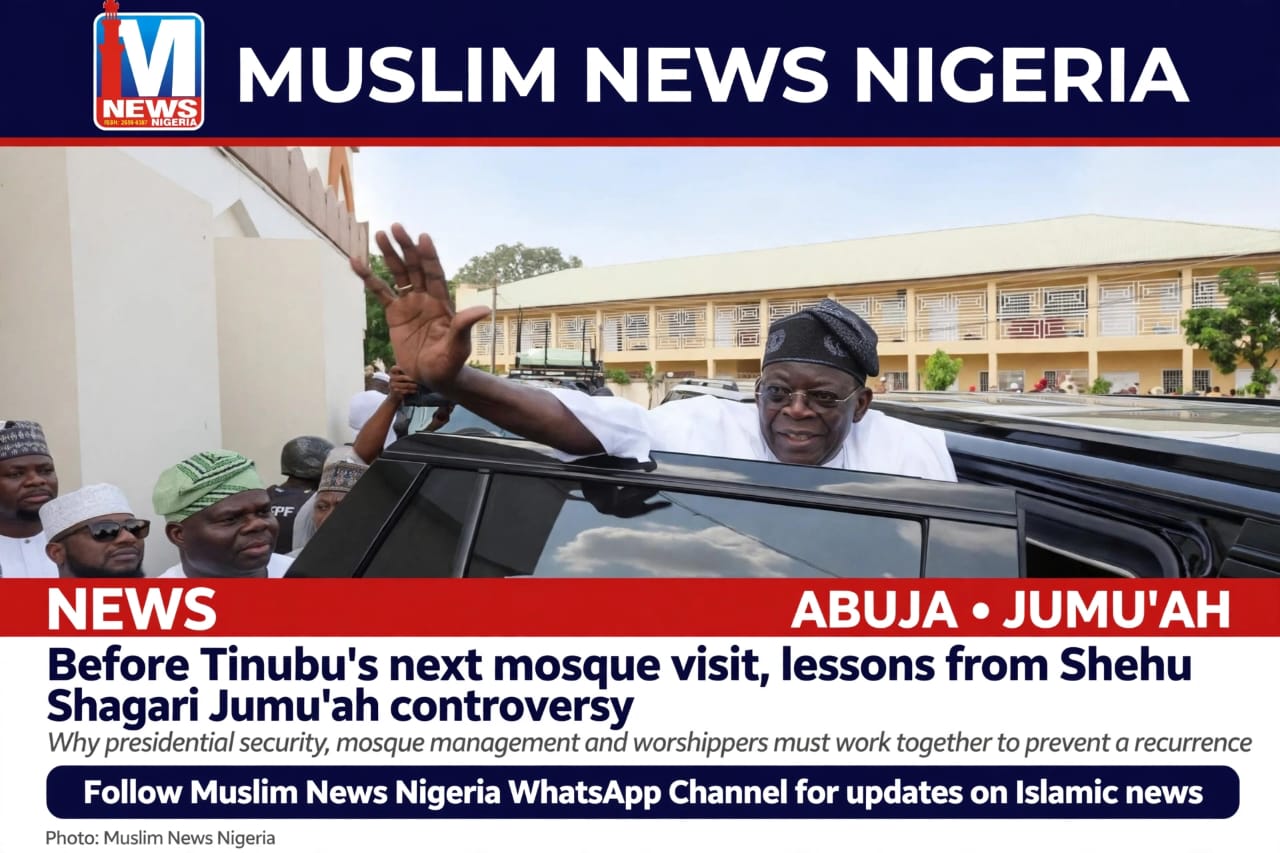
* Why presidential security, mosque management and worshippers must work together to prevent a recurrence
When videos emerged on Friday, November 13, 2026, showing youths booing President Bola Ahmed Tinubu and allegedly throwing objects at his motorcade outside the Shehu Shagari Central Mosque in Area 1, Abuja, the incident quickly became a subject of national debate.
Some of the clips captured youths chanting “Ba ma yi, ba ma so” (We don’t want you; we don’t support you), while others purportedly showed individuals throwing stones at the presidential convoy as it departed the mosque after Jumu’ah prayers.
The Presidency initially disputed reports that the President’s motorcade had been stoned. O’tega Ogra, Senior Special Assistant to the President on Digital Engagement, Strategy and New Media, dismissed the claims as misleading, while Bayo Onanuga, Special Adviser to the President on Information and Strategy, also denied that the convoy had come under attack.
Both officials shared separate video footage showing President Bola Ahmed Tinubu, dressed in white and a black cap, waving to worshippers who were cheering and taking photographs as his convoy departed the mosque.
However, the Federal Capital Territory Police Command confirmed on Monday, November 16, that the presidential motorcade had been attacked with stones and other objects. Police spokesperson Josephine Adeh disclosed that 78 suspects had been arrested, adding that President Tinubu had granted them clemency and directed that they be warned and released.
The incident generated competing narratives about whether the confrontation was politically motivated or a reaction to restrictions imposed on worshippers. While a source close to the mosque suggested that the attackers might have been politically mobilised individuals seeking to embarrass the President, other accounts pointed to frustration among congregants who were allegedly prevented from accessing the mosque or leaving its premises freely.
Beyond the political arguments, the controversy raises a fundamental question: how can the government protect the President during visits to mosques without unnecessarily restricting other Muslims’ access to their obligatory prayers?
Presidential security is non-negotiable
There should be no ambiguity about the importance of protecting the President. As Nigeria’s first citizen, his safety is a national responsibility, and no individual or group should be allowed to attack him, irrespective of political differences or grievances. The reported attack on his convoy should therefore not be excused, even if some individuals were genuinely frustrated by restrictions around the mosque.
However, protecting the President must not mean trampling upon the rights of other citizens. His decision to observe Jumu’ah at a mosque does not make the religious obligations of other Muslims less important.
In Islam, Salatul Jumu’ah is a compulsory weekly congregational prayer for eligible Muslim men. Preventing worshippers from fulfilling this obligation simply because the President is visiting can understandably generate resentment, particularly where adequate alternative arrangements have not been made.
The challenge is not to choose between presidential security and the right to worship. Both responsibilities must be accommodated through proper planning and coordination.
The Shehu Shagari Mosque factor
The Shehu Shagari Central Mosque is regarded as the oldest central mosque in Abuja, predating the National Mosque. For more than four decades, it has served as an important centre of Islamic worship in the Federal Capital Territory.
Its historical importance and location in the busy Area 1 community make the incident particularly significant. The neighbourhood has a considerable commercial population, including traders and residents who use its markets and adjoining streets. Restrictions around the mosque during Friday prayers could therefore affect worshippers arriving from different parts of the city.
Another important factor is that the mosque was undergoing renovation works facilitated by President Tinubu, a development acknowledged by the Chief Imam, Malam Rabiu Suleiman, during the Friday service.
It is possible that the renovation contributed to some of the challenges experienced during the presidential visit. Construction activities may have affected available space, entrances, movement corridors and the mosque’s capacity to accommodate a large congregation alongside the President’s security team.
A mosque undergoing renovation should receive an additional security and access assessment before hosting a presidential visit. Its management and the President’s security team must jointly determine what is practically possible without unnecessarily disrupting worshippers.
Lessons from other mosques
President Tinubu has observed Jumu’ah prayers at several other mosques, including Lekki Central Mosque in Lagos, Ansar-Ud-Deen Central Mosque in Wuse 2, Abuja, and a mosque in Ajao Estate, Surulere, Lagos. He is also expected to observe Jumu’ah prayers at the National Mosque in Abuja today, Friday, November 20, 2026, according to reliable sources.
These visits offer useful examples of how high-profile personalities can be accommodated without necessarily preventing other worshippers from observing their prayers.
At Lekki Central Mosque, for instance, arrangements can be made for prominent visitors to access designated sections while other members of the congregation continue to use the facility. Certain areas can be reserved for VIPs and cordoned off where necessary without automatically shutting down the entire mosque.
The National Mosque in Abuja and other large central mosques also demonstrate how designated VIP sections can accommodate presidential visits while allowing other congregants to continue their prayers without unnecessary restrictions.
Of course, every mosque has its peculiarities. Architectural design, available entrances, congregation size and security requirements differ. What works at Lekki Central Mosque may not be directly transferable to Shehu Shagari Mosque. Nevertheless, the underlying principle remains the same: a presidential visit should not automatically translate into the exclusion of other worshippers.
What should be done differently
Preventing a recurrence requires shared responsibility between mosque administrators and security agencies, regardless of whether the incident was politically motivated or triggered by frustration over restricted access.
First, any mosque expecting a presidential visit must work closely with the President’s security team well ahead of the engagement. Joint assessments should identify possible risks, available entrances, VIP sections, emergency routes and areas that can remain accessible to other worshippers.
Joint assessments should identify possible risks, available entrances, VIP sections, emergency routes and areas that can remain accessible to other worshippers.
Second, mosque administrators should communicate the arrangements to their congregations ahead of time. If notification is received a day or two before the visit, announcements after prayers, WhatsApp platforms and other communication channels can inform regular congregants about the expected arrival, restricted areas and alternative entrances.
Third, designated VIP sections should be established where the mosque’s structure permits. The Prophet Muhammad (peace be upon him) is reported to have said, Anzilun-naasa manaazilahum, commonly understood as according people their proper positions. The principle underscores the importance of respecting leaders and distinguished guests through appropriate arrangements. However, honouring dignitaries should not become an excuse for unnecessarily denying other Muslims access to worship.
Fourth, security agencies must ensure that restrictions are proportionate. Where certain entrances or sections must be closed, alternative pedestrian routes and clear instructions should be provided. Worshippers should not be kept waiting indefinitely without explanations, particularly after fulfilling their prayers.
Finally, mosque management should appoint designated liaison officers to coordinate with security personnel and address concerns as they arise. A clear exit and dispersal plan is equally important to prevent confusion and confrontation when the President departs.
The mosque must also communicate
Another concern arising from the controversy is the absence of a public explanation from the Shehu Shagari Central Mosque management regarding the reported restrictions and the incident outside its premises.
Even if the access restrictions were entirely imposed by government security agencies, the mosque should help its congregation understand what happened. A brief, neutral statement acknowledging the inconvenience reportedly experienced by worshippers, clarifying the management’s role and reaffirming its commitment to peaceful worship would help restore confidence.
The management should also condemn the attack on the President’s convoy and remind congregants that political disagreements must never lead to violence within or around a place of worship.
Appreciating the President’s contribution to the mosque’s renovation should not prevent its administrators from addressing genuine concerns affecting the congregation. Institutional neutrality does not require silence.
Worshippers also have a responsibility
Muslims should make it a point of duty to arrive at the mosque early, preferably before the President or any other visiting dignitary arrives. Islam encourages Muslims to arrive early for Jumu’ah and be seated before the imam mounts the minbar. Doing so would reduce last-minute congestion and help worshippers avoid unnecessary difficulties arising from security arrangements.
The incident should therefore serve as a wake-up call, particularly for habitual latecomers, except those with genuine reasons for arriving late.
Worshippers must also exercise patience, understanding and restraint when special security arrangements are made for visiting dignitaries.
Beyond arriving early, worshippers must also exercise patience, understanding and restraint when special security arrangements are made for visiting dignitaries. A presidential visit to a mosque for Jumu’ah prayers is not an everyday occurrence. Such visits are relatively rare, and whenever they happen, some temporary adjustments to normal arrangements may be necessary for security and logistical reasons.
Congregants should therefore be willing to cooperate with reasonable security measures, exercise patience when inconvenienced and respect mosque leadership in the discharge of its responsibilities. Even where arrangements are not entirely satisfactory, concerns should be expressed peacefully and through appropriate channels rather than through confrontation or violence.
This, however, does not mean that worshippers should surrender their religious rights or be unnecessarily denied access to Allah’s house. Mosque administrators and security agencies must equally demonstrate understanding and ensure that temporary arrangements do not become unreasonable restrictions on the congregation.
The need for patience and cooperation must go hand in hand with mutual respect, effective communication and consideration for everyone’s rights.
Shared responsibility for peaceful worship
Ultimately, preventing a recurrence requires cooperation among mosque administrators, security agencies and worshippers. Presidential visits to religious centres must be properly coordinated, taking into consideration the peculiarities of each facility and the needs of its congregation.
The President must be protected when he visits a mosque for Friday prayers, but other worshippers must not be denied their religious rights in the process
As Muslims prepare for another Jumu’ah, the lesson is clear: the President must be protected when he visits a mosque for Friday prayers, but other worshippers must not be denied their religious rights in the process. No political grievance justifies violence, just as no security arrangement should unnecessarily prevent Muslims from fulfilling their obligations to Allah.
A mosque should remain a sanctuary of worship, not a flashpoint for political or security tensions. With adequate preparation, effective communication, patience and cooperation among all parties, both presidential security and the religious rights of congregants can be protected.
* Rasheed Abubakar is the Publisher of Muslim News Nigeria, email muslimnewsng@gmail.com
Sponsored
Sponsored

Nigerian Muslim Personalities of the Year 2024/2025
Global Muslim Personalities of the Year 2024/2025




Discover more from Muslim News Nigeria
Subscribe to get the latest posts sent to your email.