

Analysts say new leadership has repositioned Syria on the international stage, marking a dramatic shift from its pariah status under the Assad regime
* ‘The new Syrian government had more diplomatic engagements with the international community in a year than the Assad regime had in 54 years,’ says Omer Ozkizilcik, non-resident fellow at the Atlantic Council’s Syria Project
* Syria’s new leadership has shown ‘impressive success in ending isolation,’ overcoming deep international mistrust rooted in its past, says Heiko Wimmen of the International Crisis Group
One year after the fall of Bashar al-Assad, Syria is undergoing a sweeping diplomatic reset as the country’s transitional leadership works to reestablish ties after years of isolation.
Backed by regional powers and increasingly welcomed by major global actors, President Ahmad al-Sharaa’s government is seeking to reposition Syria on the international stage – a dramatic shift from the pariah status it held under the Assad regime, analysts told Anadolu.
“The new Syrian government had more diplomatic engagements with the international community in a year than the Assad regime had in 54 years. This is quite incredible,” said Omer Ozkizilcik, a non-resident fellow at the Atlantic Council’s Syria Project.
Assad, who ruled Syria for nearly 25 years, fled to Russia in December 2024 after rebel forces ended the Baath Party’s six-decade rule. A transitional administration led by Sharaa was formed in January 2025.
Since the Assad regime’s brutal war on its population began in 2011, Syria had been politically sidelined and crippled by some of the world’s toughest sanctions.
The conflict left at least 580,000 people dead and 13 million displaced, with investigators documenting mass graves, enforced disappearances, torture, and widespread human rights violations.
Analysts say Syria’s diplomatic re-entry underscores that Western and regional isolation targeted the Assad regime’s conduct, not the Syrian people themselves.
“When Assad fell initially, everyone was hesitant,” said Ozkizilcik. “Then the Turkish-Saudi understanding was reached to help Syria and support Syria.”
A major turning point came in May, when US President Donald Trump announced in Riyadh that Washington would lift key sanctions, a move experts say opened the door for broader engagement.
Sharaa’s debut address at the UN General Assembly – the first address from a Syrian leader in nearly 60 years – further signaled Damascus’ return to multilateral diplomacy.
“All of these together show us that the international community is willing to embrace a new Syria and give it a chance to reconstruct, rebuild and recalibrate its position in the world,” Ozkizilcik added.
Heiko Wimmen, project director for Iraq, Syria and Lebanon at the International Crisis Group, said Syria’s new leadership has shown “impressive success in ending isolation,” overcoming deep international mistrust rooted in its past.
A year of high-profile visits
In his first year, Sharaa has visited at least 13 countries, including the US, Russia, France, Türkiye and Brazil.
Yet his visit to Washington, where he met Trump at the White House, was the most symbolic, analysts say.
“Him visiting the White House was a message from the Trump administration that the US is encouraging this new Syrian government and is normalizing relations with Syria,” said Ozkizilcik.
He added that Washington also signaled it would not push the new leadership into “illegitimacy,” despite Israeli objections.
Russia, which hosted Sharaa earlier this year, has also moved swiftly to redefine ties after years of backing Assad, the expert added.
Wimmen said that Sharaa’s international outreach has made him a figure in whom many external actors invest hope, though he noted Washington’s support appears limited when it comes to restraining Israel in southern Syria.
Progress on sanctions
Syria has scored major wins in loosening international sanctions.
The EU lifted all economic restrictions not tied to security concerns, and the World Bank restored Syria’s eligibility for financing after decades.
The European Commission also pledged €175 million ($203 million) this year for recovery efforts.
Several states have also announced large investments. According to President Sharaa, Syria attracted $28 billion in the first six months after amendments to investment laws.
But analysts caution that unresolved US sanctions remain a major barrier. The Caesar Act, the most sweeping of these measures, can only be suspended for six months at a time at presidential discretion. So far, Trump has waived these twice.
“These sanctions need to be lifted altogether so that investors can feel safe,” Ozkizilcik said. “Syria needs investments because 90% of the people there live under the poverty line and the country is destroyed.”
A World Bank report has estimated the cost of Syria’s reconstruction at $216 billion – nearly 10 times Syria’s 2024 gross domestic product (GDP).
A second layer of sanctions tied to terrorism designations has also begun to ease. The UN Security Council recently voted to delist Sharaa and the interior minister, clearing a bureaucratic obstacle for states engaging with Damascus.
Wimmen says that endorsements, in particular from the US, were of existential importance.
However, he warned that sanctions relief may not be enough to bring in the required investment.
“Sanctions lifting may not be sufficient to build trust towards foreign investment as long as the internal situation remains volatile,” he said.
A return to global platforms
Sharaa’s participation in global forums, including his historic address at the UN, signals the new government’s push to rejoin multilateral diplomacy.
“It was a first for the Syrian nation, and his message was basically that there is a new Syria … that this Syria wants not to be a source of threats and security risks, but a source of stability,” Ozkizilcik said.
The Syrian president also participated in COP30 in Brazil this November, the first time a Syrian leader had attended the climate summit.
“Syria is not in a position to contribute in terms of finance or contribution for climate or anything else,” said Ozkizilcik. “Syria wants to say we are no longer an isolated nation that causes disorder. We are part of the international community and we want to take part in everything that is international cooperation and collaboration.”
Looking ahead
Analysts expect Sharaa’s diplomacy to expand into Europe in 2026, with negotiations likely to focus on refugees, reconstruction, and institutional reform.
But one central unresolved issue remains: Israel.
Ozkizilcik said Damascus has been pushing for a new security mechanism to restore the 1974 disengagement line, but Israel has shown no willingness to engage.
Since Assad’s fall, he added, Israel has carried out more than 1,000 airstrikes in Syria and occupied new territory in the south, breaking the 1974 agreement.
Despite the attacks, Damascus has refrained from retaliation to preserve diplomatic momentum, Ozkizilcik explained.
“It is quite calm, and trying to stretch its arm for dialogue and reach an agreement,” he said.
If no agreement is reached next year, experts warn, a rare opportunity to stabilize Syrian-Israeli relations could be lost. – Anadolu Agency
Sponsored Event

Nigerian Muslim Personalities of the Year 2024/2025
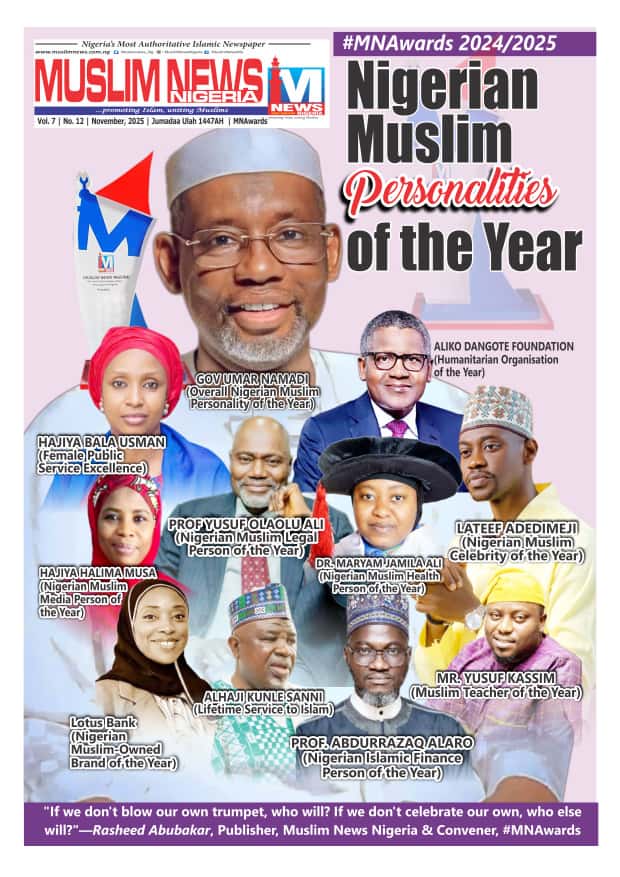
Global Muslim Personalities of the Year 2024/2025