

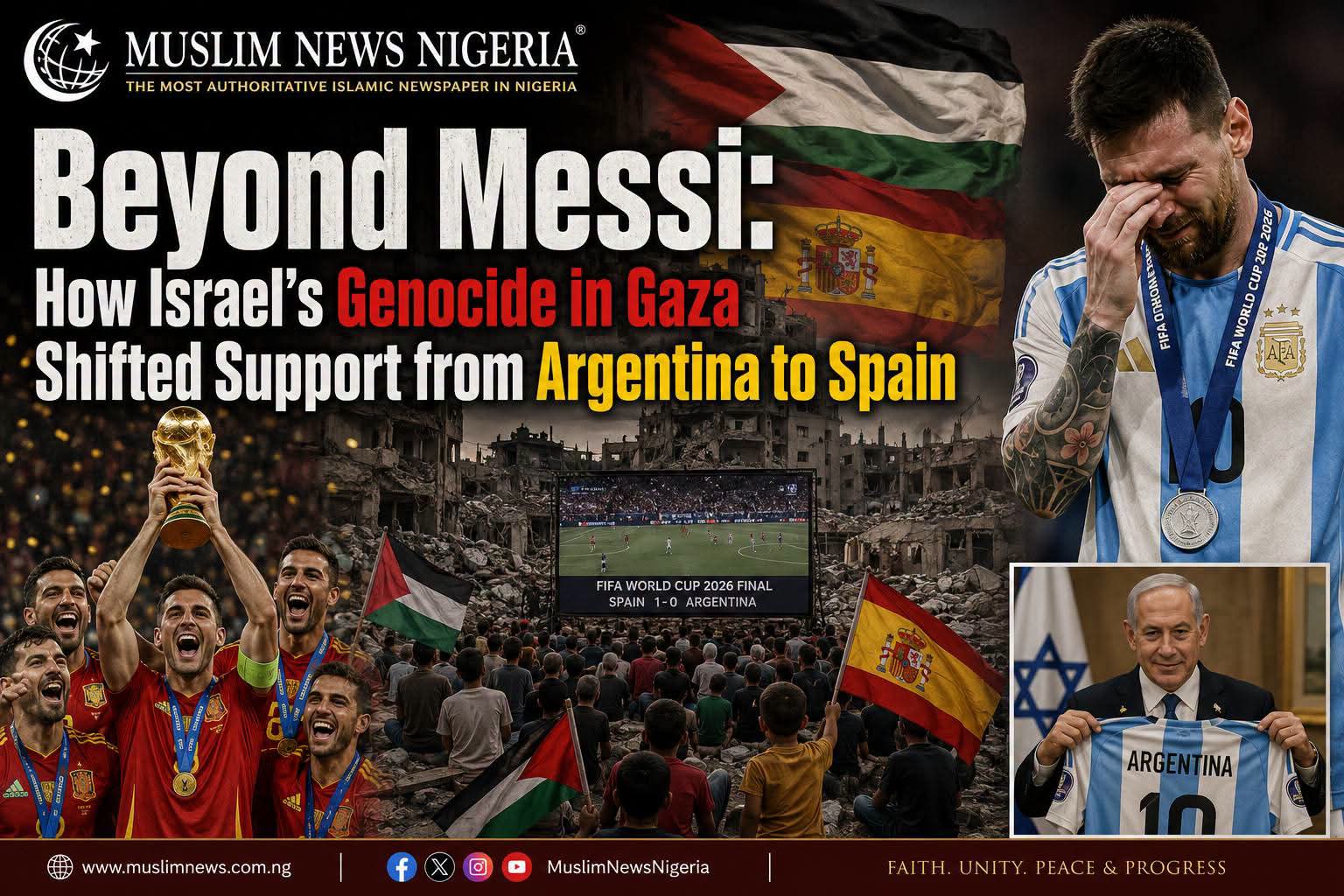
Football is often described as the beautiful game because it has the power to unite people across nations, races and religions. Yet there are moments when football mirrors the realities of the world. The 2026 FIFA World Cup final between Spain and Argentina was one of those moments. While millions watched Lionel Messi attempt to retain Argentina’s title, countless others saw something beyond football. For many Muslims and supporters of Palestine, the final became a symbolic contest that reflected the global conversation surrounding Gaza.
This is why we are rooting for Spain. 🇪🇸 https://t.co/bg3as0tcJt
— Bashir Ahmad, OON (@BashirAhmaad) July 19, 2026
For months, the world has witnessed Israel’s genocide in Gaza, which has left widespread devastation across the Palestinian territory. Entire neighbourhoods have been flattened, families displaced and over 80,000 of innocent civilians killed. Despite living through unimaginable hardship, Palestinians refused to let the war rob them of every moment of joy. Across Gaza, families gathered in displacement camps, under tents and among the ruins of homes destroyed by Israeli bombardment to watch the biggest football match on earth. Their resilience reminded the world that hope can survive even in the darkest moments.
Yüzlercr Filistinli, FIFA 2026 Dünya Kupası final heyecanını dev ekrandan takip etti.
Filistinliler İspanya’yı desteklerken, final karşılaşması bölgede ilgiyle izleniyor… pic.twitter.com/TBkck234Jk
— SON LAİK BÜKÜCÜ 🇹🇷 (@TheLaikYobaz) July 19, 2026
Ordinarily, Lionel Messi would have been the overwhelming favourite among football lovers. He remains one of the greatest footballers in history and enjoys enormous admiration throughout the Muslim world. His brilliance on the pitch has earned him millions of fans regardless of religion or nationality. Yet this World Cup final was different. For many supporters, politics became impossible to separate from football.
Spain had become one of the strongest European voices in support of Palestinian statehood. Its government recognised the State of Palestine and repeatedly criticised Israel’s military campaign in Gaza. Those positions resonated deeply with many Muslims and supporters of justice across the world. As a result, Spain attracted widespread goodwill from people who viewed the country’s foreign policy as one of solidarity with the Palestinian people.
Spain, who recognised the State of Palestine in 2024, wins the World Cup 2026 — victorious natural justice: tonight, we were all Spanish pic.twitter.com/nUwpdvPQCK
— Days of Palestine (@PalestineDays) July 20, 2026
Argentina, on the other hand, became politically associated with Israel because of President Javier Milei’s close relationship with the Israeli government. Although Argentina’s national team had nothing to do with those diplomatic decisions, many supporters inevitably viewed the match through that political lens. For them, the final was a symbolic contest between Palestine and Zionism, and supporting Spain became a symbolic expression of solidarity with Palestine.
Spain’s recognition of the State of Palestine in May 2024 alongside Ireland and Norway marked a turning point in its relationship with the Palestinian cause. Since then, Prime Minister Pedro Sánchez has consistently called for an end to the bloodshed in Gaza, making Spain one of the most outspoken European nations on the conflict. That stance significantly influenced public sentiment among many Muslims and supporters of Palestine ahead of the World Cup final.
The political atmosphere intensified just hours before the final when Israeli Prime Minister Benjamin Netanyahu publicly declared his support for Argentina after receiving an official Argentina jersey from the country’s ambassador to Israel. Images of Netanyahu holding the jersey spread rapidly across social media, generating thousands of reactions from users across the world. Many Muslims and non Muslims openly declared that they would abandon their usual support for Messi and instead cheer for Spain. Their messages made one point repeatedly. On this occasion, principles came before football.
Israeli Prime Minister Benjamin Netanyahu’s office posted photos of him holding an Argentina football shirt alongside Buenos Aires’ ambassador to Israel, Rabbi Shimon Axel Wahnish.
Netanyahu said: “I don’t hide it that I’m a fan of Argentina, I think most Israeli citizens do.… pic.twitter.com/1BeSWuhhCn
— The New Arab (@The_NewArab) July 19, 2026
The online campaign in support of Spain was remarkable because it demonstrated how deeply the humanitarian crisis in Gaza has touched ordinary people.
The debate quickly transcended football. Across X, Facebook, TikTok and other social media platforms, thousands of users openly declared that they were setting aside football rivalries to support the country they believed had shown greater solidarity with Palestine. Hashtags supporting Spain alongside Palestine trended in several countries, illustrating how geopolitical events had reshaped the emotions surrounding football’s biggest occasion.
Another factor that influenced many supporters was the contrast between footballers who had publicly shown visible solidarity with Palestine and those who had remained largely silent on the issue.
For years, Cristiano Ronaldo has enjoyed exceptional popularity across the Muslim world, not only because of his achievements on the pitch but also because of humanitarian gestures that many supporters associate with compassion for Palestinians. Those gestures further strengthened comparisons with Messi in the days leading to the final, as discussions extended beyond football ability to perceived moral and humanitarian positions.
Spain’s World Cup celebrations carried a message beyond football, as crowds raised Palestinian flags and chanted “Free Palestine”.
As the trophy came home, Palestine was remembered in the streets, turning a night of national celebration into a moment of solidarity.… pic.twitter.com/mgg6F0gVaZ
— PalPulse (@PulseofPal) July 20, 2026
Lionel Messi, by contrast, has largely avoided making public statements on the Israel Palestine conflict. Although he has never publicly endorsed Israel’s military campaign or openly declared political support for Israel, images from Barcelona’s 2013 Peace Tour, during which he prayed at the Western Wall in Jerusalem and met Israeli leaders, resurfaced once again on social media before the World Cup final. The same tour also included visits to the occupied West Bank, meetings with Palestinian leaders and activities with Palestinian children, details that received far less attention in the online debate.
Israeli Channel 11: “Argentina against Spain — is it like Israel against Palestinians?” pic.twitter.com/Pj5Npxt7nz
— Quds News Network (@QudsNen) July 19, 2026
Whether fair or unfair, perception often shapes public opinion. As the rivalry between Cristiano Ronaldo and Lionel Messi has dominated football for nearly two decades, many supporters contrasted Ronaldo’s widely publicised humanitarian gestures toward Palestinians with Messi’s silence on the issue. That comparison became even more pronounced before the World Cup final, as many pro Palestine supporters argued that Spain represented a cause they wished to identify with, regardless of Messi’s legendary status. For many of them, this was one night when solidarity with Palestine outweighed football loyalty.
Spain in solidarity with Palestine, and Palestine in support of Spain in the World Cup. 👏👏👏🙏☺️🇪🇸❤️🇵🇸 pic.twitter.com/EWlNxGjZfV
— Turgay Evren (@TurgayEvren1) July 20, 2026
When Ferran Torres struck in extra time to give Spain a one nil victory, celebrations erupted far beyond Madrid. The celebrations that followed in parts of Gaza carried a symbolism that went beyond lifting a football trophy. Videos shared online showed Palestinians waving Spanish and Palestinian flags, cheering the result despite the destruction around them. For many observers, those scenes underscored how deeply the Palestinian cause had become intertwined with global sporting events.
The 2026 FIFA World Cup final will be remembered not only for Spain’s historic triumph or Lionel Messi’s emotional tears after the defeat. It will also be remembered as the night when football became a global platform for political expression and humanitarian solidarity. Whether on the streets of Madrid, inside stadiums in the United States or among the ruins of Gaza, millions demonstrated that, for them, the beautiful game could not be separated from the pursuit of justice. In the end, Spain lifted the World Cup, but for many supporters of Palestine, the victory represented something even greater than football.
We were waiting for it. Cry more! 😂 pic.twitter.com/vK6zh0vC58
— Bashir Ahmad, OON (@BashirAhmaad) July 19, 2026
Sponsored

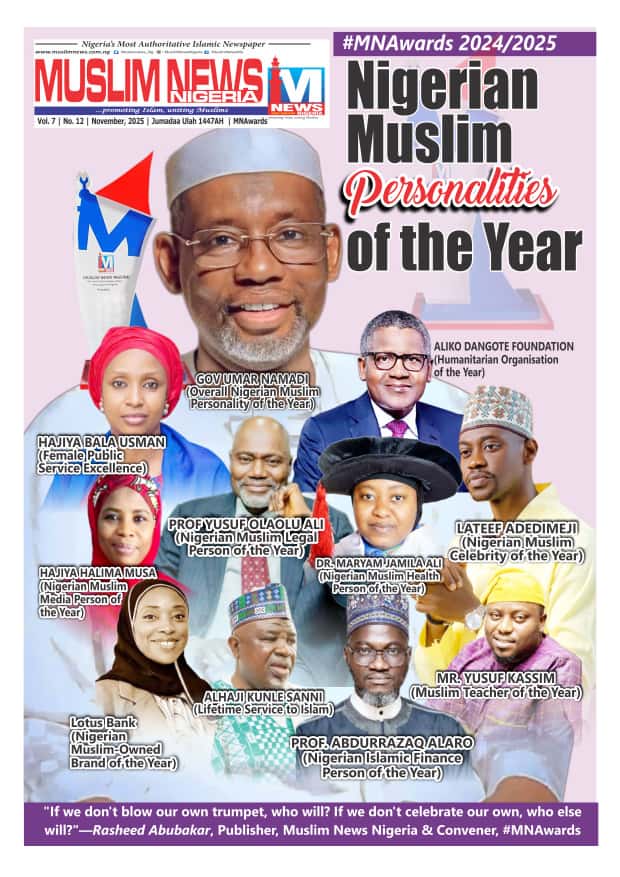
Nigerian Muslim Personalities of the Year 2024/2025
Global Muslim Personalities of the Year 2024/2025




Discover more from Muslim News Nigeria
Subscribe to get the latest posts sent to your email.