

* Saudi Arabia extends airport shutdown after weekend strikes kill 14, injure over 320; coalition vows response as Houthis threaten further attacks
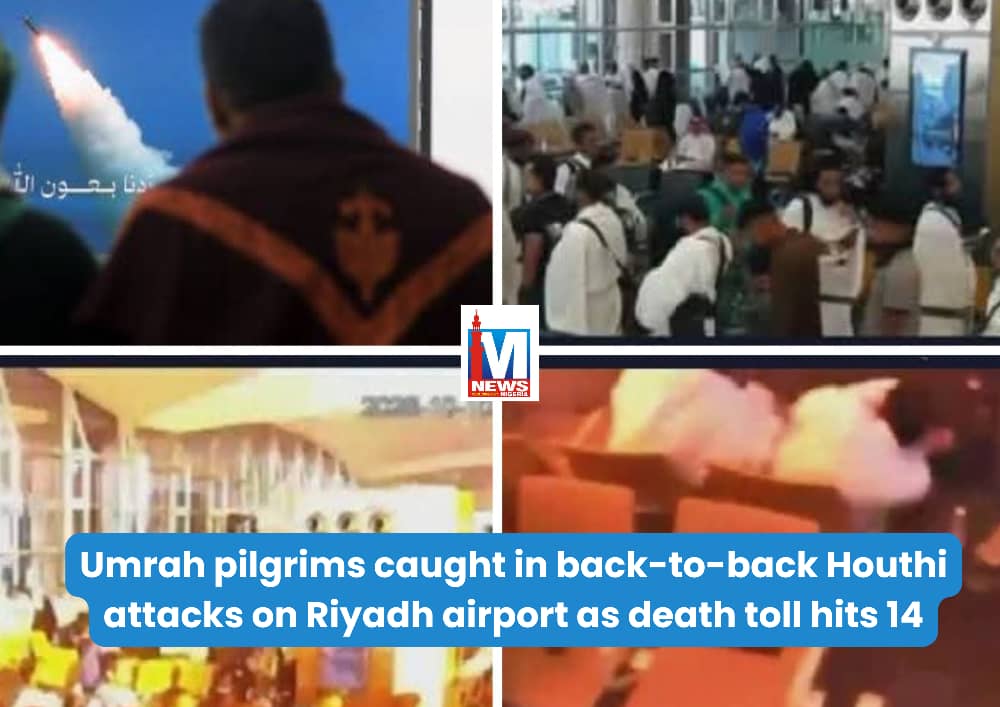
Umrah pilgrims dressed in white ihram garments were among passengers caught in back-to-back Houthi missile and drone attacks on King Khalid International Airport in Riyadh, Saudi Arabia, on Saturday, October 10, and Sunday, October 11, 2026.
The attacks killed at least 14 people and injured more than 320, according to reports by international media and Saudi authorities. The first strike killed 13 people and injured 309, while the second killed a Pakistani resident and injured 11 others.
The attacks disrupted air travel, prompting Saudi authorities to extend the suspension of airport operations while safety inspections and damage assessments continued.
Umrah pilgrims caught in the attacks
Footage circulated by international media showed smoke and fire around the airport as passengers sought safety. The presence of pilgrims in ihram highlighted the impact of the attacks on civilians travelling for religious purposes.
Saudi authorities reported that victims of Saturday’s attack included four Saudis, two Bangladeshis and nationals of the United States, Egypt, Jordan, Syria, Palestine and Sudan.
The second strike hit the airport’s domestic terminal complex, killing one person and injuring 11 others.
Saudi Arabia vows response, extends airport shutdown
The Saudi-led coalition supporting Yemen’s internationally recognised government condemned the attacks on civilian aviation facilities.
Major-General Turki Al-Malki, the coalition’s spokesperson, described the Saturday strike as a “fully fledged war crime” and vowed a decisive response in accordance with international humanitarian law. The description reflects the coalition’s position and is not a judicial determination.
Saudi Arabia’s General Authority of Civil Aviation (GACA) extended the airport shutdown to allow safety inspections and assessments of the damage.
Reuters reported that 82 per cent of scheduled flights at the airport had been cancelled as of midday GMT on Monday, while cancellations across Saudi airports reached 46.4 per cent, according to aviation analytics firm Cirium.
The Associated Press reported that preliminary findings suggested the Houthis used drones before launching cruise and ballistic missiles towards Riyadh. Investigators were examining why the kingdom’s air-defence systems failed to intercept the projectiles.
Houthis claim responsibility, warn airlines
Yemen’s Houthi movement, also known as Ansar Allah, claimed responsibility for the attacks, presenting them as retaliation for Saudi-led military operations in Yemen and restrictions affecting areas under its control.
Houthi military spokesperson Brigadier-General Yahya Saree warned airlines and travellers against using Saudi airspace.
“Take our warnings seriously, and Saudi Arabia bears responsibility for any failed interceptions,” Saree said in a statement reported by Al Jazeera.
The Houthis also claimed to have targeted King Fahd International Airport in Dammam and Saudi energy infrastructure. Saudi authorities confirmed that the Dammam airport was targeted on Sunday evening and said safety inspections and damage assessments were under way.
The claims concerning the extent of damage to other infrastructure have not been independently established in the available reports.
US and regional powers condemn attacks
US Secretary of State Marco Rubio condemned the attacks, including the strike that killed an American citizen.
“These reprehensible attacks demonstrate a blatant disregard for innocent civilian life. They must stop now,” Rubio said in a statement reported by the Saudi Gazette.
He added: “We stand with the Kingdom of Saudi Arabia and its people and extend our condolences to the victims and their families.”
Saudi Arabia, Egypt, Pakistan and Türkiye, acting through the R4 Group, also condemned the attacks, describing them as a threat to regional security and a violation of international law.
In a statement published by the Saudi Press Agency, the four countries called for an immediate and unconditional halt to the attacks and reaffirmed their support for Saudi Arabia’s security and territorial integrity.
Renewed Yemen conflict fuels regional tensions
The attacks came amid renewed fighting between the Houthis and forces aligned with Yemen’s internationally recognised government, which is backed by Saudi Arabia.
The Houthis seized Yemen’s capital, Sanaa, in 2014, prompting a Saudi-led military intervention in March 2015. A United Nations-backed truce in 2022 reduced major hostilities but failed to produce a comprehensive peace agreement.
The latest escalation has raised concerns about the potential impact on civilian aviation, energy infrastructure and international trade. The conflict also threatens security around the Bab al-Mandab Strait, a strategic shipping route linking the Red Sea with the Gulf of Aden.
Sponsored

Nigerian Muslim Personalities of the Year 2024/2025

Global Muslim Personalities of the Year 2024/2025




Discover more from Muslim News Nigeria
Subscribe to get the latest posts sent to your email.