

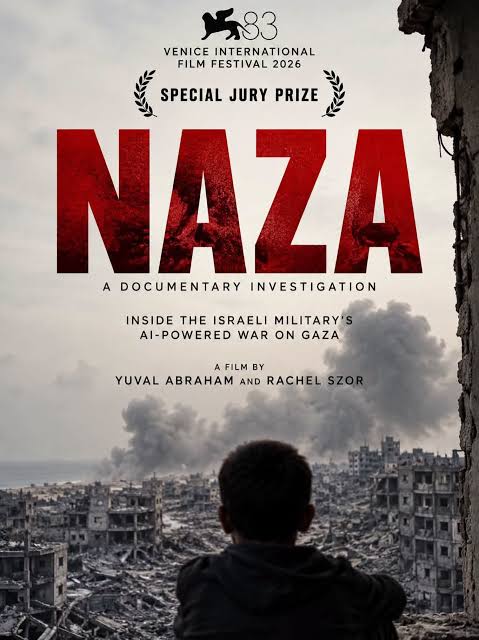
The award-winning documentary draws on testimonies from 24 Israeli soldiers and intelligence officers who describe AI-assisted targeting and civilian casualties, prompting Netanyahu and other officials to accuse its filmmakers of betraying their country, Israel. MUSLIM NEWS NIGERIA ENTERTAINMENT Reports…
An investigative documentary exposing allegations of mass civilian killings and Israel’s military targeting practices in Gaza has triggered fierce condemnation from Israeli leaders, with Prime Minister Benjamin Netanyahu threatening legislation that could strip its directors of their citizenship.
The 80-minute film, NAZA, directed by Israeli journalists and filmmakers Yuval Abraham and Rachel Szor, features testimonies from 24 anonymous Israeli soldiers and intelligence officers who describe the surveillance technologies and artificial intelligence systems used to identify targets during Israel’s genocidal war on Gaza.
Produced by The Guardian in collaboration with the Israeli-Palestinian publications +972 Magazine and Local Call, the documentary examines allegations that Israeli military targeting procedures incorporated anticipated civilian casualties into decisions to strike locations in the besieged Palestinian territory.
Its findings have provoked an escalating political and legal backlash, including accusations of treason, calls for criminal investigations and threats to revoke the filmmakers’ Israeli citizenship.
The controversy intensified after NAZA won the Special Jury Prize at the 83rd Venice International Film Festival in September 2026, where it reportedly received a 25-minute standing ovation.
What does NAZA expose about Israel’s genocide in Gaza?
The documentary investigates how Israeli military intelligence systems reportedly use artificial intelligence, surveillance and databases to identify suspected Palestinian fighters and select targets for airstrikes.
Its title, NAZA, derives from the Hebrew expression nezek agavi, meaning “collateral damage”. In the film, the term refers to the anticipated number of civilian casualties associated with a proposed military strike.
One anonymous source alleged that military officials had approved an operation targeting a single Hamas member despite an estimate that as many as 500 civilians could be killed.
The Israeli military denied that this particular strike, or anything approaching that number, had occurred.
Another interviewee described an alleged system for tracking suspected targets through surveillance of their phones and monitoring when they returned home.
The documentary also examines the use of AI-assisted tools to generate lists of potential targets and assess buildings for possible attacks.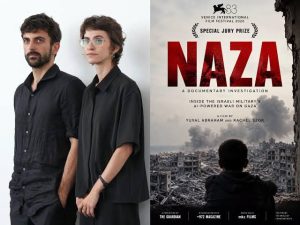
The testimonies raise questions about how military personnel assess civilian lives, the role of human judgment in automated targeting and the degree to which anticipated civilian deaths influence decisions to launch airstrikes.
The film does not rely solely on outside observers interpreting events in Gaza. Instead, its central approach is to question Israeli military personnel who say they had direct knowledge of the systems used during the war.
According to The Washington Post, the filmmakers began interviewing Israeli soldiers and intelligence officers in Tel Aviv in 2023, shortly after Israel launched its military campaign following the Hamas-led attacks of October 7 that year.
The resulting documentary builds on investigations published by The Guardian, +972 Magazine and Local Call between 2023 and 2025.
Why is Israel angry over the documentary?
The film’s allegations challenge Israel’s official account of how its military selects targets and seeks to limit civilian casualties.
For Netanyahu’s government, the documentary’s international recognition has also created a political and diplomatic problem by bringing allegations of unlawful killings and possible war crimes before global audiences through the accounts of Israeli military insiders.
Netanyahu condemned the film after its Venice premiere, describing it as part of what he called “global antisemitic incitement”.
The Israeli prime minister argued that the filmmakers were portraying the Israel Defence Forces (IDF) as war criminals while the country was defending itself against its enemies.
He subsequently announced plans to introduce legislation that could revoke the citizenship of Israelis who defame the country’s soldiers abroad.
He also proposed increasing the financial penalties that could be imposed in defamation cases involving allegations against Israeli soldiers.
In an interview with the conservative Israeli publication Makor Rishon, Netanyahu compared the documentary to “launching dozens of ballistic missiles” at Israel, according to The Guardian.
The proposed measures have not become law, and the filmmakers have not been stripped of their citizenship.
Culture minister accuses filmmakers of treason
Israel’s Culture and Sports Minister, Miki Zohar, was among the first senior officials to demand action against Abraham and Szor following the film’s international recognition.
Zohar accused the directors of harming their own country to win applause from people he characterised as antisemitic.
“I will act immediately to revoke the Israeli citizenship of these despicable creators for treason against the state,” he wrote on X, according to The Guardian.
He subsequently wrote to officials at the Population and Immigration Authority and the Interior Ministry, asking them to examine the possibility of revoking the filmmakers’ citizenship on grounds of alleged disloyalty and collaboration with the enemy.
Zohar also called for an investigation into how the material used in the film was obtained, who supplied it and whether acquiring or publishing it could amount to assisting Israel’s enemies during wartime.
“Freedom of expression is not a licence to betray the state,” he said in a statement reported by The Guardian, warning that people acting against Israel during a war should expect consequences.
The demands have raised concerns among press freedom advocates that Israel’s citizenship laws could be used to punish journalists for reporting critically on the military.
Military rejects allegations, considers legal action
The Israeli military has strongly disputed the documentary’s findings, describing its portrayal of military targeting procedures as distorted and misleading.
In its initial response, the IDF said the allegations relied on anonymous testimonies whose identities and claims could not be independently verified.
The military also rejected the suggestion that an algorithm independently determines which targets should be struck.
However, the documentary’s producers maintain that the testimonies were vetted and that protecting the sources’ identities was essential to securing their cooperation.
IDF Chief of Staff Eyal Zamir also condemned the film, accusing its creators of spreading what he described as “blood libels” and deliberate distortions of reality.
Zamir said military lawyers were examining possible legal measures concerning the documentary and those involved in producing it.
The controversy subsequently escalated beyond the film’s creators. On October 13, reports said Netanyahu had directed officials to identify the soldiers and officers interviewed in NAZA and consider prosecution over alleged security offences and damage to Israel’s interests.
The government’s position contrasts with the filmmakers’ argument that the interviews are necessary to establish what happened during military operations in Gaza and to examine the conduct of institutions that are difficult for outsiders to scrutinise.
Filmmakers defend their sources and findings
At the documentary’s North American premiere in New York on September 26, Abraham defended the decision to protect the identities of the Israeli military personnel who spoke to the filmmakers.
“Throughout the history of investigative journalism, very often granting confidentiality to sources is a means to pursue the truth,” he said during a post-screening discussion, as reported by The Guardian.
He added that the film could not have been made in the same way without confidentiality, arguing that the allegations concerned abuses that were continuing and therefore needed to be investigated.
Abraham also rejected attempts to use the October 7 attacks on Israel to justify the killing of Palestinian civilians in Gaza.
“It’s in the film and it’s completely unjustified,” he said of the Hamas-led attack. “But it also cannot justify what you’ve seen in the film. It doesn’t justify the slaughter of so many civilians in Gaza.”
He criticised what he viewed as the political use of empathy for Israeli victims to deny Palestinians similar consideration.
“I don’t want to live in a world where rightful empathy to Israeli victims is weaponized by leaders like Netanyahu,” Abraham said, arguing that such rhetoric risked perpetuating occupation and war.
Szor, his co-director, has also defended the documentary’s investigation into the military systems used in Gaza. Their work centres on the contention that the public deserves to understand how targeting decisions were made and what those decisions meant for Palestinian civilians.
Threats extend to families and media organisations
The campaign against the filmmakers has extended beyond official statements.
In September, right-wing protesters gathered outside the home of Szor’s parents in central Israel. One demonstrator was reportedly heard calling for a “death sentence for traitors”.
The Committee to Protect Journalists (CPJ) warned that hostile rhetoric from senior officials could encourage intimidation and violence against journalists and their families.
The controversy also reached the offices of Sicha Mekomit, the Hebrew-language publication associated with Local Call. Its executive director, Hagai Matar, told CPJ that a group had entered the offices, filmed the rooms and caused a disturbance.
The incidents have raised concerns about the risks faced by journalists investigating allegations against powerful political and military institutions.
Abraham has previously experienced intimidation. His family home was targeted by a right-wing mob after the 2024 premiere of No Other Land, the documentary about the destruction of Palestinian villages in the occupied West Bank that he co-directed with Palestinian filmmaker Basel Adra, Hamdan Ballal and Rachel Szor.
The filmmakers’ experience has renewed questions about whether Israeli journalists can investigate military conduct without facing threats, legal retaliation or pressure against their families.
The Guardian pledges to defend the film
The Guardian, which produced NAZA, has defended the documentary and the journalists involved in its production.
A spokesperson for the newspaper said the organisation was disturbed by the response to the film, describing Abraham and Szor as journalists and filmmakers facing attacks from people who had not yet seen their work.
“NAZA is based on more than three years of investigative journalism,” the spokesperson said. “The testimonies it contains are true and we believe they deserve to be heard. The interviews were given by confidential journalistic sources.”
The newspaper added: “We will robustly defend NAZA – and the team behind it – from any attacks or attempts at censorship.”
Film industry rallies behind the directors
The backlash has prompted support from sections of Israel’s film community, international filmmakers and press freedom organisations.
More than 1,500 Israeli film professionals reportedly signed a petition supporting Abraham and Szor, while 43 Israeli human rights organisations and directors of major international film festivals also expressed support for the filmmakers.
The CPJ condemned the citizenship threats, warning that the proposed measures could establish a dangerous precedent by exposing journalists to the loss of nationality because of critical reporting.
The organisation called on Israeli authorities to abandon efforts to use citizenship revocation, defamation laws or other legal measures to punish the filmmakers for their work.
A documentary at the centre of the Gaza debate
The controversy surrounding NAZA comes amid continued international scrutiny of Israel’s military campaign in Gaza, where tens of thousands of Palestinians have been killed and large areas of the territory destroyed.
The United Nations Independent International Commission of Inquiry on the Occupied Palestinian Territory, including East Jerusalem, and Israel concluded in September 2025 that Israel had committed genocide in Gaza. Israel has rejected the genocide accusation.
The documentary does not resolve the wider legal questions surrounding the war, but it places allegations about military targeting procedures and anticipated civilian deaths at the centre of public debate.
By relying on the testimonies of Israeli military insiders, the filmmakers have challenged official accounts of how the war was conducted and prompted questions about the responsibility of commanders, the role of technology and the protection of civilians.
The film’s reception has also exposed a wider conflict over freedom of expression: whether journalists should be able to investigate alleged military wrongdoing without being branded traitors or threatened with the loss of citizenship.
As NAZA reaches international audiences, the dispute is likely to remain a significant test of Israel’s treatment of critical journalism and of the ability of filmmakers to document the human cost of war.
Where to watch NAZA
The documentary NAZA is being released internationally through cinema screenings, with further viewing options expected online.
Audiences can check screening information, availability and updates through the film’s official website, NAZA documentary official website.
So, is NAZA pro-Hamas?
Based on its stated focus, the film is not principally about supporting Hamas or defending its actions. It is an investigation critical of Israel’s conduct of the war.
However, because it concentrates on alleged Israeli wrongdoing rather than providing a balanced account of both parties’ conduct, viewers should not treat it as a complete account of Hamas or the war as a whole.
Sponsored
Sponsored

Nigerian Muslim Personalities of the Year 2024/2025

Global Muslim Personalities of the Year 2024/2025




Discover more from Muslim News Nigeria
Subscribe to get the latest posts sent to your email.