
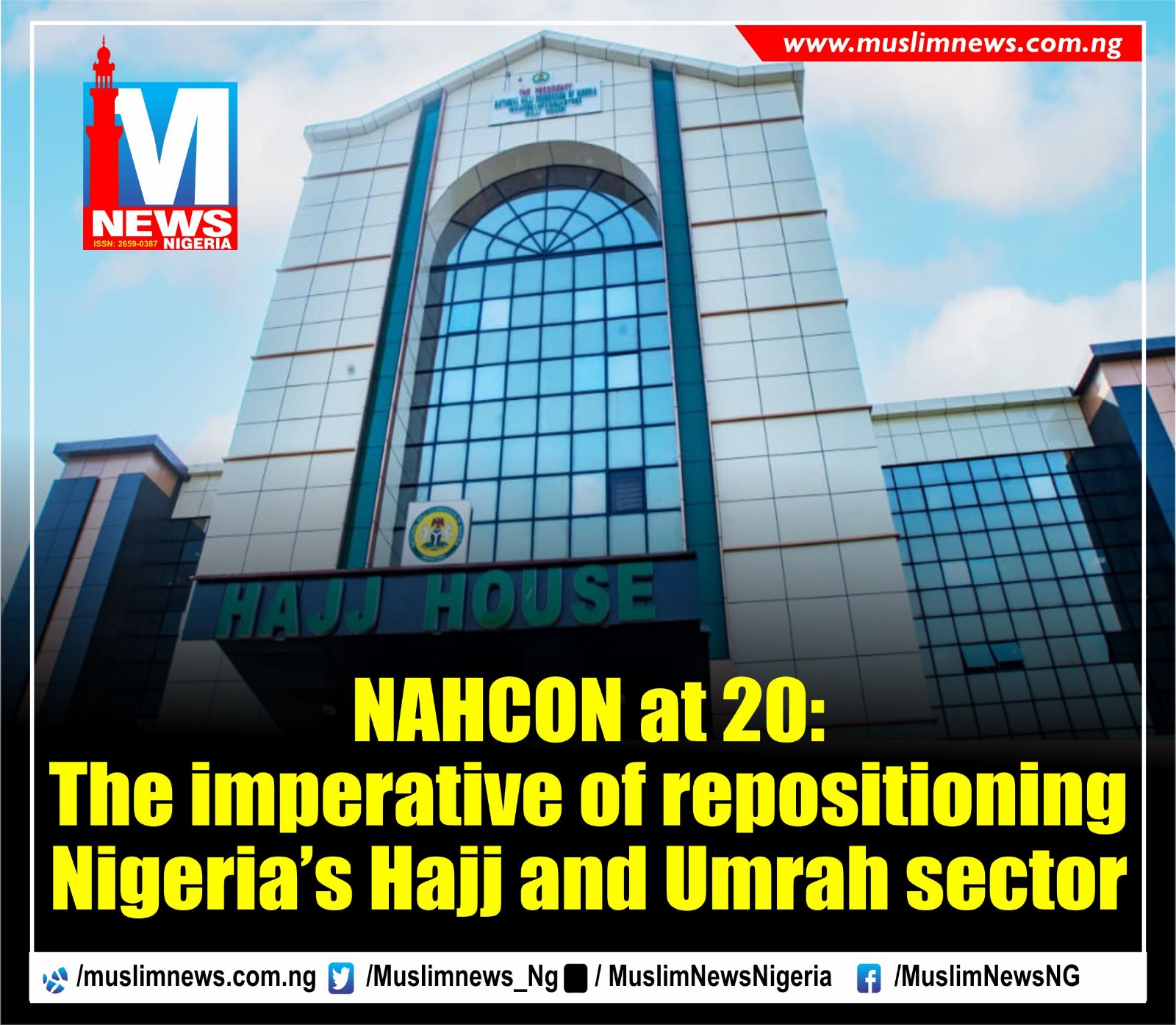
In this article, Ishaq Ibrahim Jae argues that while NAHCON has succeeded in stabilising Nigeria’s Hajj operations, its next major challenge is transitioning from a crisis-management regulator to a strategic economic institution capable of unlocking the country’s vast halal economy and Islamic finance potential. MUSLIM NEWS NIGERIA reports…
Come October 12, 2026, the National Hajj Commission of Nigeria (NAHCON) will mark two decades of existence, a milestone that calls for both celebration and critical reflection on the untapped potential of Nigeria’s Hajj and Umrah sector.
The National Hajj Commission of Nigeria was established in 2006 by an Act of the National Assembly to oversee, regulate, and coordinate Hajj and Umrah activities in Nigeria. This followed decades of administrative chaos with the most reoccurring decimal being the inability of Nigeria to airlift its pilgrims many times.
NAHCON officially began operations in 2007, inheriting a sector plagued by corruption, poor service delivery, and systemic failures. Twenty years later, the Commission has fundamentally transformed Nigeria’s Hajj operations. The first and second Boards under the leadership of Mal Muhammad Musa Bello brought stability and accountability to the the Apex regulator while the 3rd Board under Barrister Abdullahi Mukhtar Muhammad entrenched administrative and fiscal reforms which transformed NAHCON from a dependent to a self-reliant institution respected and held in high regards within and outside Nigeria.
The Barr Zikrullah Kunle Hassan led 4th Board established the Hajj Savings Scheme (HSS) and Hajj Institute of Nigeria (HIN), initiatives of its predecessors, which were set to reposition the trajectory of Nigeria’s Hajj and Umrah sector.
NAHCON’s 5th Board led by Mal Jalal Arabi and later Prof Abdullahi Usman retained the initiatives expanding the interim product of HSS from one to four banks.
With a Stabilized Hajj and Umrah sector, this country stands at the threshold of an unprecedented economic opportunity driven by one of the largest global Muslim populations. Nigeria has become the world’s eighth-largest domestic halal economy market, with global spending on halal economy products and services projected at $107 billion in 2022 and expected to reach $180 billion by 2027. Yet Nigeria captures only a fraction of this value. Nigeria’s exports currently represent only 5.7% of Africa’s $4.2 billion halal product exports to OIC countries. The Federal Government is working on a strategy to position the country as a key player in the global halal economy, aiming to add $1.5 billion to its GDP by 2027.
One of the potentials, the Hajj Savings Scheme (HSS) which started in 2020, recorded 10.9 Billion Naira turnover in 2022 which increased to 17.7 Billion Naira in the year 2025.
In December 2025, NAHCON signed a Memorandum of Understanding with four participating financial institutions—Alternative Bank, Jaiz Bank, Lotus Bank and TAJ Bank—to expand participation and introduce competition. While this seems like an expansion, it is actually a temporary measure of launching the HSS as product in Islamic Banks pending the full-blown implementation that will position Nigeria to emulate success stories like Malaysia’s Tabung Haji. The organization which was established in 1963, has grown into a multi-billion dollar Islamic investment institution with 17 subsidiaries spanning finance, plantation, telecommunications, and property development. This success was recorded with Malaysia’s less than 30 million Muslim population. With the projected population of about 120 million Muslims in Nigeria, if only 1% save ₦10,000 monthly, the scheme could generate annual deposits of ₦144 billion ($100 million), with a potential fund size exceeding ₦1 trillion within seven years. Investment returns could subsidize Hajj costs, build infrastructure, and generate thousands of jobs.
These projections will only come to pass if there is a recalibration of NAHCON’s compass. We need to move from the annual ‘managing’ of Hajj operations along with its attendant problems and political distractions to strategically planning and positioning Hajj and Umrah of the next decade. To maximize the potentials of NAHCON in the next decade, and the broader Hajj and Umrah sector, we need urgent action in five critical areas:
First, develop a comprehensive National Hajj and Umrah Policy—a 10-year strategic framework that positions the sector as a major contributor to GDP growth, foreign exchange earnings, halal economy development, Islamic finance innovation, and dignified employment for thousands of Nigerians.
Second, Consolidate and focus on regulation while leaving operations to a strengthened and professionally organized and regulated private sector. It is my belief after years of involvement in Hajj operations that Government is not a good businessman and should therefore focus more on regulation than operation.
Third, professionalize and standardize the sector through policy formulation by NAHCON and leveraging on the Hajj Institute of Nigeria (HIN) to introduce mandatory professional development of personnel to make credentials as requirements for participation in the sector, as well as enforcement of minimum service standards for all providers.
Leveraging technology integration including AI-powered systems for pilgrim management, health monitoring, and service delivery must be at the front burner going forward if Nigeria will participate and compete favourably in a globalized Hajj system as envisioned by Saudi Arabia’s Vision 2030.
Fourth, transform the Hajj Savings Scheme into Nigeria’s largest Islamic investment vehicle, following the Malaysian and Indonesian models. The Special Purpose Vehicle (SPV) model proposed by Alh Bashir Bugaje-led Technical Committee on HSS needs to be revisited.
Fifth, strengthen regional and global partnerships by formalizing strategic partnerships with Saudi authorities and other countries for improved pilgrim services, positioning Nigeria to lead AfCFTA’s halal economy agenda, and creating bilateral trade agreements with Saudi Arabia tied to Hajj operations. Already, a Letter of Intent was signed in 2022 between NAHCON, Indonesia’s BPKH and the Islamic Sharia and Economic Festival aiming to formalize collaboration in supporting joint research, sharing of best practices, capacity building and business opportunities in Hajj.
A Vision for 2036
By 2030, Nigeria should achieve 100% digital integration of all Hajj and Umrah operations, HSS enrollment of 5 million Nigerians with ₦1 trillion under management, 50,000 direct jobs in the Hajj and Umrah ecosystem, and ranking among the top 5 halal exporters to OIC countries.
By 2036, Nigeria, with the full awakening of its Hajj and Umrah sector can target halal export revenues of $5 billion, self-financing Hajj operations with zero government subsidies, and Nigeria serving as a regional training hub in Hajj and Umrah for West and Central Africa.
A Call to Action
NAHCON’s 20th anniversary presents a historic opportunity to elevate the Commission from a regulatory body into a strategic economic institution. The Federal Government of Nigeria should consider convening a Presidential Summit on Hajj, Umrah, and Halal Economy, establish a Presidential Steering Committee to develop and implement the National Hajj and Umrah Policy, facilitate the provision of ₦50 billion seed funding from the Islamic Development Bank (IsDB) for HSS infrastructure and technology, mandate collaboration between NAHCON, NEPC, and other agencies to develop an Integrated Halal Export Strategy, and champion Nigeria’s bid to host the OIC Halal Economy Summit by 2030. The nexus of His Excellency Vice President Kashim Shettima being the Chairman of the National Economic Council and supervisor of NAHCON presents us with a rare opportunity to rewrite NAHCON’s history.
Twenty years ago, NAHCON was established to solve a crisis. Today, it has the potential to unleash prosperity. Nigeria possesses the demographic foundation to become Africa’s halal economy leader. Let NAHCON’s next 20 years be defined not by what it regulates, but by what it enables: dignified pilgrimage experiences, a thriving halal economy, massive job creation, and Nigeria’s rightful place as a global Islamic economy powerhouse. The choice is ours. The time is now.
Ishaq Ibrahim Jae, Head, Department of Hajj, Hospitality and Tourism
Hajj Institute of Nigeria, Abuja. Email: aimskd@gmail.com and Ishaq.jae@hin.edu.ng
Sponsored

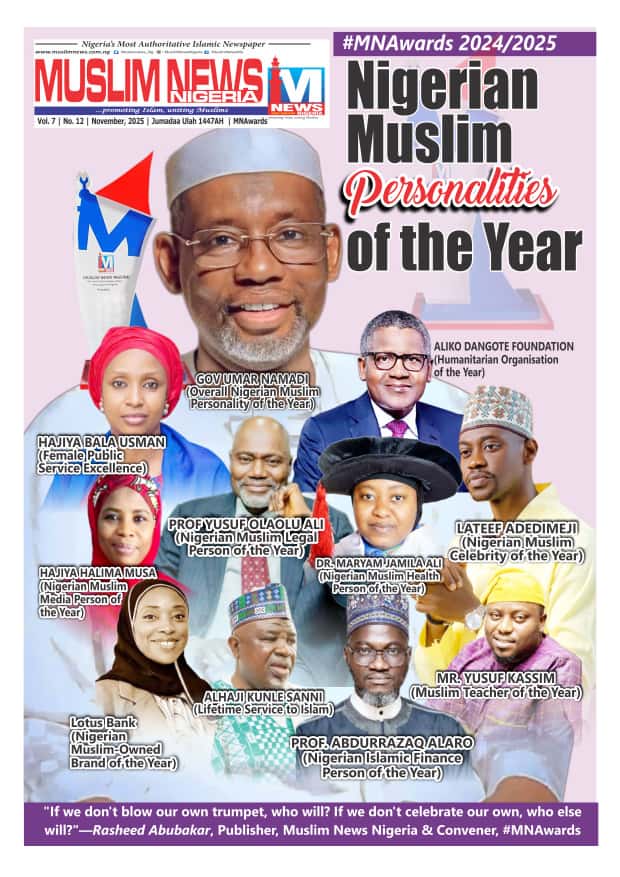
Nigerian Muslim Personalities of the Year 2024/2025
Global Muslim Personalities of the Year 2024/2025




Discover more from Muslim News Nigeria
Subscribe to get the latest posts sent to your email.