

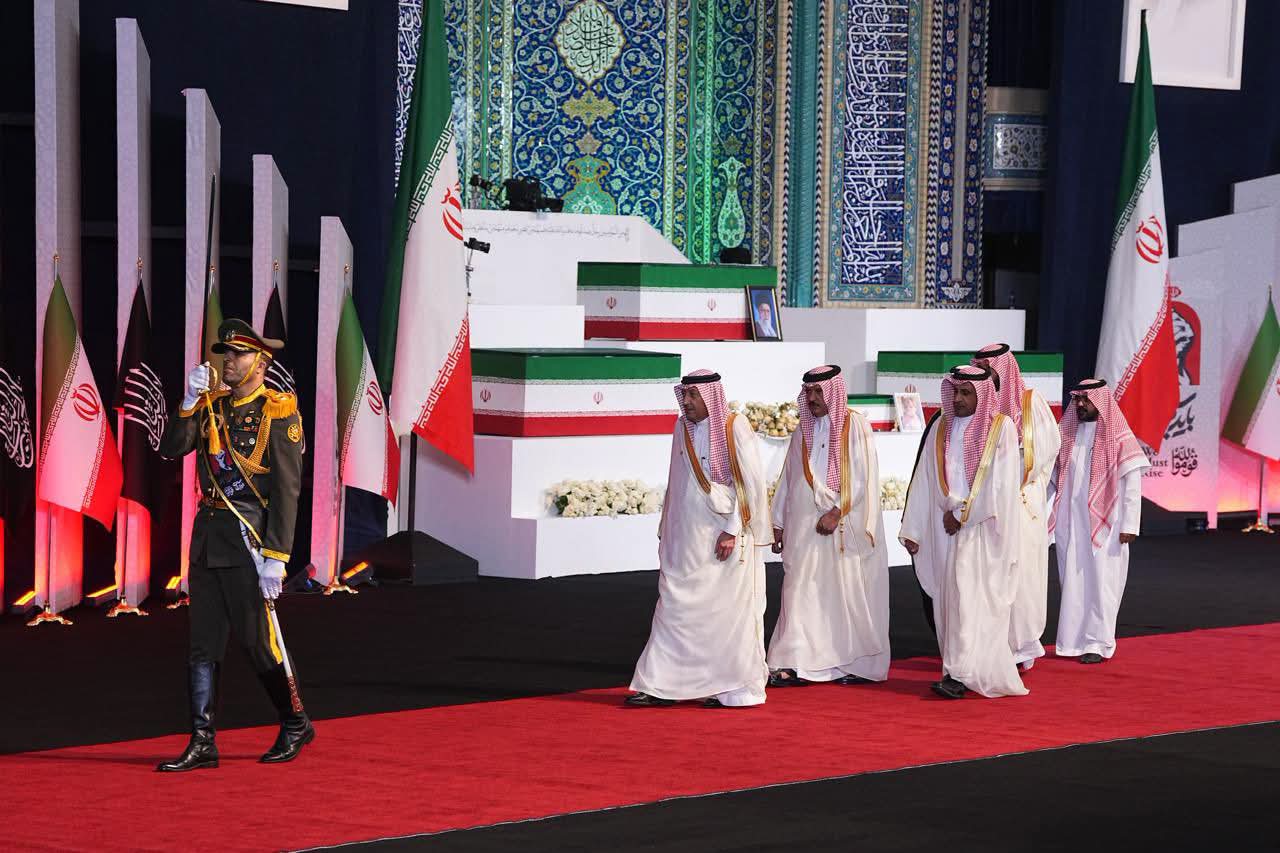
Saudi Arabia, Türkiye and dozens of foreign leaders and delegations arrive in Tehran as millions of mourners are expected to participate in funeral rites lasting until July 9.
Millions of Iranians and mourners from across the region are expected to participate in a week long series of funeral ceremonies for slain former Iranian Supreme Leader Ali Khamenei, as foreign leaders and official delegations continue arriving in Tehran to pay their final respects.
The funeral ceremonies, which officially began on Friday in Tehran, have already attracted senior government officials, religious leaders and dignitaries from Saudi Arabia, Türkiye, Iraq, Pakistan, Russia and several other countries.
Iranian state television broadcast live images of delegations paying tribute to Khamenei at the Imam Khomeini Mosalla, where his body is lying in state ahead of nationwide and regional funeral events.
Khamenei was killed in a joint United States and Israeli attack on Iran on February 28, an incident that triggered nearly three weeks of war and sharply escalated tensions across the Middle East before a ceasefire was reached under a United States and Iran memorandum brokered by regional mediators.
Among the senior foreign figures attending the ceremony were Russian Security Council Deputy Chairman Dmitry Medvedev, who arrived as a special envoy of President Vladimir Putin, Turkish Vice President Cevdet Yilmaz, Iraqi President Nizar Amidi, Iraqi Parliament Speaker Mohammed al Halbousi, Pakistani Prime Minister Shehbaz Sharif, Pakistani Senate Chairman Yousaf Raza Gillani and Pakistan’s Army Chief Asim Munir.
Senior Arab officials also present included Qatar’s Shura Council Speaker Hassan bin Abdullah Al Ghanim, Saudi Deputy Foreign Minister Waleed Elkhereiji, Oman State Council Chairman Abdulmalik bin Abdullah Al Khalili and Yemen Vice President Aidarus al Zoubaidi.
The funeral has also drawn high level delegations from Central Asia, Africa, Europe and Asia. They include Turkmen national leader Gurbanguly Berdimuhamedow, Uzbek Parliament Speaker Nuriddin Ismoilov, Kazakhstan Foreign Minister Yermek Kosherbayev, Kyrgyz Parliament Speaker Marlyn Mamataliyev and Shanghai Cooperation Organisation Secretary General Nurlan Yermekbayev.
Other dignitaries attending the ceremonies include Georgian President Mikheil Kavelashvili, Belarus House of Representatives Speaker Igor Sergeyenko, Egyptian Senate Speaker Abdel Wahab Abdel Razek, Afghanistan Deputy Prime Minister Abdul Ghani Baradar, Foreign Minister Amir Khan Muttaqi, Burkina Faso Foreign Minister Karamoko Jean Marie Traore, Congolese Foreign Minister Jean Claude Gakosso, Namibian Presidential Affairs Minister Charles Mubita, Nicaraguan Foreign Minister Valdrack Jaentschke and Serbian Information and Telecommunications Minister Boris Bratina.
China sent a delegation led by He Wei, Vice Chairman of the Standing Committee of the National People’s Congress, while Iranian media also reported the attendance of Myanmar’s special envoy Tin Aung San, Organisation of Islamic Cooperation representative Ahmed Khokher, D Eight Secretary General Seyed Soheil Mahmood, a Bangladeshi delegation led by Parliament Speaker Hafiz Uddin Ahmad and an Indian delegation headed by Bihar Governor Ata Hasnain.
Former Jammu and Kashmir Chief Minister Mehbooba Mufti, Malaysian special envoy Datuk Seri Haji Mohamad bin Sabu and representatives of Thai Shia Muslim groups were also among those paying tribute.
Representatives of regional resistance movements, including Palestinian Islamic Jihad Secretary General Ziyad al Nakhalah, senior Hezbollah officials, Yemeni representatives, Palestinian religious scholars and Lebanese political factions, also attended the memorial ceremony.
Later on Friday, Armenian Prime Minister Nikol Pashinyan arrived in Tehran and joined the growing list of foreign leaders paying tribute to the late Iranian leader.
Outside Iran, Hezbollah organised a farewell ceremony in Lebanon, while memorial gatherings were also held in Iraq and several other regional capitals.
Iran’s funeral committee said there could still be adjustments to the official funeral timetable. Although the main public farewell ceremony is scheduled to begin on Saturday morning, authorities indicated that Imam Khomeini Mosalla could be opened earlier if conditions permit.
According to the official programme, memorial ceremonies will continue throughout the weekend in Tehran with the participation of heads of state, senior government officials, diplomats and religious leaders.
Public farewell ceremonies are scheduled for July 4 and July 5, followed by the main funeral procession through Tehran on July 6.
The funeral rites will then move to the holy city of Qom on July 7 before continuing to Iraq on July 8, where ceremonies will be held in Baghdad, Najaf and Karbala. Religious and political leaders are expected to receive the body before it is transferred to major Shia holy sites.
The final funeral prayers and burial are scheduled for July 9 at the Imam Ali Reza Shrine in the northeastern city of Mashhad, one of the holiest sites in Shia Islam, where millions more mourners are expected to gather for the final farewell.
Sponsored

Nigerian Muslim Personalities of the Year 2024/2025
Global Muslim Personalities of the Year 2024/2025




Discover more from Muslim News Nigeria
Subscribe to get the latest posts sent to your email.