

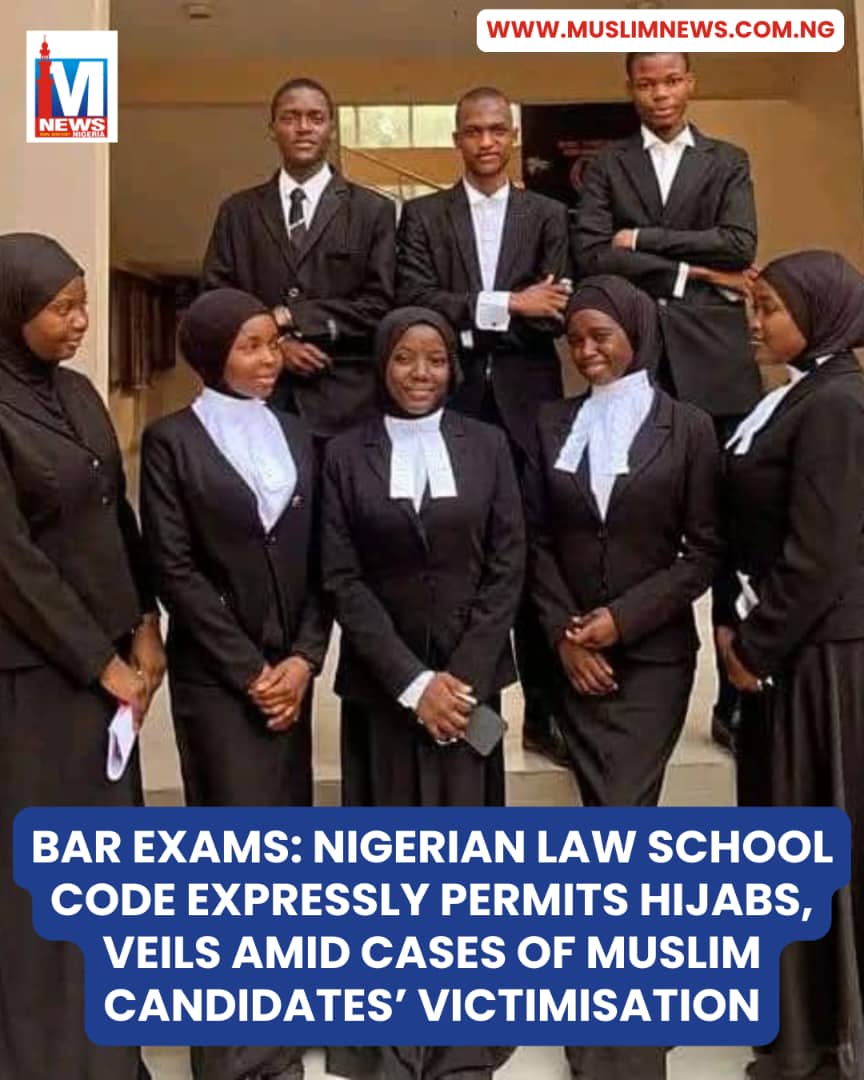
The Council of Legal Education’s Code of Conduct explicitly recognises black shoulder-length hijabs and veils as approved attire for female students, raising serious questions over the reported harassment, humiliation and disruption faced by Muslim candidates during the Bar Final Examinations.
The Nigerian Law School has come under scrutiny over the treatment of Muslim candidates wearing hijab during the ongoing Bar Final Examinations, with its own Code of Conduct expressly listing hijabs and veils among the approved attire for female students.
The controversy has sparked concerns about the victimisation of Muslim candidates by some overzealous examination personnel and the apparent contradiction between the institution’s prescribed dress code and the reported restrictions imposed on students wearing Islamic head coverings.
Muslim News gathered that several female candidates experienced delays and distress, with some uncertain whether they would be allowed to sit subsequent examination papers in their religious attire.
Law School Code expressly recognises hijab
An examination of the Nigerian Law School’s Code of Conduct for Students shows that Part B, Rule 5, titled “Dress Code,” expressly recognises hijabs and veils as acceptable attire for female students.
Under the lecture dress code, the provision lists black or navy blue skirt suits with white camisoles or shirts, black or navy blue dresses with long or three-quarter sleeves, and plain black leather shoes with moderate heels.
It also specifies that skirts and dresses must fall below the knee before listing the following approved items:
“Black skull caps, black shoulder length hijabs and black shoulder length veils.”
The same provision appears under the dinner dress code for female students, again listing black shoulder-length hijabs and veils among the approved items of clothing.
In the copy of the Code reviewed by Muslim News, these provisions appear under Part B, Rule 5(1)(v) and Rule 5(2)(v), on page 2.
The wording is significant because the institution does not merely remain silent on Islamic head coverings. It specifically identifies hijabs and veils as acceptable attire for female students.
This raises an important question: why should Muslim women who wear hijab encounter restrictions or humiliation within an institution whose own dress code expressly recognises the religious head covering?
The Code’s provisions on lectures and dinner may not, by themselves, establish the precise dress requirements for examination halls. Nevertheless, the express recognition of hijab makes it imperative for the authorities to explain any separate examination rule that may be invoked to restrict its use.
Rule 5 – Dress Code
The following dress code/regulation dress is prescribed for students for lectures:
1. Lecture Dress Code
a. Ladies
i. Black or navy blue skirt suit with white camisole or white shirt.
ii. Black or navy blue dress with long or three-quarter sleeves.
iii. Plain black leather shoes with moderate heels.
iv. The prescribed length of skirts and dresses is below the knee.
v. Black skull caps, black shoulder-length hijabs and black shoulder-length veils.
vi. Moderate earrings.
vii. Dark-coloured hair attachment/wig not longer than shoulder length.
viii. Short nude-coloured nails.
b. Men
i. Black or navy blue trousers and suit with white shirt.
ii. Black or Law School tie.
iii. Black socks.
iv. Black plain leather shoes.
2. Dinner Dress Code
The following dress code is prescribed for students for dinner:
a. Ladies
i. Black skirt suit with white camisole or white shirt.
ii. Plain black leather shoes with moderate heels.
iii. The prescribed length of skirts and dresses is below the knee.
iv. Black skull caps, black shoulder-length hijabs and black shoulder-length veils.
v. Moderate earrings or stud.
vi. Hair attachment/wig is prohibited.
vii. Short nude-coloured nails.
b. Men
i. Black trousers and suit with white shirt.
ii. Black or Law School tie.
iii. Black plain leather shoes.
iv. Black socks.
3. Electronic Gadgets
a. The use of electronic gadgets and social media during lectures in general is prohibited.
b. Audio and video recording of lectures is absolutely prohibited.
c. Visually impaired students are allowed to record the lectures.
d. The use of cameras during lectures is prohibited.
e. The use of social media like WhatsApp, Twitter, Instagram, YouTube, etc., during lectures is strictly prohibited except where such is permitted by the lecturer for specific research purposes.
Rule 6 – Penalties for General Indiscipline and Misconduct
Students may be liable for the sanctions set out under any of the following acts which constitute misconduct:
Sponsored

Sponsored

Nigerian Muslim Personalities of the Year 2024/2025

Global Muslim Personalities of the Year 2024/2025




Discover more from Muslim News Nigeria
Subscribe to get the latest posts sent to your email.