

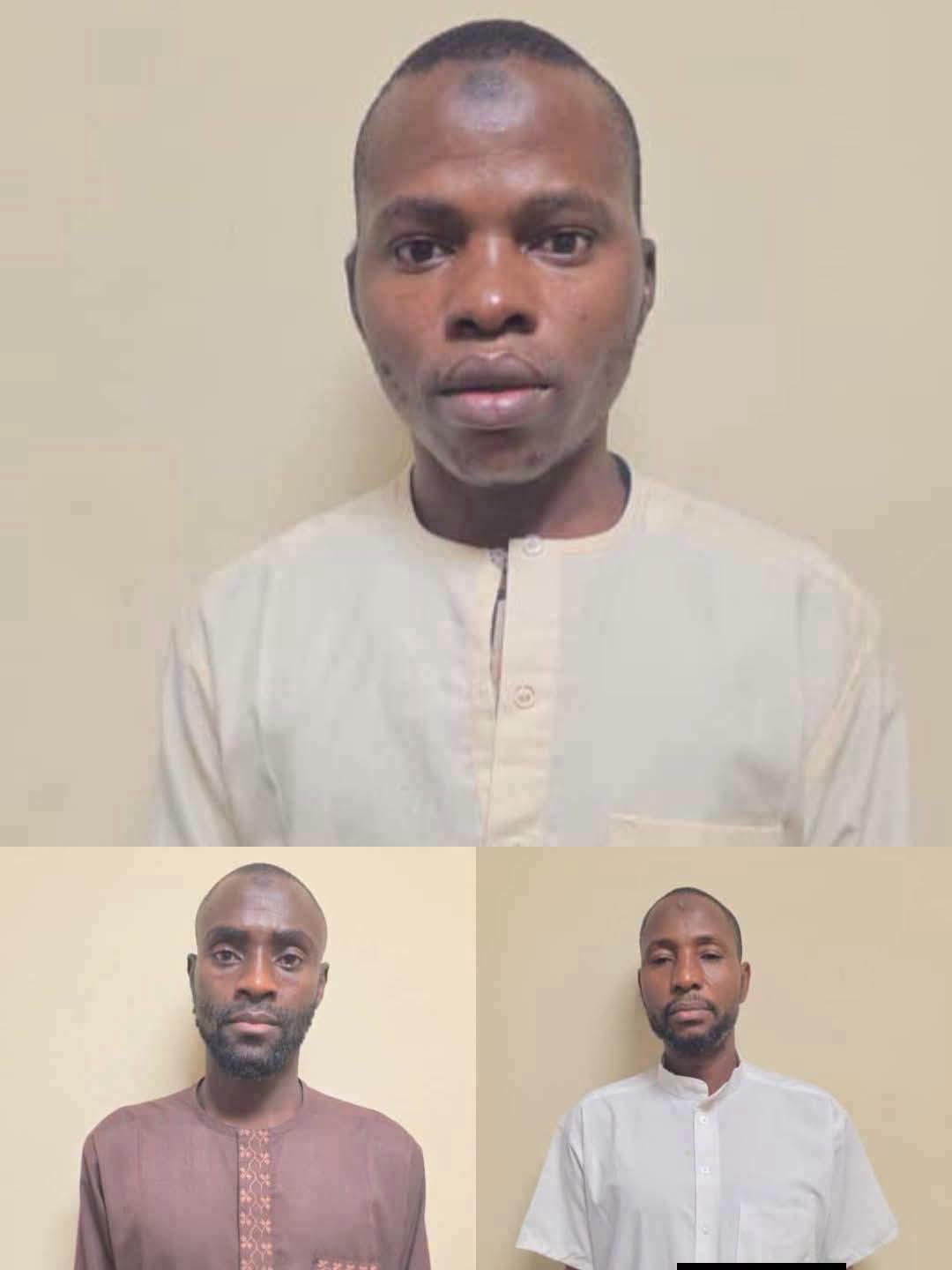
The three men in the featured picture have dominated conversations across social media since the Federal Government arraigned them over the abduction of the recently rescued schoolchildren and teachers in Oriire Local Government Area of Oyo State. Sadly, the discussion has drifted away from the serious allegations before the court to something far more troubling. Their Muslim names and the zabibah, the dark mark that sometimes appears on the foreheads of some Muslims after years of prostration during daily prayers, have become the centrepiece of public debate.
Even before the court could examine the evidence, some Christians and isese traditional worshippers had already delivered their own verdict, not only against the accused who go by their names Abdulrazak Umar, Yunusa Musa and Shamsu Adamu Sani, but against Islam itself. For many commentators, those outward features alone became sufficient to place a faith embraced by more than two billion people around the world in the dock.
Such reasoning is neither fair, logical, consistent nor commonsensical. History has shown that people of different religious backgrounds have either been accused or convicted of kidnapping, terrorism and other violent crimes. Yet, when the suspect is a Muslim, the crime is often blamed on Islam or presented as an indictment of Islam.
But when similar offences involve adherents of Christianity, traditional religion or even free thinker, the focus and the blame is put on the individual offender, sparing the religion of the offender of any blame.
Pastor Caleb and the Alleged Kidnapping Syndicate
The case involving Pastor Caleb Agu readily comes to mind. In 2020, operatives of the Special Anti Robbery Squad and the Anti Kidnapping Unit arrested Pastor Caleb Agu alongside Eze Andrew Okuegbunuwa, the traditional ruler of Obor Community in Imo State for belonging to a kidnapping syndicate and involvement in many criminal activities.
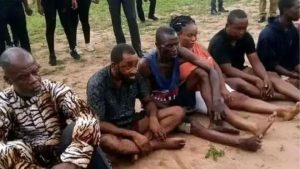
According to investigators, Pastor Agu allegedly provided prayers, rituals and logistical support to the gang before and after kidnapping operations. Other suspects named in the case included Ikechukwu Njoku, Ebenezer Obioha, Fabian Obioha and Bernard Uzoma.
The case attracted widespread national attention. Yet, the religious identity of the pastor and the predominantly Christian background of the suspects did not attract blame from Nigerians. No responsible observer concluded that Christianity promotes kidnapping or that Christians should collectively bear responsibility for the criminality of those individuals. The focus remained on the suspects and the allegations against them, rather than on Christianity.
If such responsible standard applied in this case, why should Islam or the entire Muslim community be blamed for the alleged atrocities of Abdulrazak Umar, Yunusa Musa and Shamsu Adamu Sani?
Nathaniel Samuel, the Christian Suicide Bomber
That same year, a Christian suicide bomber, Nathaniel Samuel was arrested inside a Living Faith Church in Kaduna during a Sunday service with an alleged improvised explosive device (IED).The incident was initially followed by false and mischievous claims that Nathaniel was a Muslim, but only pretending to be a Christian. His father later publicly confirmed that Nathaniel Samuel was indeed a Christian.
Despite the affirmation, Nathaniel crime was neither labelled a terrorist nor his criminality blamed on Christianity by the media or social media commentators. Interestingly, while The Punch newspaper described Nathaniel as a “suspected suicide bomber,” (not as a “Christian suicide bomber”) Channels Television, Independent Newspaper and Sahara Reporters simply referred to him as “a man” who was arrested. Later, several media organisations reported his father’s claim that “he was ill.”
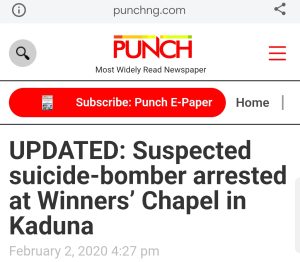
In a nutshell, the alleged offence was treated as his personal responsibility. Christianity was never placed on trial, nor were Christians collectively blamed for his alleged actions. If that standard was correct then, it remains the only standard that should also apply today; so why the double standards. If Christianity was not blamed for the alleged actions of Nathaniel Samuel, why should Islam and the entire Muslim community be blamed for the alleged atrocities of Abdulrazak Umar, Yunusa Musa and Shamsu Adamu Sani? Little did many of these mischievous commentators realised that many Muslim students, including Fulani children were among those kidnapped in Yawota community in Oriire Local Government, Oyo State.
When Christian extremists disguise themselves as Muslims
Another example that exposes the danger of religious profiling occurred in Osun State in 2014. At the height of Boko Haram attacks, three men reportedly stormed a Baptist church in Ikonifin, Ola Oluwa Local Government Area, wearing turbans and disguising themselves as Muslim militants. They threw explosive bangers during a church service, causing panic and injuring several worshippers as they fled.
The alleged plan, however, reportedly failed when the suspects were apprehended by local youths while attempting to escape. Media reports at the time stated that they were members of the same church and allegedly confessed that the incident had been arranged with their pastor, who later claimed it was only a drama.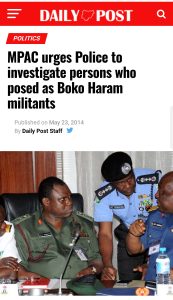
The Muslim Public Affairs Centre (MPAC) immediately called for a full police and security investigation, warning that if the plot had not been uncovered, many Nigerians would have wrongly concluded that Muslims or Boko Haram were responsible. The incident illustrates why criminal allegations must be investigated thoroughly before blame is placed on any religious community. It also reinforces the need to judge individuals by credible evidence rather than by their appearance, names or perceived religious identity
Gruesome murders of Muslims by terrorist Oro, Masquerades
Surprisingly, some adherents of traditional religion have also joined in blaming Islam for the alleged atrocities of a few individuals, conveniently forgetting that history records incidents of violent extremism involving members of traditional cult groups. These incidents are not mere allegations or rumours; they are well documented in the Nigerian media and judicial records.
For instance, in 2021, several mainstream media organisations reported that armed masquerades invaded Kamorudeen Central Mosque in Osogbo, Osun State, during congregational prayers. One Muslim worshipper was killed, while fourteen others sustained varying degrees of injury. The attack shocked the nation. Yet, no one concluded that traditional religion promotes terrorism simply because the attackers were adherents of traditional worship.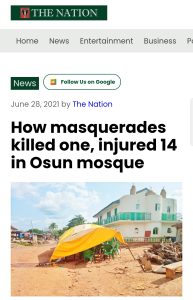
History records even more disturbing examples. On January 3, 1953, respected Muslim scholar Alfa Bisiriyu Apalara was abducted, murdered, decapitated and his body parts thrown into Lagoon in Lagos by members of the Awo-Opa secret cult. Eleven members of the cult were subsequently convicted and sentenced to death.
More than five decades later, Sheikh Sufwan Bello Akodo was brutally hacked to death in Epe, Lagos, during a territorist attack that involved members of the Iyinla and Awo-Opa cults over an Islamic lecture that coincided with a traditional festival. Seven members of the cult were later convicted and sentenced to death for the murder.
Despite these horrifying and well documented crimes, Nigerians did not declare traditional religion a terrorist faith or conclude that it encourages murder and violence. The blame rested exactly where it belonged – the perpetrators. Why, then, should a completely different standard apply simply because the accused happen to be Muslims? If traditional religion was not condemned for the crimes of the misguided few among its adherents, why should Islam be condemned for the alleged actions of a handful of individuals?
Global Examples
The inconsistency in media reportage and the framing of Islam is not limited to Nigeria. It is a global phenomenon, with countless examples across the globe. One of the most striking example occurred on March 15, 2019, when Australian white supremacist Brenton Tarrant attacked two mosques in Christchurch, New Zealand, murdering 51 Muslim worshippers and injuring many others.

The world rightly condemned Tarrant as a terrorist. Yet, governments, scholars, responsible media organisations and rational individuals did not place Christianity on trial nor declare it a terrorist religion because of the religious background of one criminal. The blame was squarely put on the perpetrator and his extremist ideology. It was neither blamed on Christianity nor on billions of Christian faithful. That is precisely the same standard that should apply whenever a misguided Muslim is accused of committing a crime.
Jihad and the crusades: One history, two standards
Those who are always quick to accuse Muslims of terrorism often attempt to link every act of violence committed by individuals claiming to be Muslims with the Islamic concept of jihad. Unfortunately, jihad remains one of the most misunderstood terms in the world today, largely because of years of deliberate misinformation, sensational media coverage and the conscious misuse of the term by violent extremist groups.
The media frequently describe terrorists as “jihadists” simply because they invoke the word Jihad. Yet, invoking a religious term does not make one’s actions religiously legitimate. Classical Islamic teachings on Jihad prohibit the killing of innocent people, whether Muslims or non-Muslims. The teachings also forbid the destruction of places of worship, including monasteries, synagogues, churches and mosques, as well as the killing of women, children, the elderly and other non combatants. By these standards, the actions of terrorist groups stand in direct violation of the very principles of Jihad they claim to represent.
Ironically, while considerable attention is devoted to portraying Jihad as synonymous with terrorism, far less emphasis is placed on Christianity history of religious wars. The Crusades, launched between the eleventh and thirteenth centuries remain the bloodiest religious conflicts in history.
During the First Crusade of 1096 to 1099, Crusader forces captured Jerusalem and massacred thousands of Muslim and Jewish inhabitants. Historians also record that during the Albigensian Crusade, which began in 1209, the Catholic Church led a campaign against the Cathars, a Christian sect in Southern France, resulting in the mass killing of fellow Christians.
Yet no reasonable person argues today that modern Christianity should be judged by the atrocities committed during the Crusades centuries ago. In the same vein, no religion should be defined by those who distort its teachings to justify violence. If Christians are not held collectively responsible for the excesses committed in the name of Christianity throughout history, when then should Muslims be held responsible for the crimes of individuals or groups who abuse Islamic terminology and violate Islamic teachings. Justice requires one standard, not two.
Conclusion
Conclusively, individuals or groups that commit atrocities while invoking Islamic expressions are not implementing Islam. Rather, they are only exploiting religious language to justify criminality. Mainstream Muslim scholars across the world have consistently and unequivocally condemned such groups, exposing their distorted interpretation of Islamic teachings.
Ironically, Muslims themselves remain among the greatest victims of terrorism. Thousands of innocent Muslims, Islamic scholars, traditional rulers and worshippers have been murdered by extremist groups in Nigeria and across many parts of the world. To suggest that such criminals represent Islam is not only inaccurate and misplaced, it’s also a grave injustice to the millions of Muslims who have lost their loved ones to terrorists and their criminal activities.
The fight against terrorism must never become an excuse for religious profiling or collective condemnation. Doing so will only make it difficult to solve the problem, since the accused finger will be pointed to the wrong direction.
Nigeria’s Constitution guarantees freedom of religious practise to everyone. That constitutional guarantee becomes meaningless if an entire members of a religious community is treated as suspects whenever an individual who bears a ‘Muslim’ name is accused of a crime.
If the alleged crimes of Pastor Caleb Agu did not define Christianity, if the actions of Nathaniel Samuel did not place Christianity on trial, and if the atrocities committed by members of traditional cult groups did not define traditional religion, so also, the crimes of Abdulrazak Umar, Yunusa Musa and Shamsu Adamu Sani cannot and should not define Islam. Justice demands consistency. Anything short of that is prejudice disguised as objectivity.
Nigeria’s greatest enemy is terrorism, not Islam, Christianity or traditional religion. The country needs thorough investigations, credible intelligence, diligent prosecution and fair trials, not religious stereotyping. Criminals should be identified by their actions, prosecuted on the strength of evidence and punished in accordance with the law, regardless of their religious or ethnic identity.
Defeating terrorism requires the collective efforts of Muslims, Christians, traditional worshippers and every patriotic Nigerian. That unity becomes impossible when innocent people are demonised simply because they share the same faith as an accused person; as blaming religions for the crimes of adherents is not only misleading, it also constitutes a major distractions.
Let the accused answer for their crimes. Let the courts determine the innocence or otherwise, based on evidence. But let no religion be condemned because of the alleged actions of those who betray its teachings.
Terrorism has no religion. Criminality has no tribe. Justice must have no prejudice.
* Rasheed Abubakar, Publisher, Muslim News Nigeria. Email muslimnewsng@gmail.com
Sponsored

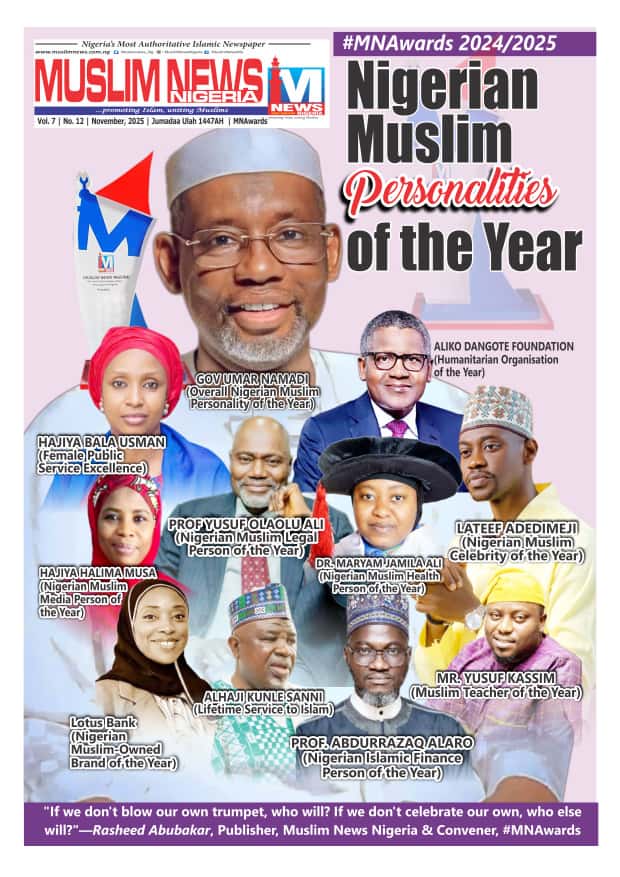
Nigerian Muslim Personalities of the Year 2024/2025
Global Muslim Personalities of the Year 2024/2025




Discover more from Muslim News Nigeria
Subscribe to get the latest posts sent to your email.