

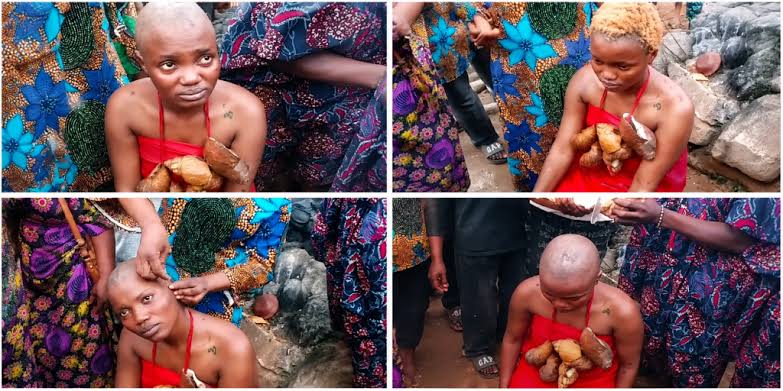
* “It’s a lie, I’m not bleeding, I’m alive,” she cries
A wave of public outrage has followed the denial by a female TikToker, Wasilat, that she filmed the Oloolu masquerade during the 2026 Oloolu Festival in Ibadan, Oyo State, with many Nigerians calling on her to seek legal redress over the treatment she allegedly suffered.
The controversy, which has dominated conversations across social media, began after videos surfaced on Monday showing the content creator undergoing traditional cleansing rites at the Oloolu compound.
The footage fuelled widespread claims that she had violated a long standing traditional prohibition by filming the Oloolu masquerade and had narrowly escaped death after allegedly suffering mysterious health complications.
However, speaking during a telephone interview on Lagelu FM’s Ibi Aye N Lo programme hosted by Adesoye Omotosho on Monday, Wasilat rejected the allegations, insisting that she neither recorded the Oloolu masquerade nor died as widely claimed on social media.
“It is a lie. I am not bleeding. I am alive,” she said emotionally.
“I am not dead. I did not capture the Oloolu masquerade. May I not be implicated. I did not record Oloolu.”
According to her, she had gone to her family’s shop around the Oremeji area on the day of the incident but did not even open the shop before noticing people moving around the area.
She explained that she saw an Amotekun vehicle passing and merely recorded activities on the road, maintaining that the Oloolu masquerade itself never passed through the route where she was standing.
“When I saw people passing, I saw an Amotekun vehicle passing. Oloolu did not even pass through that route. So I filmed it and posted it on social media. Everyone in the TikTok comment section asked me to delete it. The following day, while I was at the shop, they came to meet me there,” she said.
Wasilat said she immediately deleted the video after people advised her to remove it.
She also lamented that eyewitnesses who knew what actually happened failed to defend her.
“I do not know why the eyewitnesses on Thursday did not defend me. I do not know who came up with that agenda, but I know God will judge,” she added.
Police said I committed no offence
Giving more details of her ordeal, Wasilat alleged that some people later arrived at her shop with police officers and took her to a police station.
According to her, police officers informed her that she had committed no criminal offence.
She, however, alleged that after leaving the police station, she was taken to the Oloolu compound where she was compelled to undergo traditional rites against her will.
She claimed that her hair was shaved during the process and insisted she never consented to participating in the rituals.
Her emotional account has further intensified public debate over the incident.
Palace explains its position
Meanwhile, the spokesperson to the Olubadan of Ibadanland, Chief Adeola Oloko, offered a different account of the incident.
Speaking to The Punch, Oloko said Wasilat did not record the Oloolu masquerade itself but mistakenly captured Alawo Oloolu, a figure associated with the Oloolu tradition.
He said members of her family later contacted traditional custodians after she reportedly complained of unusual health challenges following the recording.
Oloko also stated that women are traditionally prohibited from seeing Oloolu and said the traditional rites were carried out in accordance with the customs of the community.
He, however, said he could not confirm claims circulating on social media that Wasilat disguised herself as a man before recording the procession.
Police have no record
Also speaking to The Punch, the spokesperson for the Oyo State Police Command, CSP Ayanlade Olayinka, said the command had no official record of the incident.
“I have no information about the incident because it was not reported at any nearby police station,” he said.
Sowore condemns incident
Among notable Nigerians who reacted was African Action Congress presidential candidate, Omoyele Sowore.
In a Facebook post, Sowore described Wasilat’s treatment as an abuse of human dignity, arguing that no cultural practice should violate the rights of any citizen.
“While culture occupies a vital place in our lives, any cultural practice that is oppressive, discriminatory or insensitive to gender should be abandoned immediately,” he wrote.
Nigerians demand justice
Following Wasilat’s interview, many Nigerians took to social media to express sympathy for her and urged her to institute legal action.
Ogunkoya OA wrote, “Take them to court and claim damages.”
Veronica Durojaye said, “Lord, thank You she is still alive. Why are people so happy about another person’s death?”
Mahmur Ajibowo questioned the silence of women’s rights advocates.
“No one is talking about women’s rights here. Where are the feminists?” he asked.
Ray Goings also queried how the tradition would apply to foreign visitors.
“Even when a foreign tourist comes to the festival and films the masquerade, will he or she also undergo this cleansing?” he wrote.
Several other commentators argued that regardless of cultural beliefs, no Nigerian should be subjected to coercion, public humiliation or compulsory participation in traditional rituals against his or her will.
Others maintained that visitors should respect local customs and traditions but insisted that enforcement must remain within the limits of the law.
Human rights concerns
The incident has generated wider conversations about the relationship between cultural practices and the rights guaranteed under the Constitution of the Federal Republic of Nigeria.
Legal commentators and rights advocates have pointed to constitutional protections covering the dignity of the human person, personal liberty, freedom of conscience and freedom of religion, arguing that no citizen should be compelled to participate in religious or traditional practices without consent.
The controversy has also reignited debates on women’s rights, with many Nigerians questioning whether women should face restrictions, intimidation or compulsory rituals based solely on gender.
Background
The controversy erupted after videos circulated online showing Wasilat undergoing what appeared to be traditional cleansing rites at the Oloolu compound.
She was seen with her head shaved, dressed in red garments and surrounded by traditional worshippers. Other videos showed animals reportedly presented as part of the rites, while social media users claimed her mother pleaded with traditional custodians on her behalf.
The annual Oloolu Festival attracts traditional rulers, worshippers, cultural enthusiasts and visitors from across Yorubaland.
As public debate continues, many Nigerians are calling on the Oyo State Government, the Nigeria Police Force, the National Human Rights Commission and other relevant authorities to establish the full facts surrounding the incident and determine whether Wasilat’s constitutional rights were violated.
Additional reporting: The Punch.
Sponsored
Sponsored

Nigerian Muslim Personalities of the Year 2024/2025

Global Muslim Personalities of the Year 2024/2025




Discover more from Muslim News Nigeria
Subscribe to get the latest posts sent to your email.