

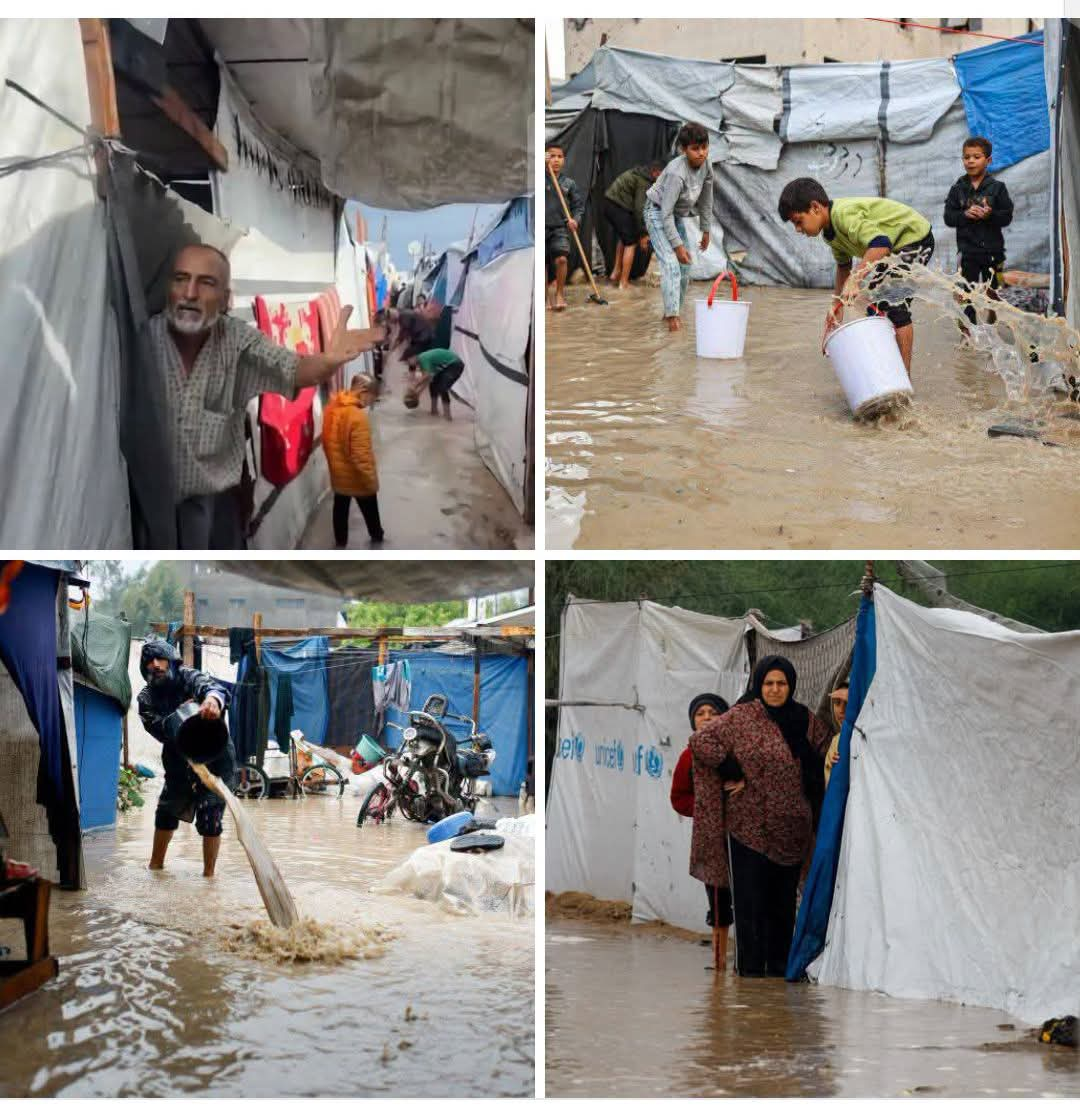
* First winter storm floods 70,000 tents, kills at least five Palestinians as children, women and thousands of families face another humanitarian nightmare
“Oh Muslims, where are the Muslims? Oh world, where are you? We are drowning. Look at our equipment, our belongings and our condition. Water, water! Everything has been submerged. Oh world!”
These were the anguished words of a Palestinian man as floodwaters swept through displacement camps in Gaza, leaving thousands of families struggling to salvage their belongings and find shelter after the territory was hit by its first major winter storm of the season.
The storm, which began on Friday night, November 6, and continued over the weekend, flooded approximately 70,000 tents within 12 hours, exposing already vulnerable Palestinians to freezing conditions, contaminated water and the risk of further displacement.
At least five Palestinians, including three children and two women, were killed when a sand embankment collapsed onto tents in the Al-Berka Reservoir area, southwest of Deir al-Balah, on Sunday, November 8, according to the United Nations Office for the Coordination of Humanitarian Affairs (OCHA).
An infant was also reportedly drowned in a separate incident linked to the heavy rainfall, bringing further grief to families already struggling with the consequences of the prolonged humanitarian crisis.
Rescue efforts were hampered by the scale of the flooding and the lack of adequate equipment. Residents and rescuers were seen searching through mud and sand with their bare hands, while families struggled to recover soaked mattresses, clothes and other belongings from their submerged tents.
For many displaced Palestinians, the storm has destroyed what little protection they had left, leaving children and older people exposed to cold, rain and the growing threat of disease.
Children bear the brunt
Children are among those most severely affected by the flooding, with thousands facing the prospect of spending the winter in damaged tents and makeshift shelters.
UNICEF said more than 106,000 people had been directly affected by the storm, while approximately 950,000 displaced Palestinians were living in areas exposed to flooding. Of this number, about 400,000 people, nearly half of them children, faced extreme risk.
The agency also warned that more than half a million children were living in torn tents, makeshift shelters or damaged buildings, leaving them exposed to harsh weather conditions.
“These children and their mother were killed because they had nowhere safe to sleep. That is the reality in Gaza today,” UNICEF Executive Director Catherine Russell said, referring to the family killed when the sand embankment collapsed.
The flooding has also disrupted children’s education. According to the UN, 55 learning spaces serving approximately 55,000 children were affected, further limiting access to education and safe environments.
Families trapped in flooded camps
The scale of the emergency is reflected in the distress calls received by Gaza’s Civil Defence teams.
OCHA said Civil Defence received 2,166 distress calls from people seeking help during the storm but managed to respond to only 218, highlighting the severe limitations facing rescue teams.
By November 8, more than 26,000 households had reported storm-related damage. At least 6,000 family shelters were destroyed, another 17,400 were damaged, while approximately 3,900 households were left without any shelter.
In some locations, floodwater reached depths of up to 1.5 metres, inundating tents, damaging belongings and making movement difficult.
The situation has been compounded by damaged sanitation infrastructure, with sewage mixing with floodwaters and increasing the risk of waterborne diseases and infections. Health facilities and essential services have also been affected, while families face shortages of clean drinking water, medicines, dry clothing and blankets.
The UN further warned that thousands of buildings across Gaza remain at risk of collapse, raising concerns that further rainfall could lead to additional deaths and injuries.
Shelter shortage deepens humanitarian crisis
The flooding has exposed the consequences of the severe shortage of adequate shelter for displaced Palestinians.
UN estimates indicate that approximately 1.4 million people, representing about 65 per cent of Gaza’s population, are living in tents and makeshift shelters.
Humanitarian organisations have repeatedly warned that many of these structures cannot withstand heavy rain, strong winds or the harsh winter conditions.
OCHA said stocks of tents, tarpaulins, blankets and clothing were virtually exhausted, while about 150,000 tents remained outside Gaza, including 117,000 supplied by the Egyptian Relief Committee and stored in Al-Arish.
Al Jazeera also reported that Israel was blocking the entry of tens of thousands of mobile homes and hundreds of thousands of tents, with only a fraction of the required shelter supplies allowed into the territory. The restrictions have further complicated efforts to provide safe accommodation for displaced families.
The Palestinian humanitarian authorities and aid organisations have continued to call for the entry of emergency shelter materials, rescue equipment and other essential supplies to prevent further loss of life.
Muslim countries intensify humanitarian response
Amid the worsening humanitarian situation, some Muslim-majority countries have renewed calls for increased assistance to Palestinians.
Pakistan’s Prime Minister, Shehbaz Sharif, expressed concern over the flooding and the plight of displaced families, directing the country’s Ministry of Foreign Affairs to pursue all possible means of urgently escalating humanitarian assistance to Gaza.
Türkiye has also maintained its humanitarian support for Palestinians. According to Anadolu Agency, the country had delivered 109,332 tonnes of humanitarian aid to Gaza by July 2026 through 21 ships and 14 aircraft, with assistance coordinated by the Disaster and Emergency Management Authority (AFAD) and the Turkish Red Crescent.
The supplies included food, tents, blankets, hygiene materials and medical assistance.
Saudi Arabia, through its King Salman Humanitarian Aid and Relief Centre (KSrelief), has also supported humanitarian operations in Gaza. A project launched in August 2026 was providing approximately 500,000 litres of safe drinking water daily to nearly 100,000 people.
Although these interventions form part of broader humanitarian assistance to Gaza rather than emergency responses specifically announced for the latest storm, they remain important amid the worsening needs of displaced families.
A winter of uncertainty for displaced Palestinians
For thousands of families whose tents have been destroyed or flooded, the immediate challenge is finding somewhere dry and safe to sleep as more rain threatens the territory.
The latest storm has once again exposed the vulnerability of Palestinians forced to live in makeshift shelters after losing their homes, with children, women and older people bearing much of the hardship.
Humanitarian agencies have called for urgent access to shelter materials, clean water, sanitation facilities, medical supplies and other essential assistance, warning that the combination of flooding, cold weather and inadequate shelter could lead to further suffering.
Sponsored
Sponsored

Nigerian Muslim Personalities of the Year 2024/2025

Global Muslim Personalities of the Year 2024/2025




Discover more from Muslim News Nigeria
Subscribe to get the latest posts sent to your email.