

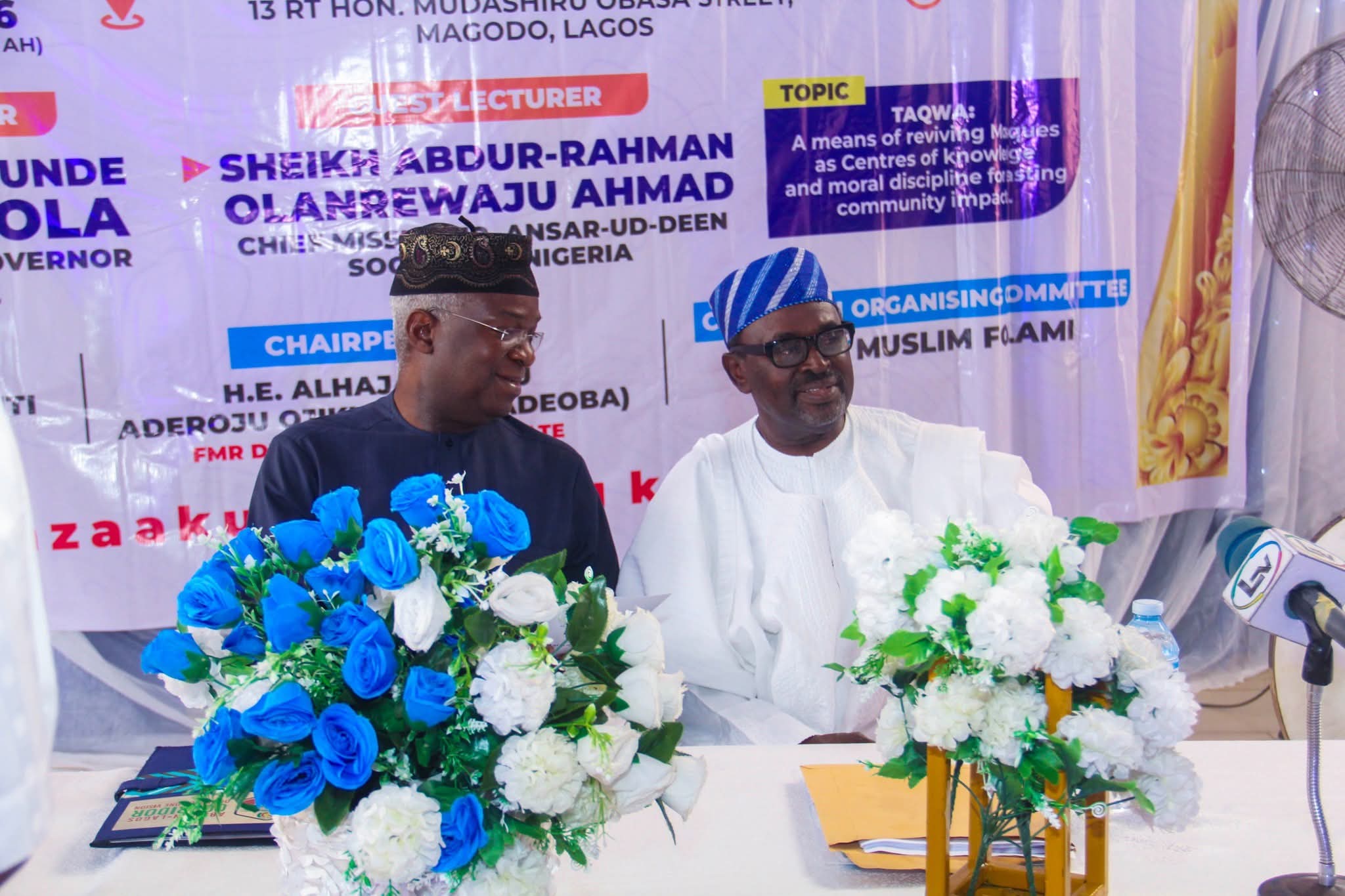
* At Jama’at-ul Islamiyya 12th Triennial National Conference
* Family, social, economic factors fuelling societal decay: Adangba
Former Lagos State Governor, Mr Babatunde Raji Fashola (SAN), has called for a radical approach to tackling insecurity in Nigeria, saying the country must restore respect for law and order, strengthen law enforcement institutions and address the values shaping citizens’ conduct.
Mr. Fashola made the call on Saturday, August 22, 2026, while delivering the keynote address at the 12th Triennial National Conference of Jama’at-ul Islamiyya of Nigeria held at the Jama’at-ul Islamiyya of Nigeria Mosque, Magodo, Lagos.
The conference, themed, “Nigeria’s Political Adventure, Insecurity and Need for More Radical Approach to Stability,” brought together members of the Board of Trustees, Council of Elders, National Executive Council, spiritual leadership, branch and divisional chairmen, women and youth leaders, Muslim scholars and members of the organisation.
Muslim News gathered that the event was chaired by the Pro-Chancellor and Chairman of the Governing Council of Crescent University, Abeokuta, Alhaji Rafiu Adisa Ebiti, while former Deputy Governor of Lagos State, Alhaja Sinatu Aderoju Ojikutu (nee Adeoba), served as chairperson.
‘Nobody should be above the law’
Fashola said Nigeria’s insecurity required a comprehensive response that went beyond deploying more security personnel, stressing that the country must confront the institutional and societal factors contributing to instability.
The former governor identified the restoration of law and order as the first radical step towards achieving stability, urging Nigerians to collectively commit to building a society where nobody is above the law.
“Can we come to an agreement and say to any people that we want to be a country of law and order? And that nobody should be above the law?” he asked.
He stressed that such an agreement must apply irrespective of political affiliation, religion or ethnicity.
According to him, Nigeria cannot achieve stability if citizens continue to make excuses for people who violate the law, regardless of their political, religious or ethnic background.
Mr. Fashola also urged Nigerians to examine the values they are passing to younger generations, particularly their attitude towards law enforcement.
“What kind of values are we living by?” he asked.
“We must begin to reset our own minds,” he added, urging citizens to develop greater respect for law and order.
Mr Fashola, a former Minister of Works and Housing, warned about the consequences of misconduct by law enforcement officers, noting that violations by uniformed officers extend beyond the individual because the uniform represents the authority of the state.
He therefore maintained that citizens also had a responsibility to create an orderly society instead of leaving the entire responsibility for security to government.
‘Government must succeed almost all the time’
Mr. Fashola explained the difficult position of government in dealing with insecurity, noting that the state was expected to protect citizens consistently, while criminals needed only one successful attempt to cause serious harm.
“Government is the one we all look up to, to secure us,” he said.
“For government, 99 per cent is not good enough. For the criminal, one per cent is faster,” he added.
He said the imbalance illustrated the difficult odds confronting the state and the need for government to remain effective in preventing, detecting and responding to criminal activities.
Mr. Fashola, however, urged Nigerians to recognise that security was a shared responsibility, stressing that citizens must contribute to maintaining law and order rather than expect government alone to resolve every security challenge.
Drug abuse, youth idleness fuel insecurity
The former Minister identified drug abuse, particularly among young people, as another urgent issue requiring attention.
Referring to recent seizures of illicit drugs, he said Nigeria needed to confront the relationship between substance abuse and violent crime while developing preventive measures to stop young people from becoming vulnerable to drug use and criminality.
Mr. Fashola also called for greater investment in programmes capable of positively harnessing the energy of young Nigerians.
The former governor cited the National Youth Sports Festival as an example of an initiative designed to engage young people positively rather than leave them idle.
Recalling the thinking behind the initiative, he said large numbers of young Nigerians could not simply be left without productive activities.
“If we leave these people doing nothing, 400,000 of them, they can’t do it,” he said.
He stressed that youth development should form part of Nigeria’s broader strategy for addressing insecurity alongside effective policing, justice reform and stronger social institutions.
‘State police can create new professional cadre’
On state police, Mr. Fashola said the initiative should be considered as part of a broader institutional reform rather than simply an increase in the number of security personnel.
“We must see as an opportunity to create a new cadre in the public sector,” he said.
Mr. Fashola noted that Nigeria had established professional cadres in various sectors.
“We are engineering cadre, we are medical cadre,” he said, arguing that law enforcement should similarly be developed as a professional career structure.
He urged policymakers to properly consider the recruitment, training and professional development of personnel who would serve in state police formations.
According to him, state police should not be viewed merely in terms of numbers but as an opportunity to build a stronger and more professional law enforcement system.
He also stressed that law enforcement was only one component of the criminal justice system, which should cover the process from protecting citizens and apprehending offenders to prosecution and correction.
Mr. Fashola warned that the country must also ensure that adequate correctional facilities were available to accommodate convicted offenders if improved policing and prosecution resulted in more convictions.
He said policymakers must therefore consider the entire criminal justice chain when implementing reforms in the security sector.
Mr. Fashola commended Jama’at-ul Islamiyya of Nigeria for convening the conference, describing the gathering as timely in view of the country’s security challenges.
He urged the organisation and other stakeholders to continue engaging with national issues and developing practical solutions to Nigeria’s political, security and social challenges.
Family, social, economic factors fuelling decay in society: Adangba
The conference also featured a lecture on “Taqwa: A Means of Reviving Mosques as Centres of Knowledge and Moral Discipline for Lasting Community Impacts.”
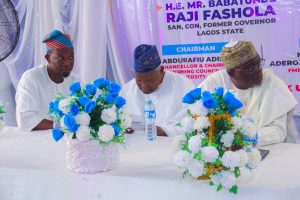
The scheduled guest lecturer, the Chief Missioner of Ansar-Ud-Deen Society of Nigeria, Sheikh Abdul Rahman Ahmad Olanrewaju, was represented by the Chief Imam of Muhammad Rasulullah Mosque, Surulere, Lagos, Sheikh Abdul Rahman Sulaiman Adangba.
Adangba identified family, social and economic factors as some of the issues responsible for confusion and decay in society, saying they must be properly addressed to restore society to the desired path.
“The whole lecture is about the structure for the Muslim Ummah,” he said, stressing the need to address the root causes of decadence.
He said the family, social and economic factors contributing to confusion and decay must be properly addressed if the Muslim community was to uproot the problems and restore society to a better condition.
Sheikh Adangba described the mosque as the House of Allah and a place where Muslims should gather not only for worship but also to discuss their collective future and contribute to the development of society.
He said Taqwa should not be understood merely as fear, but as a relationship of consciousness, responsibility and mutual respect between an individual and Allah.
“It can only be enhanced by knowledge, wisdom, and efficient response to problems that attack the Ummah,” he said.
He stressed the importance of effective mosque leadership, saying those entrusted with leading mosques must possess the knowledge and capacity required to guide members and deliver meaningful programmes.
According to him, the revival of mosques requires “connecting the unconnected” and ensuring that people who are brought into the mosque understand their responsibilities and how they can contribute to society.
The respected Muslim scholar also spoke on the role of Shariah, describing it as a path of existence and a direct injunction from Allah governing human life.
He said justice must be an essential component of leadership, while knowledge should not be limited to formal education but should also encompass morals and character.
“If the leadership of the mosque is right, then those who come to pray behind the Imam will be guided according to how they should lead,” he said.
Sheikh Adangba commended the organisers for the successful conduct of the conference and the serene environment provided for the gathering.
He, however, advised the organisation to revisit the recommendations of its previous triennial conference and ensure that they were properly implemented before moving on to new recommendations.
He said recommendations should be technically put to use to ensure that deliberations at successive conferences produced tangible results.
Oyekan seeks practical solutions to insecurity
Earlier in his welcome address, the President of Jama’at-ul Islamiyya of Nigeria, Engr. Hashim Oyekan, said the conference was taking place at a pivotal moment in Nigeria’s history.
Engr. Oyekan said the theme was both timely and urgent, given the complex socio-political and security challenges facing the country.
He added that Nigeria’s security situation required the attention of religious organisations because they could not remain indifferent to the plight of society.
“Stability cannot be achieved through rhetoric alone; it demands actionable solutions, unyielding justice, and a collective commitment from both leadership and the citizenry,” he said.
Engr. Oyekan said political and economic strategies must be anchored on moral discipline, stressing the need for mosques to return to their historic roles as centres of intellectual growth, moral character formation and community development.
He said when mosques thrive on the principle of Taqwa, communities would naturally reflect righteousness, peace and integrity.
Jama’at launches Centenary School Project
The conference also witnessed the launch of the Jama’at-ul Islamiyya Centenary School Project, an initiative designed to mobilise support for the development of the organisation’s group of schools.
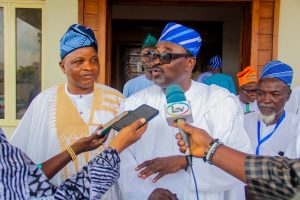
Engr. Oyekan said education remained one of the most powerful tools for social transformation and moral elevation.
According to him, the project seeks to provide accessible, high-quality modern education grounded heavily in Islamic values, with the aim of preparing young Nigerians to lead with both competence and conscience.
He appealed to guests, donors and members of Jama’at-ul Islamiyya to support the project generously, describing contributions to the initiative as an investment in a legacy that would benefit future generations.
The organisation also called for donations in support of its various projects.
Conference marks leadership transition
The 12th Triennial National Conference also marked the formal transition from the current administration to a new leadership team.
Engr. Oyekan described leadership in Islam as a sacred trust, or Amanah, and expressed gratitude to the Executive Council, scholars and members of Jama’at-ul Islamiyya for their support, dedication and prayers throughout his tenure.
“As my tenure draws to a close, I express my deepest gratitude to the executive council, our scholars, and every member of Jama-at-ul Islamiyya for your unwavering support, dedication, and prayers throughout my stewardship,” he said.
He prayed that Allah would grant the incoming Executive Council wisdom, strength and guidance to steer the organisation to greater heights.
Sponsored
Sponsored

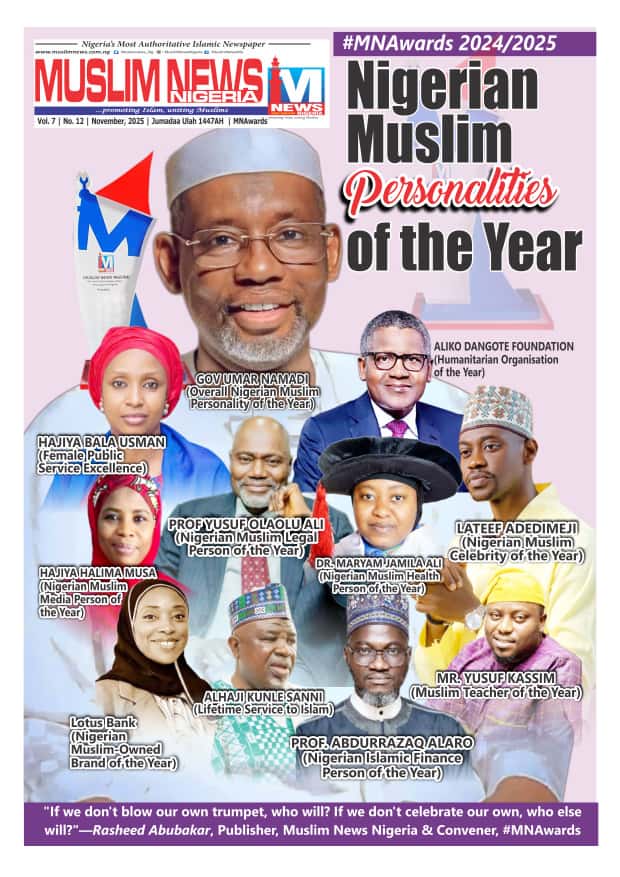
Nigerian Muslim Personalities of the Year 2024/2025
Global Muslim Personalities of the Year 2024/2025




Discover more from Muslim News Nigeria
Subscribe to get the latest posts sent to your email.