

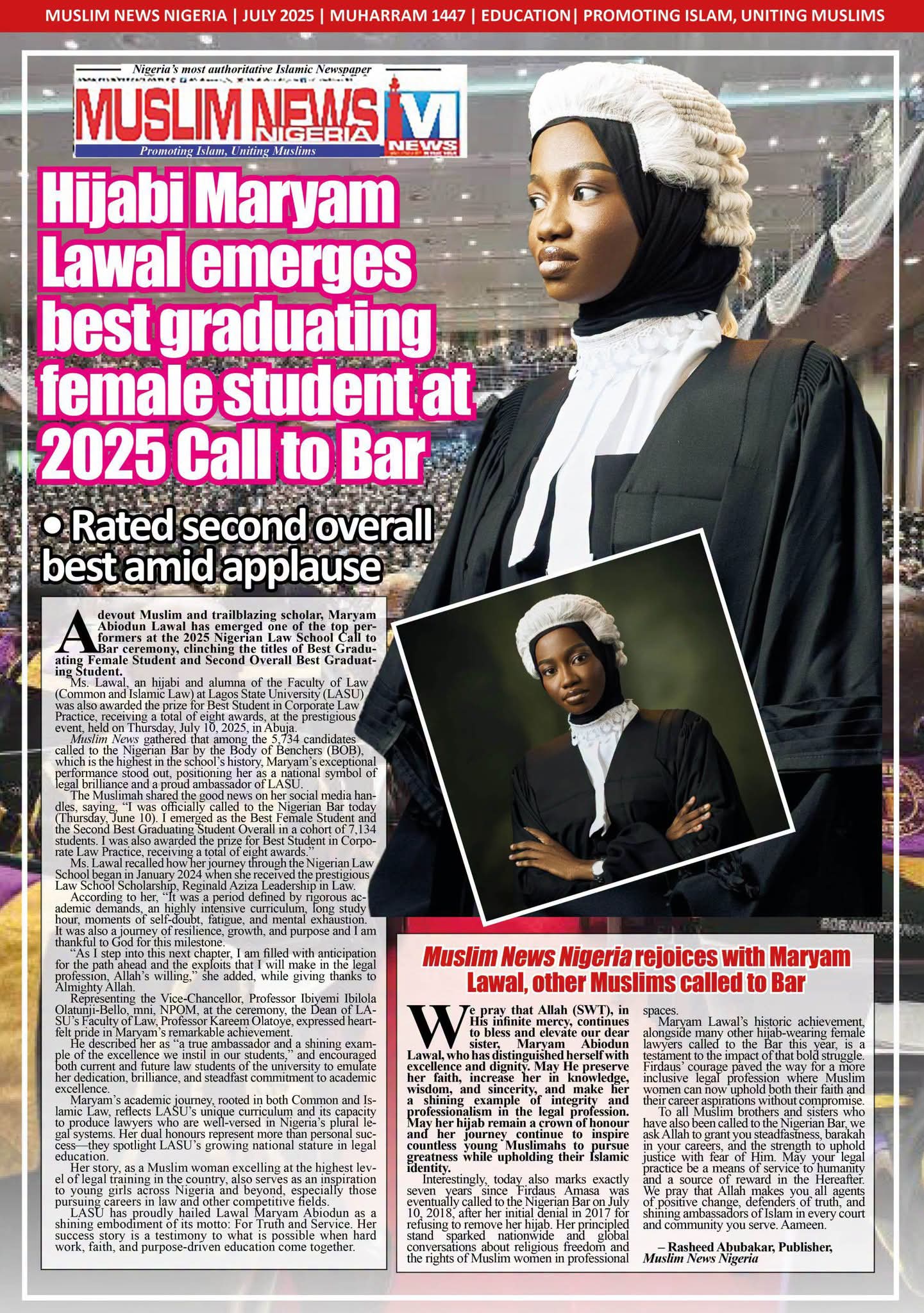
When Maryam Lawal stepped forward in her hijab as the best graduating female student at the 2025 Call to Bar, Muslim homes across Nigeria did what they always do at such news: we celebrated. WhatsApp groups lit up. The publisher of this very newspaper wrote a heartfelt prayer for her. And rightly so — a hijabi sister topping the legal profession in Nigeria is a story worth telling.
But let me ask an uncomfortable question: when the celebrations faded, did anything change in how our children pursue knowledge? Or did we file the story under “good news” and return to the same old pattern — pushing our children toward certificates while the Qur’an gathers dust on the shelf?
Hijabi Maryam Lawal emerges best graduating female student at 2025 Call to Bar
The Celebration Trap
Nigerians love celebrating Muslim achievers. From the best graduating students at UNILAG to professors leading historic clinical trials, we share these stories with pride. This is good — Islam commands us to honour excellence. The problem is what happens next: nothing.
We celebrate success but never study its source
We share the photo but skip the lesson. What made Maryam Lawal’s achievement Islamic was not just the hijab she wore on stage — it was the worldview behind it. Yet our conversations stop at “Masha Allah, well done.” We rarely ask: what does our religion say about why she should learn at all?
Knowledge is pursued as hustle, not worship
For many Nigerian Muslim families, education is a ticket out of poverty — nothing more. Children are told to “read your book” so they can “make money.” The moment learning is disconnected from Allah, it becomes a hustle: stressful, joyless, and spiritually empty. Is it any wonder so many brilliant graduates graduate into anxiety?
What the Qur’an Actually Says About Knowledge
Here is the deeper truth our celebrations miss. The Qur’an does not treat knowledge as a career strategy. It treats it as worship — and it says so plainly.
Allah raises the knowledgeable — Surah Al-Mujadila 58:11
“Allah will raise those who believe among you and those who are given knowledge in degrees.” Notice the order: belief first, then knowledge. The verse does not say Allah raises the rich, the connected, or the famous. Degrees of honour in this Book are measured by knowledge combined with faith. When a Muslim student sits down to study with the intention of serving Allah, she is not just preparing for an exam — she is climbing ranks that no certificate can measure.
The Prophet’s own dua for learning — Surah Ta-Ha 20:114
“My Lord, increase me in knowledge.” This is the dua Allah taught His own Prophet. Not “increase me in wealth” or “increase me in followers” — in knowledge. If the Prophet Muhammad himself, the most knowledgeable of creation, was commanded to ask for more knowledge, what excuse do our children have for treating learning as a chore?
The question that separates the two kinds of students — Surah Az-Zumar 39:9
“Are those who know equal to those who do not know?” The Qur’an’s answer is obvious — but notice what it implies. The verse does not compare the rich and the poor, or the employed and the unemployed. The fundamental divide in the Qur’an’s worldview is between those who know and those who do not. Our children should feel this in their bones: every hour of serious study is a step across that divide.
Muslim News Nigeria rejoices with Maryam Lawal, other Muslims called to Bar
Three Lessons for Nigerian Muslim Families
1. Tie every achievement back to gratitude
When your child tops the class, don’t just celebrate the result — name the Source. Teach them to say, “This is from Allah’s favour,” the way Maryam Lawal’s own story reminds us. Gratitude turns certificates into barakah; ingratitude turns them into arrogance.
2. Make the Qur’an the anchor of all learning
A child who memorises the Qur’an without understanding it, then studies law or medicine as if Allah had nothing to do with it, has been given a divided education. Even fifteen minutes of Qur’an study with meaning each evening — with a teacher who explains, not just corrects pronunciation — gives every other subject its proper direction.
3. Teach intention before instruction
The classical scholars said actions are judged by intentions. Before a child opens a textbook, teach them to intend: “I am learning to benefit my ummah and please my Lord.” A student with this intention never wastes an hour — and never despairs at a failure.
From Headlines to Habits
Maryam Lawal’s story deserved every celebration it received. But the greatest tribute we can pay to such achievers is not applause — it is imitation. The Qur’an has been telling us for fourteen centuries that knowledge is the path to honour, in this world and the next. The question for every Nigerian Muslim home is simple: will we keep celebrating knowledge from a distance, or will we finally make it a way of life?
If you want your own children to combine worldly excellence with Qur’anic understanding, consider giving them structured guidance early. At QuranlyHub, our online Quran classes for kids pair qualified male and female teachers with meaning-first teaching — so the next generation of Nigerian achievers can excel at the Bar and still know their Book.
* Adeel Ahmed is an Islamic scholar with an MPhil in Qur’anic exegesis (Tafseer). He writes Qur’an-research-based articles addressing the real problems facing Muslim families and shares his knowledge through QuranlyHub, an online Qur’an academy.
Sponsored

Sponsored

Nigerian Muslim Personalities of the Year 2024/2025

Global Muslim Personalities of the Year 2024/2025




Discover more from Muslim News Nigeria
Subscribe to get the latest posts sent to your email.