

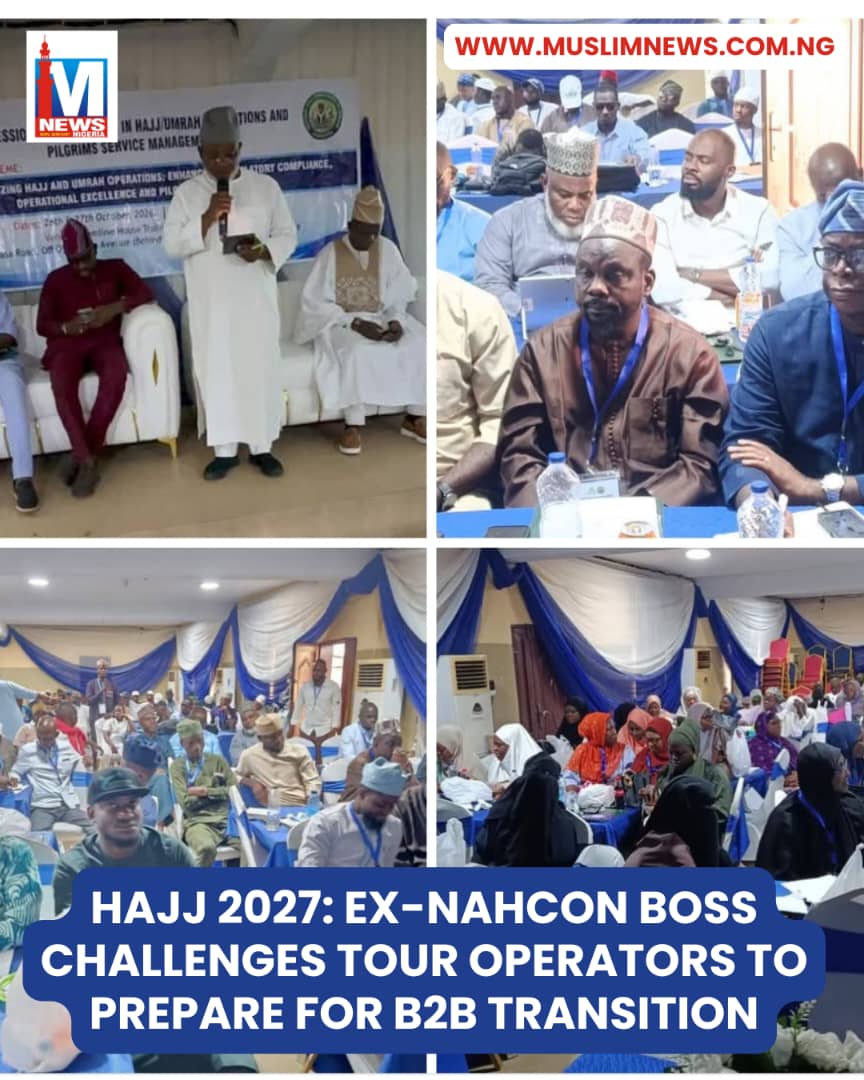
* Zikrullah Kunle Hassan stresses financial capacity, professional standards, Saudi partnerships and pilgrim welfare as private-sector role expands.
Former Chairman and Chief Executive Officer of the National Hajj Commission of Nigeria (NAHCON), Alhaji Zikrullah Kunle Hassan, has challenged Nigerian Hajj and Umrah tour operators to strengthen their institutional, financial, technical and managerial capacity ahead of the proposed Business-to-Business (B2B) model.
Hassan said greater private-sector participation would require operators to demonstrate professionalism, accountability and consistent service delivery rather than rely solely on regulatory licences or pilgrim allocations.
He spoke on Tuesday, October 27, 2026, while delivering the keynote address at a professional certificate programme in Hajj and Umrah Operations and Pilgrim Service Management for NAHCON-licensed tour operators in Lagos.
Muslim News gathered that the two-day programme, held on Monday and Tuesday, October 26 and 27, was organised by NAHCON, the Hajj Institute of Nigeria (HIN), the Association for Hajj and Umrah Operators of Nigeria (AHUON), and the Hadaya and Umrah Tour Operators of Nigeria (HUTON).
B2B transition presents opportunities and challenges
Hassan said Saudi Arabia’s Vision 2030 reforms were transforming the global Hajj industry through greater digitalisation, private-sector participation, commercial accountability and measurable service quality.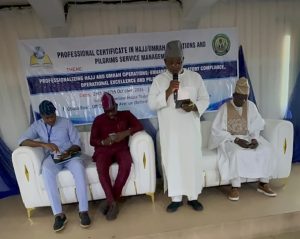
He identified the proposed B2B model, under which private operators are envisaged to manage up to 98 per cent of pilgrims, as a major development that would reshape operators’ responsibilities.
The former NAHCON chairman commended the commission’s current leadership, under Ambassador Ismail Abba Yusuf, for its diplomatic engagement with Saudi authorities, which he said had provided Nigeria with a phased transition beginning with 30 per cent private-sector participation in 2027.
“The fundamental question is no longer whether Nigerian Tour Operators will assume greater responsibilities, but whether they possess the institutional, financial, technical and managerial capacity to discharge those responsibilities successfully,” Hassan said.
He stressed that operators would need to demonstrate competence, credibility and consistent service delivery to remain competitive in the international pilgrimage industry.
Compliance must become part of business culture
Hassan, who is also the chairman of Fajr Centre, Ikorodu, Lagos, identified regulatory compliance as a foundation of professional Hajj and Umrah operations, urging operators to meet the legal, financial and contractual requirements governing pilgrimage management in Nigeria and Saudi Arabia.
He said compliance should become an integral part of organisational culture, supported by clear operating procedures, competent personnel, transparent financial records, properly documented service contracts and effective internal controls.
“A licence gives an operator the authority to conduct business, but professionalism gives the public confidence in the operator’s ability to deliver,” he said.
Hassan described compliance as a shared responsibility, with NAHCON expected to provide clear guidelines, timely communication and consistent oversight, while operators must understand and fulfil their obligations.
He also called for due process in addressing violations and a transparent, predictable regulatory environment.
Operators urged to strengthen planning and Saudi partnerships
On operational excellence, Hassan described Hajj as a complex international operation requiring the coordinated management of accommodation, transportation, feeding, healthcare and religious guidance within strict timelines.
He said successful service delivery depended on early planning, effective procurement, sound contract negotiations, competent personnel and strong coordination with Saudi service providers.
“A failure in one component of the service chain can undermine the entire pilgrimage experience,” he warned, citing delayed buses, inadequate accommodation and poorly coordinated feeding arrangements as examples.
Hassan urged operators to establish service-level agreements with suppliers and prepare contingency plans for flight disruptions, illness, extreme weather, transport delays, accommodation problems and regulatory changes.
He also called for greater investment in digital registration, secure document management, electronic payment records, real-time communication and accurate pilgrim databases.
“Our operators must therefore move from reactive problem-solving to proactive operational management, supported by clearly defined responsibilities, performance indicators and continuous monitoring,” he said.
Pilgrim satisfaction remains the ultimate measure
Hassan described pilgrim satisfaction as a central measure of professional pilgrimage management, reminding operators that Hajj was not an ordinary commercial journey.
He said pilgrims often spend years saving and preparing for the spiritual obligation and therefore deserve services that protect their safety, dignity and wellbeing.
“The people we serve are the Guests of Allah, who have often committed years of savings and preparation to fulfil a lifelong spiritual aspiration,” he said.
He urged operators to establish effective systems for collecting feedback, responding promptly to complaints and using lessons from each pilgrimage exercise to improve subsequent operations.
According to Hassan, commercial sustainability and pilgrim satisfaction should reinforce each other, as businesses that consistently deliver value are better positioned to earn public confidence and maintain their competitiveness.
“The true measure of a successful Tour Operator is not simply the number of pilgrims transported, but the quality of the experience delivered and the trust sustained,” he said.
Hassan warns against division among operators
The former NAHCON chairman also urged tour operators and their associations to strengthen unity and cooperation as private-sector responsibilities expand.
He warned that fragmentation, unhealthy rivalry and conflicting institutional interests could weaken the industry’s ability to meet the demands of the emerging Saudi business model.
Hassan called on AHUON, HUTON and other stakeholders to promote shared professional standards, ethical conduct and pilgrims’ welfare, while ensuring that disagreements were addressed through dialogue and established procedures.
“Healthy competition should encourage innovation, efficiency and better service, rather than division,” he said.
He added: “We may operate different businesses, but we serve the same pilgrims, represent the same country and share a common responsibility for Nigeria’s reputation.”
Five priorities for professionalising Hajj operations
Hassan outlined five priorities for operators preparing for greater private-sector participation: continuous professional certification, stronger corporate governance, operational preparedness, industry harmony and pilgrim-centred performance.
He encouraged the Hajj Institute of Nigeria to deepen collaboration with industry stakeholders through specialised certification programmes, professional standards and evidence-based research.
Recalling the institute’s establishment and eventual take-off in February 2023, Hassan said modern Hajj administration could no longer depend on experience, goodwill and ad hoc practices alone.
“It required systematic professional training, specialised knowledge, institutional competence and internationally acceptable service standards,” he said.
He urged participants to treat the training as more than an opportunity to obtain certificates, describing it as a commitment to improving Hajj and Umrah operations in Nigeria.
“Our ultimate aspiration should be to build a Nigerian Hajj and Umrah industry in which operators compete on quality, cooperate in the national interest, comply with the highest professional standards and consistently deliver excellent services to the Guests of Allah,” Hassan said.
Sponsored
Sponsored

Nigerian Muslim Personalities of the Year 2024/2025

Global Muslim Personalities of the Year 2024/2025




Discover more from Muslim News Nigeria
Subscribe to get the latest posts sent to your email.