

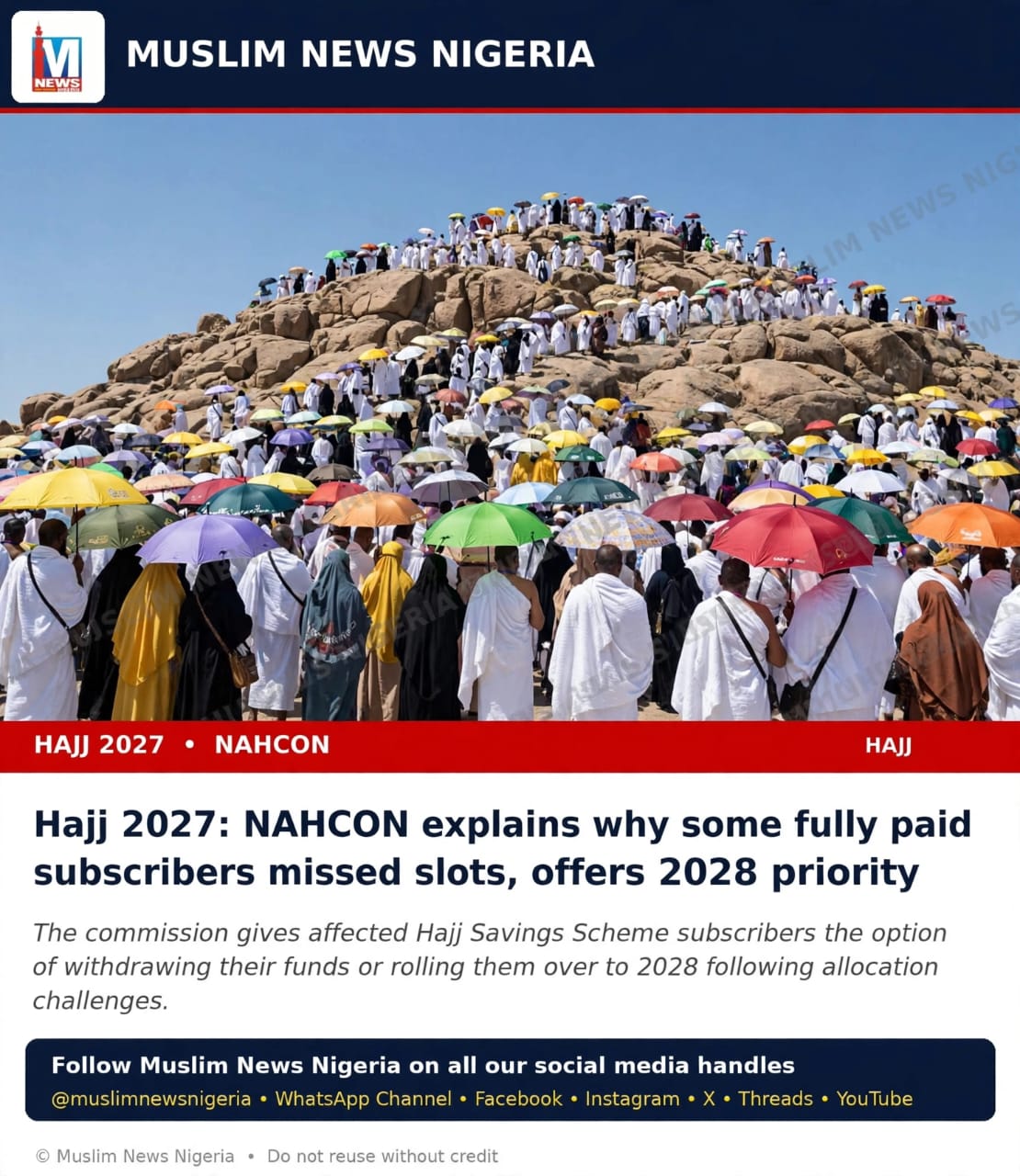
* The commission gives affected Hajj Savings Scheme subscribers the option of withdrawing their funds or rolling them over to 2028 following allocation challenges.
The National Hajj Commission of Nigeria (NAHCON) has explained why some intending pilgrims who fulfilled the financial requirements for the 2027 Hajj through the Hajj Savings Scheme (HSS) could not secure slots, blaming the development on limited allocations and a backlog of applicants.
The commission, in an official statement issued by its management on Wednesday, November 25, 2026, acknowledged the disappointment of affected subscribers and other Nigerian Muslims who had made the necessary financial commitments but could not be accommodated for the forthcoming pilgrimage.
NAHCON said Nigeria, like other countries, was affected by a global reduction in Hajj slots imposed by the Saudi Arabian authorities due to space constraints.
According to the commission, the development has created a backlog of intending pilgrims across the Hajj Savings Scheme and State Muslim Pilgrims’ Welfare Boards, agencies and commissions.
“NAHCON is required to operate within approved quotas, regulations and timelines,” the statement said.
The commission, however, expressed optimism that ongoing investments by the Saudi Government in Hajj infrastructure could make additional slots available in subsequent pilgrimage seasons.
Subscribers given refund, rollover options
Addressing concerns over the fate of affected subscribers’ contributions, NAHCON clarified that the Hajj Savings Scheme was designed as a structured savings and investment initiative that enables intending pilgrims to contribute gradually towards Hajj while earning applicable investment returns.
It stressed that the scheme was not a pay-as-you-go arrangement and that completing payment did not automatically guarantee allocation for a particular Hajj season.
“Eligible subscribers and intending pilgrims who fulfilled the payment requirements for the 2027 Hajj but could not be accommodated will be accorded priority for the 2028 Hajj, subject to approved quotas and regulatory requirements,” the commission stated.
It offered affected subscribers two options: requesting a refund through their respective HSS partner banks or retaining their contributions in the scheme for the 2028 pilgrimage.
Those opting for a refund are expected to approach their respective partner banks and initiate withdrawals in line with established procedures.
Subscribers choosing to roll over their savings will retain their funds in the scheme and continue to earn applicable investment returns, which NAHCON said could help offset future Hajj fares.
The commission also advised intending pilgrims targeting the 2028 Hajj to complete their required savings by the conclusion of the 2027 Hajj to allow for timely reconciliation and registration.
Subscribers reportedly receive non-allocation messages
The commission’s clarification comes amid reports that some HSS subscribers had begun receiving text messages informing them that they would not be accommodated for the 2027 pilgrimage.
In a report published on November 24, Hajj Reporters disclosed that affected subscribers received notifications stating that they had not been allocated slots because of Nigeria’s limited Hajj quota.
The message, reportedly sent to subscribers, read:
“Dear HSS Subscriber, we regret to inform you that you could not be allocated a slot for the 2027 Hajj due to the limited Hajj quota allocated to Nigeria.”
The message further informed recipients that their savings would remain with Jaiz Bank and be automatically rolled over to the 2028 Hajj, subject to verification.
Those who preferred refunds were advised to visit any Jaiz Bank branch.
Hajj Reporters also quoted an unnamed source as saying that about 2,300 slots had initially been allocated to HSS subscribers, with expectations of securing another 1,200. The source alleged that the additional slots were not obtained, leaving an estimated 1,000 subscribers to be deferred to 2028.
However, the publication said it could not obtain further details from Jaiz Bank before going to press. The figures have not been independently confirmed by NAHCON.
HSS operates on first-come, first-served basis
According to information published on NAHCON’s official Hajj Savings Scheme platform, the initiative was established in partnership with State Pilgrims’ Welfare Boards and four financial institutions: Jaiz Bank, TAJBank, Alternative Bank and Lotus Bank.
The scheme operates on a first-come, first-served queue system, allowing intending pilgrims to save towards the cost of Hajj over a period of time.
NAHCON’s published guidelines also state that once a subscriber saves the required amount for a particular Hajj year, the subscriber is notified of qualification, after which the savings are transferred automatically to the commission’s e-Hajj portal for slot processing.
The latest statement’s clarification that full payment does not automatically guarantee a slot therefore raises questions about how the available places were distributed among eligible subscribers and how the first-come, first-served arrangement was applied.
NAHCON develops national Hajj database
As part of efforts to address the allocation challenges and improve future planning, the commission disclosed that it was developing a National Hajj Database in collaboration with State Muslim Pilgrims’ Welfare Boards, agencies and commissions, HSS partner banks and other relevant stakeholders.
The proposed database is expected to strengthen allocation management, address existing backlogs and improve coordination among the institutions involved in Hajj administration.
NAHCON advised subscribers and members of the public to obtain further information through its official communication channels and designated HSS partner banks.
It reaffirmed its commitment to equitable allocation, regulatory compliance, transparency and the welfare of Nigerian pilgrims.
Background: On September 17, 2026, NAHCON announced that Saudi Arabia had declined Nigeria’s request for additional 2027 Hajj slots, leaving the country’s allocation at 50,000, comprising 35,000 slots for government pilgrims and 15,000 for licensed private tour operators. The commission attributed the decision to capacity limitations and operational constraints at the holy sites.
Sponsored
Sponsored

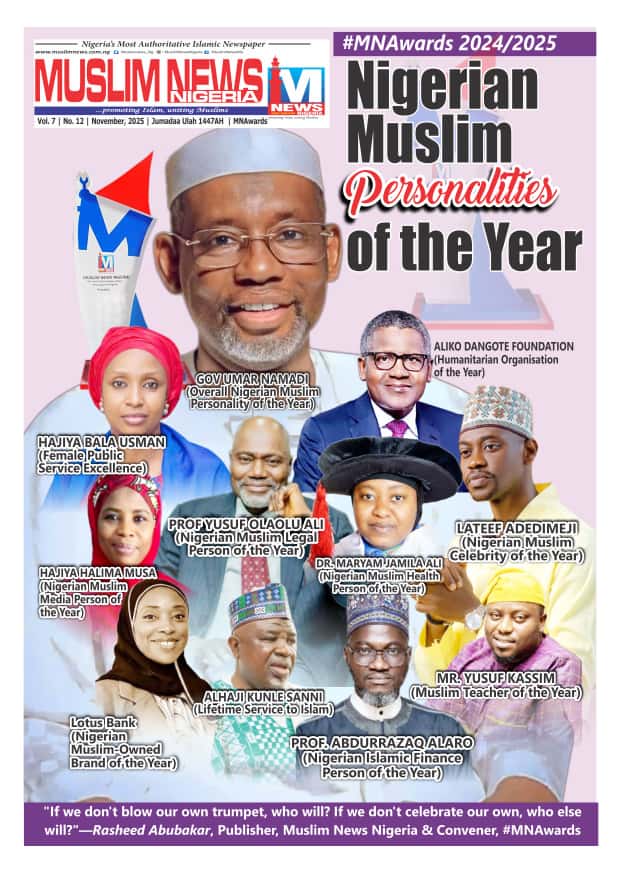
Nigerian Muslim Personalities of the Year 2024/2025
Global Muslim Personalities of the Year 2024/2025




Discover more from Muslim News Nigeria
Subscribe to get the latest posts sent to your email.