

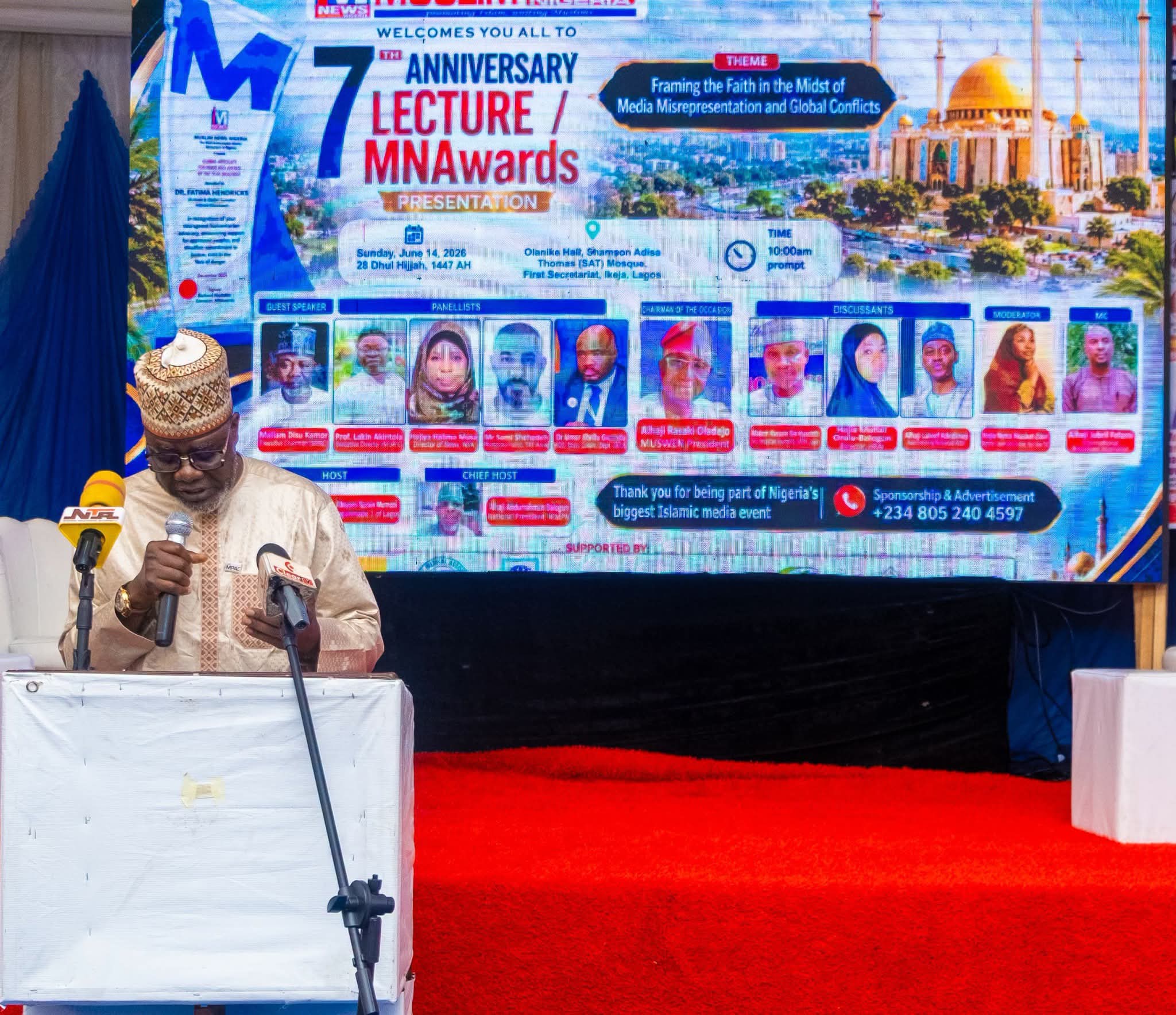
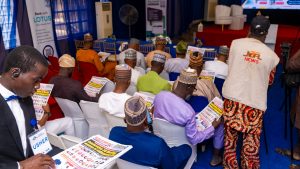
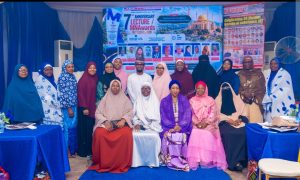
Disu Kamor, Executive Chairman of the Muslim Public Affairs Centre (MPAC) Nigeria, delivered a thought-provoking keynote address at the 7th Anniversary Lecture of Muslim News Nigeria, held on 14th June 2026 at Olanike Hall, Shamsi Adisa Thomas Mosque, First Secretariat, Ikeja, Lagos.
Speaking on the theme “Framing the Faith in the Midst of Media Misrepresentation and Global Conflicts,” Kamor examined how global and local media narratives shape public perception of Islam and Muslims, highlighting concerns around misrepresentation, selective reporting, and the growing influence of digital misinformation.
He also called for strategic engagement, responsible journalism, and stronger institutional and community-driven efforts to reclaim narrative agency in an increasingly polarised information landscape.
FULL TEXT BELOW
All praise is due to Allah, the Lord of the Worlds. We seek His guidance, His mercy, and His blessings. May peace and blessings be upon our noble Prophet Muhammad (SAW), his family, his companions, and all those who follow his path until the Day of Judgment.
The Chairman of this occasion, Alhaji Rasaki Oladejo FSC, President of the Muslim Ummah of South West Nigeria (MUSWEN) and Deputy President-General (South) of the Nigeria Supreme Council for Islamic Affairs; the Publisher and Management of Muslim News Nigeria; distinguished Islamic scholars, esteemed panellists, and honoured guests; respected media practitioners; leaders of our community; our dear brothers and sisters in Islam; ladies and gentlemen.
Assalamu Alaikum Warahmatullahi Wabarakatuh.
I am deeply honoured to join you today as Muslim News Nigeria marks its seventh anniversary. Seven years is not a small thing. In a media environment as turbulent and commercially pressured as ours, staying true to a mission of faithful, responsible journalism for seven years deserves our recognition and our du’a.
I congratulate the Publisher, the management team, the editorial staff, the contributors, the advertisers and every loyal reader who has supported and sustained this platform. May Allah continue to reward your efforts and increase you in all that is good.
The theme of today’s lecture- “Framing the Faith in the Midst of Media Misrepresentation and Global Conflicts”- is not merely timely. It is urgent. We live in a world where narratives shape perceptions, perceptions influence policies, and policies ultimately affect lives. In such an environment, the media occupies a strategic position- one capable of promoting understanding or deepening divisions, of building bridges or erecting walls. And for the Muslim community across the world, the question of how that power is exercised is one with very real, very daily consequences.
@mpacng boss, Disu Kamor delivered the keynote address at our 7th Anniversary Lecture and #MNAwards held over the weekend. Below are some notable quotes from his thought-provoking address
Share #Rawshield #MuslimNews #Media #Islamophobia #Journalism #Panamá #MuslimNewsNigeriaAt7 pic.twitter.com/oxYIwZVzzb
— Muslim News Nigeria (@muslimnews_NG) June 17, 2026
For many Muslims around the world, including here in Nigeria, concerns about media representation remain a persistent and painful challenge. Too often, Islam is viewed through the narrow lenses of conflict, violence, and extremism, while the faith’s extraordinary contributions to peacebuilding, education, charity, social justice, and human development receive far less attention- if any at all.
Unfortunately, media framing often determines how entire communities are perceived. It shapes what our neighbours think of us, what our employers assume about us, and in some cases, how the state treats us. The pen, we know from our tradition, is among the most powerful tools in human hands. And in the age of digital media, that power has been multiplied a thousandfold.
In Nigeria, we have witnessed how even the simple matter of Muslim schoolgirls wearing the hijab generated intense and unnecessary public controversy. What should have been a straightforward discussion about constitutional rights, religious freedom, and civic inclusion was, in too many instances, framed as a threat to public order or national cohesion.
Such framing distorts public understanding and fuels suspicion among citizens who should be united by mutual respect and shared nationhood. Nigeria is home to more than 230 million people and over 500 indigenous languages, making it one of the most diverse societies in the world.
In such a pluralistic environment, responsible media reporting is not merely a professional obligation; it is a national security imperative. Words can either strengthen social cohesion or deepen fault lines.
Similarly, the activities of Boko Haram created one of the gravest image crises for Muslims in Nigeria. While Muslims themselves have been among the largest victims of Boko Haram’s atrocities- our scholars assassinated, our mosques bombed, our communities displaced- public narratives often failed to make that distinction.
Communities devastated by terrorism found themselves unfairly burdened by the stereotypes created by criminals who falsely claimed to act in the name of Islam. According to reports from humanitarian and security organisations, thousands of Muslims have been killed by Boko Haram across Borno, Yobe, and Adamawa States.
Mosques, Islamic scholars, traditional rulers, and Muslim communities have repeatedly been targeted by the terror group. Yet public discourse often overlooks these realities, creating the false impression that Muslims are merely associated with the crisis rather than being among its principal victims.
This is why we must continuously affirm an important truth: criminals do not define a faith. Extremists do not represent the values of over two billion Muslims worldwide. According to the Pew Research Center, Muslims constitute approximately 25% of the world’s population, making Islam the second-largest religion globally. Yet despite representing nearly one-quarter of humanity, studies continue to show that media coverage of Islam is disproportionately associated with conflict, extremism, and security concerns, rather than education, philanthropy, innovation, and community development.
The challenge becomes even more acute in an era dominated by digital media and instant communication. Information now spreads across continents within seconds. Regrettably, misinformation and disinformation often travel faster than verified facts.
Research by the Massachusetts Institute of Technology found that false information spreads significantly faster on social media platforms than truthful information, reaching larger audiences in a shorter period. This reality places an enormous responsibility on journalists, editors, digital influencers, and ordinary consumers of information to verify before they share.
Images are manipulated. Headlines are sensationalised. Context is sacrificed for clicks and engagement. The consequence is the reinforcement of prejudice and the normalisation of misinformation.
The Pattern We See in Nigeria
A recent and instructive example occurred right here at home, in connection with the abduction of school children and teachers in Oyo State. Several media organisations reported that the kidnappers had demanded the implementation of Shari’ah law as a condition for releasing their victims.
The claim spread rapidly. It was cited, amplified, and debated. It fed existing anxieties. And then- it was publicly dismissed as entirely false by the abducted school principal herself, while still in captivity. But here is what we must reflect on carefully: by the time the correction arrived, the narrative had already done its work. The suspicion had been seeded. The association had been made. And the correction, as is so often the case, received a fraction of the attention that the original false report commanded.
This was not an isolated incident. At MPAC, we have documented headlines that mischaracterised Muslim community policies. We have seen mosque bombings framed around Christian calendar dates while the word “mosque” was conspicuously omitted.
We have watched media organisations attribute to Islamic scholars statements that bore no resemblance to what those scholars actually said. And we have observed, repeatedly, that corrections come only after sustained public pressure- by which time the damage has already been done.
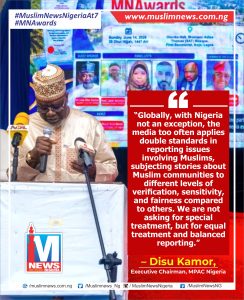
The pattern is clear. Stories involving Muslims are frequently held to a different standard of verification, sensitivity, and contextual fairness than comparable stories involving other communities. We are not asking for special treatment. We are asking for equal treatment.
Consider also how the December 2015 Zaria massacre was covered. When hundreds of members of the Islamic Movement in Nigeria were killed- an event that prompted international human rights bodies to call for independent investigation- the coverage in many mainstream Nigerian outlets was muted, cautious, and brief.
The victims’ Muslim identity did not generate the kind of sustained, empathetic front-page treatment that would almost certainly have accompanied comparable losses by other communities. The contrast was stark and telling. When Muslim lives are taken, the story too often fades quietly. When Muslims are accused of anything- however unverified- the story runs boldly and loudly.
The Western Narrative on Nigeria: Media Fabrication, ACLED Data, and the CPC Designation
Among the most consequential- and most contested- narratives imposed on Nigeria from abroad is the claim that the country is witnessing a systematic campaign of Christian genocide, allegedly perpetrated by Muslim Fulani herders against Christian farming communities in the Middle Belt and beyond.
This narrative has been aggressively promoted by certain Western advocacy networks, evangelical lobby groups, and segments of the international media, and it has found institutional expression in some of the most powerful policy corridors in the world.
The language deployed is deliberately emotive and maximally charged: “genocide,” “ethno-religious cleansing,” “persecution of Christians.” These are not neutral descriptors. They carry the weight of international law, moral condemnation, and- crucially- policy consequences. They are designed to activate a specific Western audience primed, after decades of conflict reporting, to view Muslim agency and Christian victimhood through a familiar binary. And they have worked.
The evidence, however, does not support this framing. The Armed Conflict Location and Event Data project (ACLED)- one of the most rigorously maintained, globally respected, and politically independent conflict monitoring databases in the world- has produced detailed data on the nature and pattern of violence in Nigeria’s Middle Belt and North Central zones.
What that data consistently reveals is not a one-sided religious war, but a complex, multi-directional conflict rooted primarily in competition over land, water, and grazing routes, exacerbated by climate change, governance failure, and the proliferation of small arms. Both farming communities and herding communities have suffered casualties. Both have perpetrated violence. The violence is real. The suffering is real. But the “genocide against Christians” narrative is a profound distortion of that reality.
ACLED data further shows that Muslim communities- including Fulani civilians themselves- have been victims of retaliatory and vigilante violence that rarely makes international headlines. Entire villages have been burned. Muslim farmers and herdsmen have been killed in reprisal attacks. The dead on all sides share a poverty, a vulnerability, and a neglect by the state that is the common thread connecting their tragedies. Yet the selective amplification of only one side of this violence- the side that fits a predetermined narrative- is not journalism. It is propaganda.
International media organisations- some of them otherwise reputable- have published pieces that rely on the testimony of highly partisan local sources, on figures provided by organisations with explicit advocacy agendas, and on anecdotal accounts that are presented without contextualisation or independent corroboration. The resulting coverage has shaped international opinion in ways that bear little relationship to the empirical record.
Local Nigerian media, for its part, has not been entirely innocent in this regard.
Ethnic and religious affiliations have coloured editorial judgements. Some outlets have amplified foreign-produced narratives without interrogating their sourcing or their ideological presuppositions. Others have allowed their reporting to be driven by advertiser interests, political patronage, or the pressure of social media virality. The consequence is a domestic media landscape that, in critical moments, has failed to provide the kind of grounded, evidence-based, contextually sophisticated reporting that such a complex conflict demands.
The policy consequences of this distorted narrative became starkly visible when the United States Commission on International Religious Freedom (USCIRF) recommended, and the US State Department subsequently acted upon, the redesignation of Nigeria as a Country of Particular Concern (CPC) under the International Religious Freedom Act.
Nigeria had previously been removed from that designation- a decision that reflected a more nuanced assessment of the country’s multi-religious dynamics. The reimposition of the CPC label, driven in no small part by the framing of the Middle Belt conflict as a campaign of religious persecution against Christians, carried serious diplomatic, reputational, and economic implications.
It is important to understand precisely what the CPC designation means and what drives it. The International Religious Freedom Act directs the US government to designate as Countries of Particular Concern those nations whose governments have engaged in or tolerated “particularly severe violations of religious freedom.” The designation triggers a range of potential responses, from diplomatic pressure to sanctions.
Its application to Nigeria, a country whose constitution formally guarantees freedom of religion, whose Supreme Court includes Muslim and Christian justices, whose armed forces and intelligence services are led by Muslims and Christians, and whose federal executive has been led by presidents of both faiths, reflects the degree to which a specific- and specifically Western evangelical- framing of Nigerian religious dynamics has been elevated to the level of official US foreign policy.
What is most troubling is not that Nigeria faces real challenges of intercommunal violence- it does. What is troubling is that the CPC designation, and the narrative ecosystem that produced it, serves as a vehicle for external actors to shape Nigerian domestic politics, interfere in Nigerian constitutional arrangements, and exert leverage over Nigerian foreign policy, all under the cover of “religious freedom” advocacy. The Muslim community in Nigeria has a right- and a duty- to name this interference clearly and to challenge it publicly.
Nigerian Muslims must demand that international discourse about our country be grounded in verifiable data, not in the ideological preferences of foreign advocacy groups. We must engage the institutions- ACLED, the UN, the AU, academic research centres- that produce the evidence which contradicts the dominant narrative.
We must build alliances with Nigerian Christians who share our commitment to evidence-based public discourse and who are as alarmed as we are by the manipulation of intercommunal tensions for foreign political purposes. And we must make the case, forcefully and persistently, in every available forum: the story being told about Nigeria’s religious landscape abroad is not the whole story. In many of its most dramatic claims, it is not even an accurate story.
A Mirror from the International Stage
This double standard is not unique to Nigeria. It is a documented, global phenomenon. Let me draw your attention to an example that has become a reference point in media ethics discussions worldwide. On July 22, 2011, Anders Behring Breivik- a white, right-wing Norwegian extremist- detonated a car bomb in Oslo and then carried out a mass shooting on the island of Utøya, killing 77 people, the majority of them young people attending a youth camp. It was the deadliest attack in Norway since the Second World War.
And yet, in the immediate hours that followed, before the perpetrator’s identity had been established, several prominent Western media outlets speculated openly that the attack bore the hallmarks of al-Qaeda and was in all likelihood the work of Islamic extremists.
When it emerged that the perpetrator was indeed a white Christian nationalist, the framing shifted entirely. The word “terrorist” appeared with markedly less frequency. Headlines spoke instead of a “madman,” a “lone wolf,” a “deranged gunman.” The very same acts that would have triggered weeks of commentary about Islamic radicalisation became, instead, a conversation about individual mental illness and political extremism in the abstract.
The contrast was documented extensively by media scholars and press freedom organisations around the world. It illustrated, with painful clarity, that the label of “terrorism” is not applied consistently on the basis of the act- but is too often applied selectively on the basis of the identity of the perpetrator. A Muslim who commits violence is immediately cast as a representative of Islam. A non-Muslim who commits identical violence is treated as an individual acting alone.
This asymmetry has consequences that extend far beyond the headlines. It shapes public opinion. It influences legislation. It affects the daily lives of ordinary Muslims- in Norway, in Nigeria, and everywhere in between.
Similarly, we see this challenge playing out in global conflicts where media narratives determine whose suffering is visible and whose pain is rendered invisible. The ongoing tragedy in Palestine is perhaps the most consequential example of our time. The destruction of homes, hospitals, schools, and mosques has generated global debate not only about international law and human rights, but about the most fundamental question of whose humanity the media chooses to centre.
Since October 2023, international humanitarian agencies have documented tens of thousands of casualties, widespread destruction of civilian infrastructure, and the mass displacement of an entire population in Gaza. The conflict has forced a global reckoning with questions of media framing, selective terminology, and the deeply unequal visibility of human suffering across different communities.
From Reaction to Accountability
It is no longer sufficient for Muslim organisations to respond to these incidents through press statements alone, however well-worded those statements may be. Our community deserves more than eloquent rebuttals.
We deserve structural accountability. Legal and media scholars have affirmed that Nigeria’s existing framework- including the provisions of the Nigerian Constitution, the Criminal Code, defamation law, the Nigerian Press Council, and the National Broadcasting Commission- already provides mechanisms through which false, damaging, and discriminatory reporting can be formally challenged. What has been lacking is not the law, but the will to consistently deploy it.
In the United Kingdom, Muslim organisations have successfully pursued regulatory complaints that compelled major newspapers to publish formal corrections. On 23 November 2015, The Sun newspaper, a British national newspaper, published a front-page headline claiming “1 in 5 Brit Muslims’ sympathy for jihadis”, more than 2,600 complaints by British Muslims were filed with the Independent Press Standards Organisation (IPSO). The lead complaint was brought by Muslim Engagement and Development (MEND). On 17 February 2016, IPSO upheld the complaint, ruling that the coverage was “significantly misleading” and breached Clause 1 (Accuracy) of the Editors’ Code of Practice. There is no principled reason why similar accountability cannot be pursued here in Nigeria.
At MPAC, we believe the time has come for our community to move from reactive rebuttals to structured engagement with regulatory bodies, and where evidence warrants it, to the courts. Holding media organisations accountable is not an act of hostility toward the press. It is an act of service to it- because a press that is not held to professional standards will ultimately forfeit the public trust upon which its authority depends.
The Silence of the Ummah: Social Media, Sectarian Distraction, and the Battle for Narrative
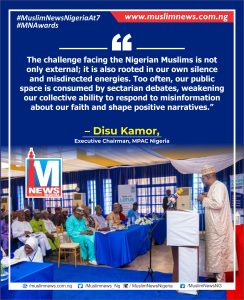
There is a challenge within our community that we must name honestly, even if it is uncomfortable to do so. The challenge of media misrepresentation that we have discussed at length this morning is not exclusively the product of hostile external actors. It is also, in part, the product of our own silence- and of our own misdirected energies.
We live in an era when any individual with a smartphone and an internet connection has the capacity to reach thousands, potentially millions, of people. The barriers to public communication that previously made access to media a privilege of the powerful have largely collapsed. Social media platforms- X (formerly Twitter), Instagram, Facebook, YouTube, TikTok, WhatsApp, Threads- have placed publishing tools in the hands of everyone. The question is no longer whether we have the means to tell our story. The question is whether we are choosing to use those means.
The honest answer, for much of the Nigerian Muslim community, is that we are not. We are not engaging with anything close to the consistency, the strategic intent, or the volume that the moment demands. While anti-Muslim narratives circulate freely, while false stories about Islam seed suspicion in millions of minds, while the “Christian genocide” framing spreads across global platforms with barely a credible rebuttal from within our ranks- too many Muslims are elsewhere. They are on the same platforms, yes. But they are fighting a different war entirely.
The war they are fighting is with each other.
Our social media spaces are dominated- often overwhelmingly so- by sectarian wranglings and theological debates: Sunni against Shi’a, Sufi against Salafi, follower of one sheikh against follower of another, arguments about moon sighting, about mawlid, about dress codes, about the validity of particular supplications, about who belongs to the right group and who has deviated from the straight path. These debates are not inherently without value. Theology matters. Jurisprudence matters. Scholarly discourse is a cherished inheritance of our tradition.
But when those debates consume the overwhelming majority of our public energy- when the timelines of our young population are filled with furious arguments about intra-Muslim differences while the broader public conversation about Islam is being shaped entirely by our adversaries- we have made a strategic error of the highest order. We have, in effect, handed the microphone to those who wish us ill, while occupying ourselves with arguments that, however passionately we hold them, do not register in the court of public opinion as evidence of a confident, coherent, and civically engaged community.
This is not accidental. Both foreign and domestic media have, at various points, actively encouraged and amplified the most divisive voices within Muslim public discourse. Outlets looking for a story about “Muslim extremism” or “Muslim intolerance” will reliably find material to work with if they scroll through the sectarian arguments that dominate so many Muslim social media spaces. The inward-facing hostility that characterises too much of our online discourse provides constant raw material for those seeking to portray Islam as violent, backward, and fundamentally incapable of pluralistic coexistence.
Foreign media organisations and their local affiliates have a vested interest in portraying the Muslim community as fractured, feuding, and preoccupied with ancient grievances. The image of Muslims perpetually arguing among themselves reinforces the broader narrative of Islamic dysfunction. It suggests a community incapable of organising itself for productive civic purposes. It confirms, for the sceptic, the suspicion that Muslim public life is defined by conflict rather than by contribution. Every sectarian argument conducted in public, every takfiri accusation traded online, every video of Muslims denouncing other Muslims as deviants and innovators- these become exhibits in a case that hostile media actors are building against us, and we are, unwittingly, supplying the evidence.
The domestic media landscape in Nigeria is no less culpable. Local newspapers and television channels, competing for audience in a fractured, commercially strained environment, have learned that religious controversy sells. A story about Muslims arguing over whether a particular practice is permissible will generate clicks and engagement. A story about Muslim scholars denouncing each other will drive traffic. By platforming the most inflammatory voices and the most divisive disputes within our community, local media creates a feedback loop: the more attention sectarian conflict receives, the more it proliferates; the more it proliferates, the more it reinforces the perception that Islam is synonymous with division. With hatred and intolerance.
Let us be direct: the Muslim community in Nigeria is failing to show up where it matters most. We are failing to counter Islamophobia on social media with consistent, coordinated pushback. We are failing to correct false narratives with the urgency and volume that false narratives demand. We are failing to present the face of Islam that our tradition actually calls us to present- the face of scholarship, of mercy, of civic contribution, of civilisational pride. We are failing because we are distracted, and because some of our distractions are being carefully curated for us by media actors who understand that a community consumed by internal conflict is a community unable to defend itself in the public square.
This must change. And the change must begin with intentionality. Individual Muslims with any capacity for public communication- whether they have ten followers or ten thousand- must ask themselves: what am I contributing to the narrative about my faith? Am I amplifying voices that strengthen our community’s position in public discourse, or am I adding fuel to the fires of internal division? Every post, every share, every comment is a small act of either building or burning. The aggregate of those small acts is the public face of our community.
We need Muslim social media practitioners who understand that they are not merely posting opinions- they are doing da’wah in the broadest sense of the word, shaping the information environment in which their fellow citizens form their views about Islam and Muslims. We need Muslim WhatsApp group administrators who take their responsibility seriously: who refuse to allow their groups to become sewers of sectarian poison, and who actively circulate accurate, constructive, and empowering content about their faith. We need young Muslims who are bold enough to engage publicly- not with aggression, but with knowledge, with confidence, and with the unshakeable conviction that the truth of Islam is more than capable of defending itself when competently and consistently communicated.
We need more Muslim journalists committed to professionalism and ethical reporting.
We need more Muslim academics, researchers, and public intellectuals contributing fearlessly to national conversations.
We need more Muslim filmmakers, writers, broadcasters, and digital creators telling authentic stories that reflect the richness, diversity, and profound contributions of our communities.
We must recognise that narrative power does not belong only to those who own media platforms. It belongs equally to those who consistently produce credible, compelling, and truthful content. The camera, the microphone, the social media platform, the keyboard- these are all available to us. The question is whether we will use them with intention and discipline.
This is why institutions such as Muslim News Nigeria remain important and worth celebrating. By providing balanced reporting, amplifying underrepresented voices, and promoting informed public discourse, this publication contributes significantly to the work of correcting misconceptions and strengthening our social fabric.
At MPAC, we have always believed in constructive engagement rather than confrontation. We believe that changing perceptions requires professionalism, strategic communication, and the kind of sustained, patient dialogue that the Prophet Muhammad (SAW) himself modelled for us. He did not abandon the public square. He engaged it- with wisdom, with clarity, and with an unshakeable commitment to truth.
When a Nollywood film portrayed a woman in niqab as a bank robber, the concern we raised was not about artistic licence. It was about the cumulative effect of repeated negative associations between Islamic symbols and criminality. Individually, such portrayals may appear minor. Cumulatively, they shape attitudes, inform assumptions, and harden prejudices. Responsible storytelling requires both creative freedom and an awareness of the social weight that representation carries.
Our concern is not about demanding favourable coverage. Our concern is fairness. We are not asking the media to become pro-Muslim. We are asking the media to remain pro-truth.
A Call to Action
As we celebrate seven years of Muslim News Nigeria, let this occasion serve as more than a commemoration. Let it be a commissioning.
A call to journalists: uphold accuracy, balance, and the fearless pursuit of truth.
A call to Muslim lawyers: defend the dignity of your community through legal advocacy, challenge defamation and discrimination with rigor, and build expertise in media law, human rights, and public interest litigation. The courtroom is a forum of accountability, and your presence there protects the voiceless.
A call to Muslim scholars: root your public engagement in the textual depth and ethical breadth of the Islamic tradition, speak with clarity and courage on matters of justice and human dignity, and equip your communities with the intellectual tools to navigate hostile narratives without retreating into isolation or apology.
We urge you also to turn away from rhetorics that revive old disagreements and set them before the youth as though they were the pressing questions of our age. The tradition is wide, and its wisdom is needed now for the struggles that surround us. Guide the young toward the work that lies before them, that their energy may be spent in service of the present need and the common good.
A call to Muslim institutions: invest in communication, media engagement, and public advocacy as a religious obligation, not merely a strategic interest.
A call to young Muslims: pursue careers in journalism, public relations, digital media, and strategic communications. Your community needs your voice, your skill, and your presence in those spaces.
A call to every Muslim on social media: post with purpose. Share with discernment. Engage with courage. Counter bigotry with knowledge, not anger. When Islam is misrepresented, do not scroll past. Respond, with evidence, with civility, and with confidence. The narrative war is being fought on your timeline, whether you choose to engage or not. Disengagement is not neutrality; it is surrender.
A call to all people of goodwill: reject the temptation of prejudice and embrace the harder, more rewarding path of dialogue and understanding.
The future will not be determined by technology or algorithms alone. It will be determined by values- by the choices made, day by day, by people who decide that truth matters and act accordingly.
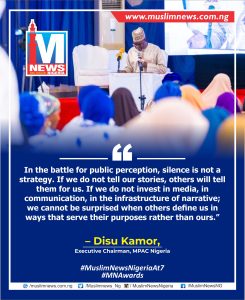
To my brothers and sisters, in the battle for public perception, silence is not a strategy. If we do not tell our stories, others will tell them for us. If we do not invest in media, in communication, in the infrastructure of narrative- we cannot be surprised when others define us in ways that serve their purposes rather than ours.
The challenge before us is therefore clear: we must move from being subjects of narratives to becoming authors of narratives; from reacting to perceptions to shaping them; from lamenting misrepresentation to building institutions capable of advancing truth, justice, and understanding.
This is not merely a media responsibility. It is a communal responsibility. It is, I would argue, a religious responsibility. For we are a people commanded to be witnesses to truth- Shuhadaʿ ʿalal-nas- witnesses before mankind. That witness must extend into every media space of our time.
May Allah- Subhanahu wa Taʿala- grant us the wisdom to communicate truth with courage, the patience to engage those who misunderstand us, and the strength to remain steadfast in the pursuit of justice. May He bless Muslim News Nigeria, its leadership, its dedicated team, and all those who support its mission. And may He make this gathering a means of goodness, clarity, and renewed purpose for us all.
I congratulate Muslim News Nigeria once more on this remarkable milestone. Seven years of holding the line for truth. May the next seven be even greater, and may every edition that follows be a sadaqah jariyah for all those who contributed to it.
Thank you. Wassalamu Alaikum Warahmatullahi Wabarakatuh.
Kamor.disu@mpac-ng.org
Sponsored
Sponsored

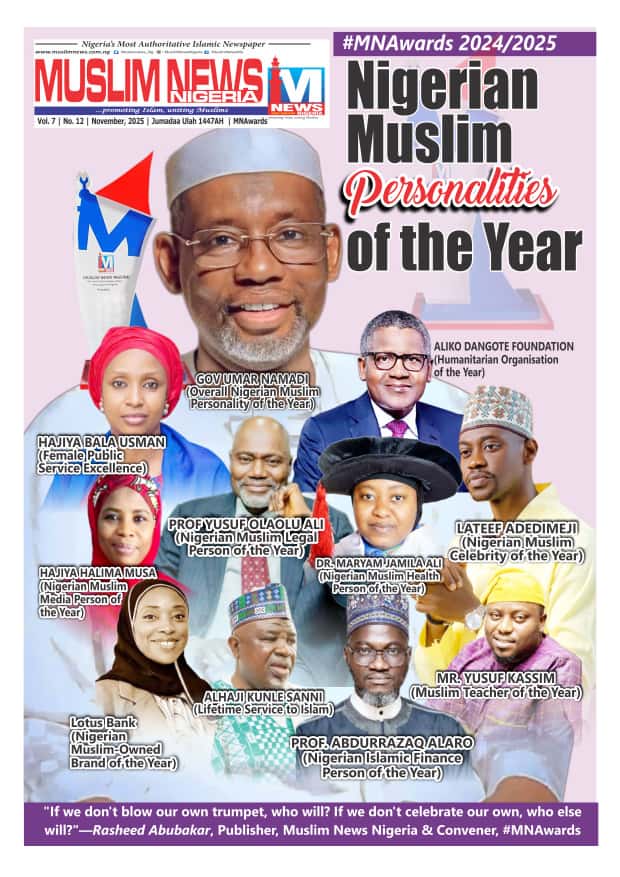
Nigerian Muslim Personalities of the Year 2024/2025
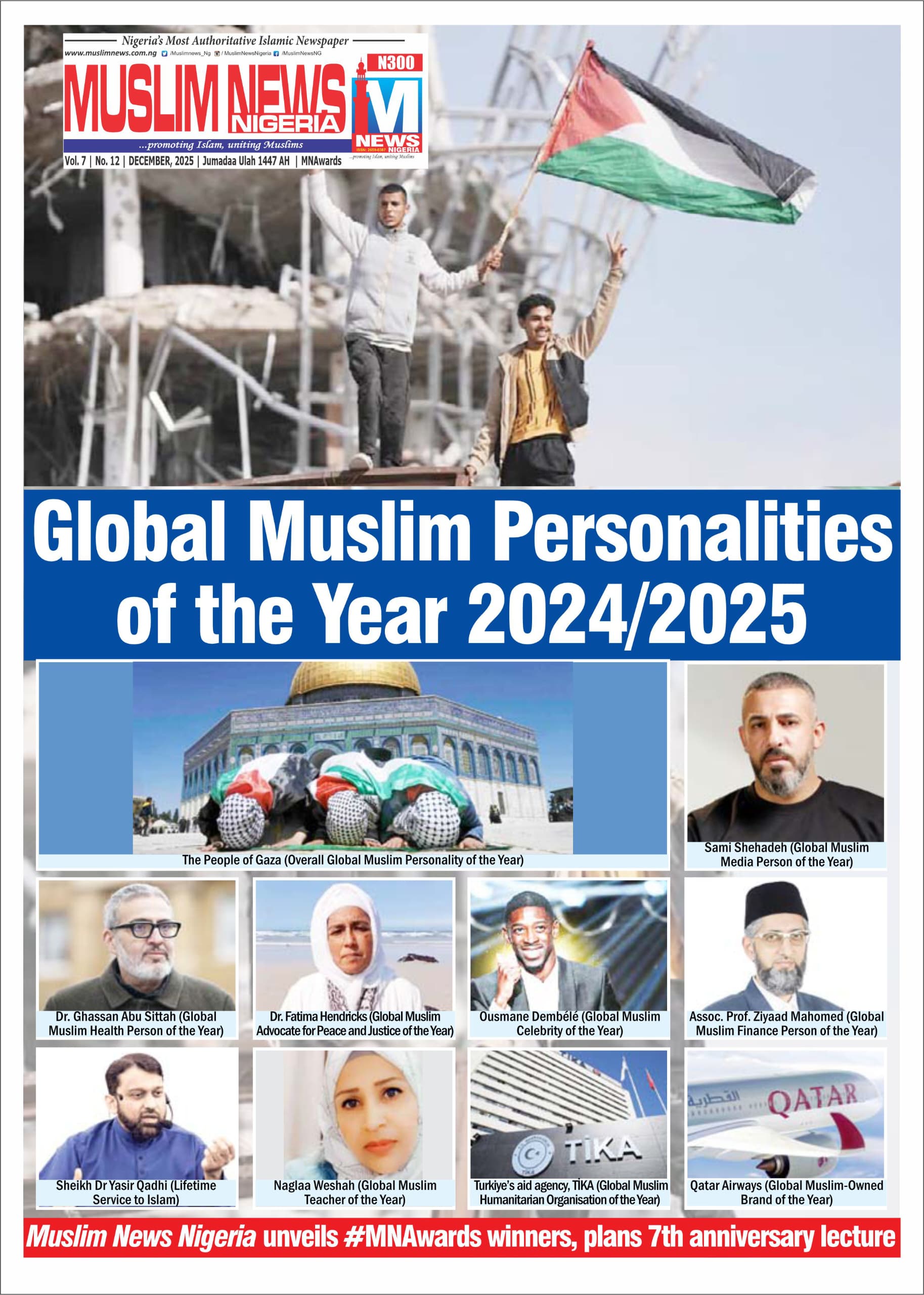
Global Muslim Personalities of the Year 2024/2025


Discover more from Muslim News Nigeria
Subscribe to get the latest posts sent to your email.