

By Rasheed Abubakar
Many Arab leaders who have condemned the Houthis’ continued attacks on Saudi Arabia, including strikes that have killed innocent civilians, have faced criticism from some Muslims who accuse them of hypocrisy. These critics argue that the leaders are quick to defend Saudi Arabia but have failed to take comparable military action against Israel over its devastating war on Gaza, which South Africa and others have alleged amounts to genocide in legal proceedings.
Türkiye’s President, Recep Tayyip Erdoğan, has come under particular scrutiny because of his longstanding support for Palestinians and his reputation among many Muslims as a defender of the oppressed. Critics therefore question why a leader who has repeatedly condemned Israel’s actions in Gaza would support Saudi Arabia’s security against the Houthis but has not deployed Turkish troops to fight Israel.
1. Palestine’s statehood and the problem of divided leadership
Unlike Saudi Arabia, which exercises sovereign authority over its territory and has an established government capable of entering into defence arrangements, Palestine faces severe limitations on its effective sovereignty. Although Palestine enjoys broad international recognition, its territorial control, borders and security remain constrained by Israeli illegal occupation and the division of Palestinian political authority.
On November 29, 2012, the United Nations General Assembly accorded Palestine non-member observer state status, strengthening its international standing and reaffirming the Palestinian people’s right to self-determination. However, its current status does not translate into the effective territorial control and unified security authority exercised by an established sovereign state such as Saudi Arabia.
Palestinian political authority is also divided between Fatah, which dominates the Palestinian Authority, and Hamas, which has controlled Gaza since 2007. Hamas won the 2006 Palestinian legislative elections before taking control of Gaza following violent clashes with Fatah. Meanwhile, the Palestinian Authority, led by Mahmoud Abbas, has exercised limited self-government in parts of the West Bank.
2. Hamas, Fatah and the absence of a unified military strategy
Neither the Palestinian Authority under Mahmoud Abbas nor Hamas has established a publicly documented collective defence arrangement equivalent to the type of agreement under discussion between Türkiye and its partners, nor is there a publicly established invitation from a unified Palestinian government requiring Türkiye to deploy its armed forces against Israel.
Mahmoud Abbas has generally pursued a diplomatic approach, emphasising negotiations, international recognition, legal action through institutions such as the International Court of Justice (ICJ) and non-military resistance. Despite Israeli illegal settlement expansion and military operations in the West Bank, including East Jerusalem, home to Al-Aqsa Mosque, he has not called for a Turkish or Arab military invasion of Israel.
Hamas, by contrast, has historically relied on armed resistance and has maintained relationships with regional armed groups associated with Iran’s ‘Axis of Resistance’, including Hezbollah in Lebanon, the Houthis in Yemen and various armed groups in Iraq.
The Palestinian leadership’s division therefore remains a major obstacle to establishing a common strategy for statehood, resistance, diplomacy and security.
3. Why Erdoğan’s support for Hamas matters
Erdoğan’s position on Hamas further exposes the weakness of this comparison. Hamas is designated as a terrorist organisation by the United States, the European Union, the United Kingdom, Canada and several other governments. However, Erdoğan, has consistently rejected the characterisation of Hamas as a terrorist organisation, describing it instead as a liberation movement and referring to its members as mujahideen. His position reflects Ankara’s distinction between Hamas as a Palestinian political and armed movement and the terrorist designation adopted by several Western governments.
This stance has generated considerable tension between Türkiye and Israel, as well as criticism from governments that classify Hamas as a terrorist organisation.
4. Palestinian reconciliation: Erdoğan’s push for unity
One of Erdoğan’s longstanding positions has been that Palestinian factions must overcome their differences and work towards national unity. This is significant because a divided Palestinian leadership weakens its ability to coordinate political strategy, negotiate effectively and present a united position on statehood and self-determination.
On July 26, 2023, Erdoğan hosted Mahmoud Abbas and Late Ismail Haniyeh, then head of Hamas’s political bureau, in Ankara. The meeting underscored Türkiye’s engagement with both sides and the importance Erdoğan attached to Palestinian reconciliation. Haniyeh was killed in Tehran in July 2024 in an attack widely attributed to Israel.
By maintaining relations with rival Palestinian leaders, Erdoğan has sought to encourage cooperation rather than limit Türkiye’s engagement to one faction. His approach recognises that lasting progress towards Palestinian statehood requires more than military resistance or international condemnation of Israel; it also requires a credible and coordinated Palestinian political leadership.
It would therefore be reasonable to argue that Palestinian reconciliation should be among the priorities of Arab and Muslim-majority governments seeking to support the Palestinian cause. A united Palestinian leadership would be better placed to articulate its objectives, pursue international support and determine the most appropriate forms of assistance.
5. Türkiye’s support extends beyond military intervention
The absence of Turkish troops in Gaza does not mean Ankara has confined its response to verbal condemnation. Türkiye has pursued diplomatic, economic, humanitarian and legal measures in support of Palestinian rights.
On May 2, 2024, Türkiye announced the suspension of all import and export transactions with Israel. On August 7, 2024, it filed a declaration of intervention in South Africa’s case against Israel at the International Court of Justice (ICJ) concerning the Genocide Convention. These steps demonstrated Ankara’s willingness to use economic pressure and international legal mechanisms rather than relying exclusively on military action.
Türkiye has also supported humanitarian relief through government agencies and non-governmental organisations, including the Disaster and Emergency Management Authority (AFAD), the Turkish Cooperation and Coordination Agency (TİKA) and the Foundation for Human Rights and Freedoms and Humanitarian Relief (İHH).
The risks associated with these humanitarian efforts are not merely theoretical. In May 2025, five IHH aid workers involved in a food-assistance project in Gaza, carried out in cooperation with the United Nations World Food Programme, were killed in Israeli attacks over two days. Two other workers were seriously injured. The organisation said the workers had been preparing and delivering food aid to Palestinians in need. These deaths highlight the dangers faced by humanitarian personnel attempting to provide assistance amid the ongoing conflict.
Another case is that of Muhammad Murtaja, a Palestinian employee of TİKA in Gaza, who was arrested by Israeli authorities in February 2017 and accused of assisting Hamas. He denied the allegations, while Türkiye maintained that he was entitled to due process and legal protection. After spending years in Israeli detention, Murtaja was released in February 2025 as part of a prisoner exchange during the Israel–Gaza war.
6. The risks of direct military intervention in Gaza
Deploying Turkish troops to fight Israel would represent a major escalation beyond diplomatic, economic and humanitarian measures. It could turn the existing hostility between Ankara and Tel Aviv into a direct military confrontation, with consequences extending far beyond Gaza.
Israel has repeatedly opposed Erdoğan’s relationship with Hamas and rejected a Turkish military role in Gaza during discussions about postwar arrangements under the Trump administration.
Sending Turkish troops into the territory could therefore trigger a wider conflict, strain Türkiye’s relations with Western allies and further destabilise the region.
Israel’s opposition to Erdoğan does not automatically give it the legal right to attack Türkiye. Article 2(4) of the United Nations Charter prohibits the threat or use of force against another state’s territorial integrity or political independence, subject to recognised exceptions, including lawful self-defence under Article 51. Israel’s military actions in Palestine and its strikes against Iran have raised serious questions about compliance with international law, although each case must be assessed on its specific facts.
The absence of Turkish troops in Gaza does not, by itself, prove hypocrisy. Türkiye has pursued economic pressure, humanitarian assistance, diplomatic engagement and international legal action in support of Palestinians. Critics may argue that Erdoğan should do more, but refusing to enter a direct military confrontation with Israel is not the same as abandoning the Palestinian cause.
Yemen: A different security challenge
Having established that Türkiye’s support for Saudi Arabia under the Makkah Joint Defence Agreement does not automatically make Erdoğan a hypocrite over Gaza, the next question is what the pact entails and how it relates to the Saudi-Houthi conflict in Yemen.
What the pact provides
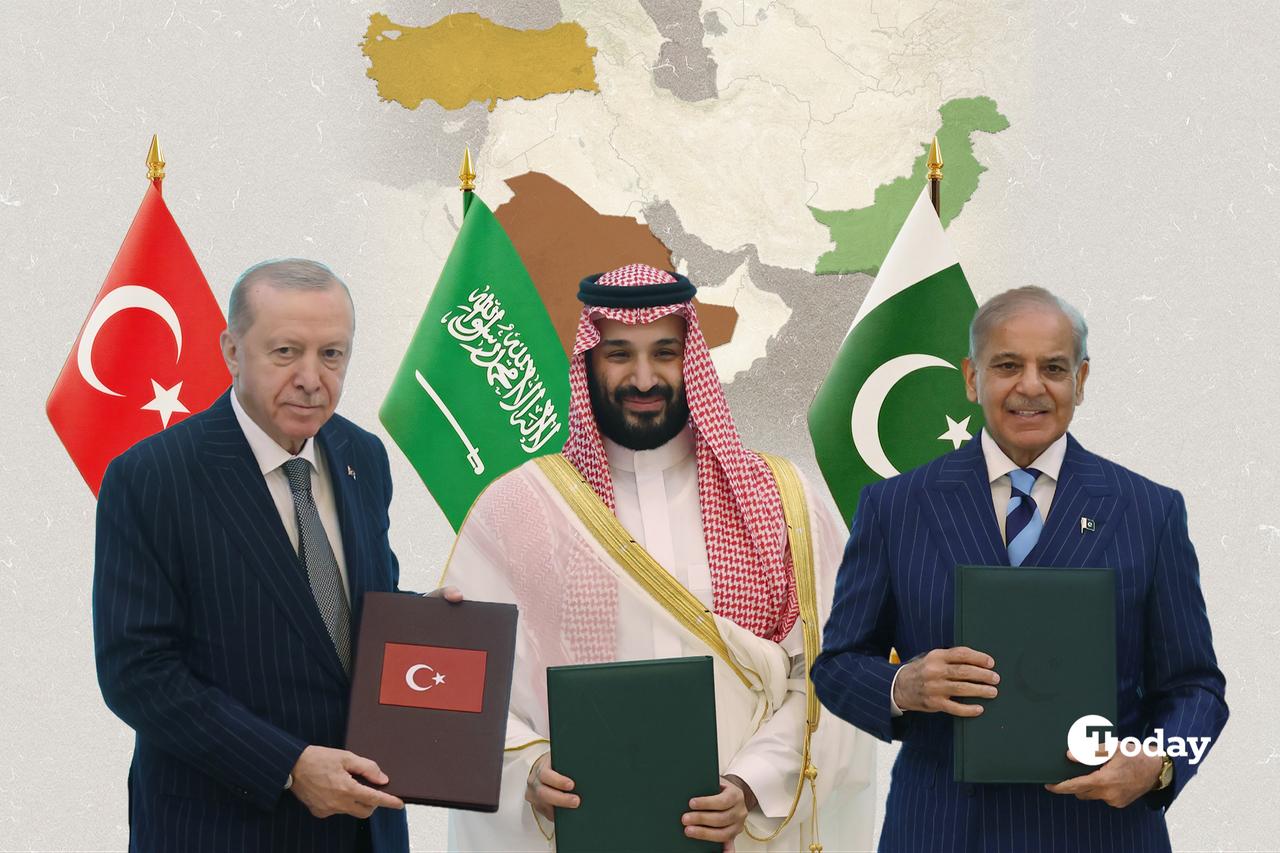
Signed on August 7, 2026, by Türkiye, Saudi Arabia and Pakistan, the Makkah Joint Defence Agreement states that an armed attack against one member shall be regarded as an attack against all three. Its purpose is to strengthen collective deterrence and defence cooperation. The agreement was signed before the latest escalation between Saudi Arabia and the Houthis in October, which has resulted in deadly attacks affecting civilians, including Muslim pilgrims.
The pact reflects Saudi Arabia’s effort to strengthen its security partnerships amid growing concerns about regional threats and the reliability of its traditional security arrangements. Rather than relying exclusively on external powers, Riyadh is seeking closer defence cooperation with Türkiye and Pakistan.
As of October 17, the agreement’s implementation remains a developing process, with practical cooperation and national procedures still relevant to how its commitments will operate.
How it relates to the Houthis
The Houthis, officially known as Ansar Allah, seized Sana’a in 2014 and control the Yemeni capital, and substantial parts of northern Yemen. They have fought against Yemen’s internationally recognised government and launched missile and drone attacks against Saudi territory and infrastructure.
Although the government is sometimes described as the ousted or exiled Yemeni government because the Houthis took control of the capital, Yemen’s internationally recognised government remains the country’s recognised government. The Houthis’ territorial control does not erase that distinction.
The movement is allied with Iran and has received Iranian military support. However, it retains its own leadership, local objectives and political ambitions. Its relationship with Tehran therefore adds a wider regional dimension to the conflict without making the Houthis simply an Iranian-controlled force.
The renewed attacks on Saudi Arabia have demonstrated the threat the Houthis pose to civilians, transport networks and critical infrastructure. On October 10, a Houthi attack on Riyadh’s King Khalid International Airport reportedly killed at least 12 people and injured more than 300, with pilgrims among those affected.
Saudi Arabia therefore has legitimate grounds to seek assistance from its partners to protect its population and infrastructure. However, the right to defend its territory should not be interpreted as an unlimited mandate for offensive military operations in Yemen. Any response must comply with international law and take account of civilian lives.
Why Iran welcomed the pact
Interestingly, Iranian President Masoud Pezeshkian welcomed the Makkah Defence Agreement between Saudi Arabia, Türkiye and Pakistan, describing it as “an important step towards bringing Muslims together.” In an interview with Al Jazeera, he said the initiative could encourage Muslim countries to cooperate and pursue Islamic unity rather than engage in conflict.
Responding to concerns about whether the agreement was directed against Iran, Pezeshkian said it could bring Muslims together rather than divide them into opposing camps. His response suggests that Tehran does not necessarily regard the pact as an anti-Iran alliance, although this should not be interpreted as evidence that all Iranian officials share his assessment.
The signatories have also indicated that the agreement is not intended to remain an exclusive arrangement among the three countries. Turkish Foreign Minister Hakan Fidan said President Recep Tayyip Erdoğan wanted to expand the framework beyond its founding members, identifying Egypt as a natural partner. Bangladesh has also publicly expressed interest in joining, according to Al Jazeera, while Pakistan has stated that the agreement remains open to other countries willing to uphold its principles.
These developments lend weight to the argument that the pact is being presented as a framework for wider regional security cooperation rather than an inherently anti-Iranian alliance.
Türkiye’s role: Defence is an amanah, not a licence for offensive war
Türkiye’s commitment to Saudi Arabia under the Makkah Joint Defence Agreement should be understood as a responsibility of collective defence, an amanah, or trust, that must be fulfilled in accordance with the pact’s terms and applicable national procedures.
Despite unverified claims circulating online, Türkiye has however not announced plans to send troops into Yemen to fight the Houthis. In fact, Turkish Foreign Minister Hakan Fidan said Ankara was assessing how to help Saudi Arabia defend itself, particularly through air defence, electronic warfare and technical support, in his October 8, 2026, interview. He explicitly ruled out Türkiye’s participation in offensive military operations.
The distinction is also central to the accusations against Erdoğan over Gaza. Türkiye can honour a defensive commitment to Saudi Arabia without launching an offensive campaign in Yemen, just as its support for Palestinians does not automatically require Turkish troops to fight Israel. The two situations must be judged on their distinct circumstances.
* Rasheed Abubakar is the Publisher of Muslim News Nigeria Email: muslimnewsng@gmail.com
Sponsored
Sponsored

Nigerian Muslim Personalities of the Year 2024/2025

Global Muslim Personalities of the Year 2024/2025




Discover more from Muslim News Nigeria
Subscribe to get the latest posts sent to your email.