

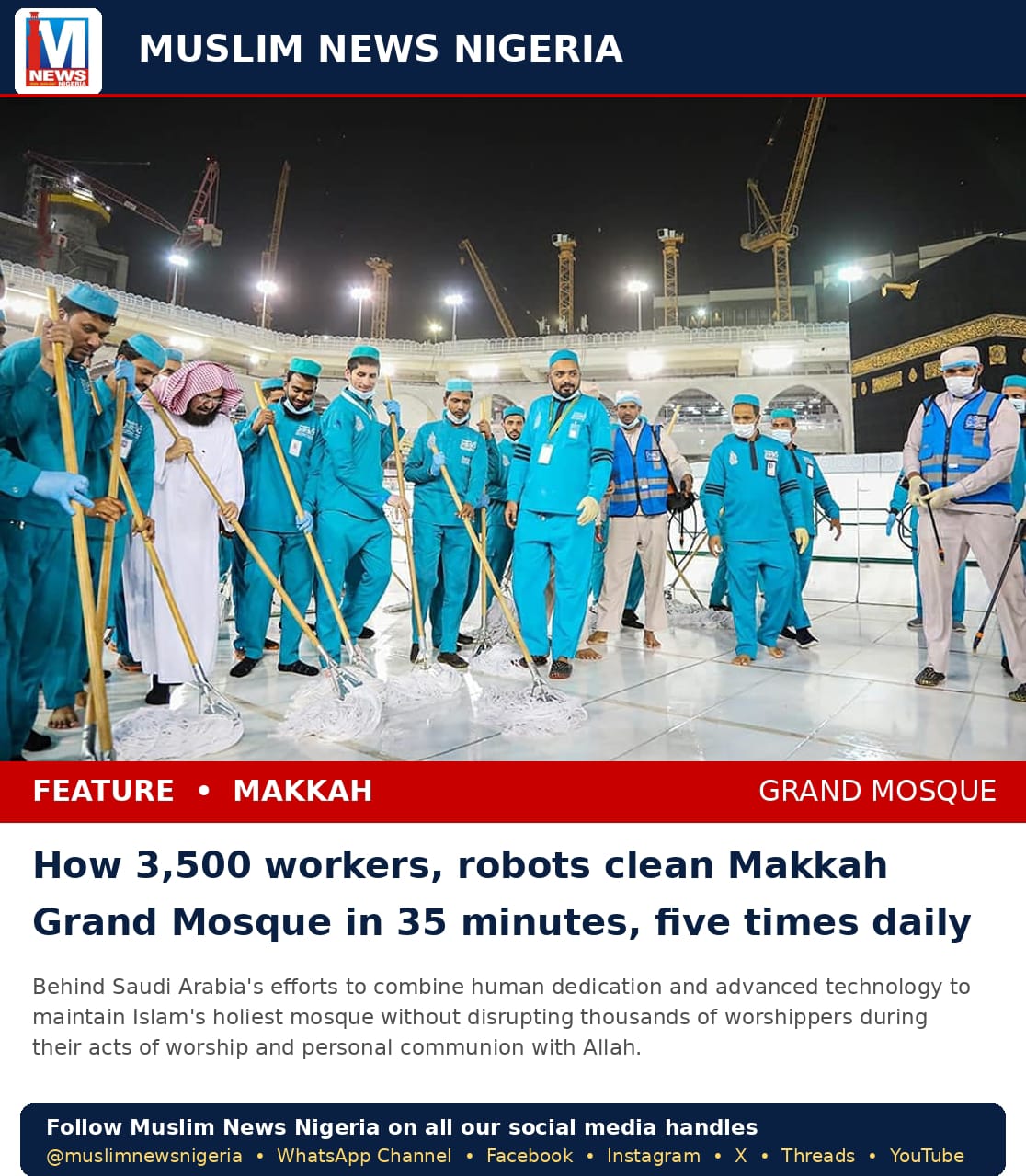
… Behind Saudi Arabia’s efforts to combine human dedication and advanced technology to maintain Islam’s holiest mosque without disrupting thousands of worshippers during their acts of worship and personal communion with Allah.
Every day, about 3,500 men and women, supported by hundreds of specialised cleaning machines and automated robots, work around the clock to keep the Grand Mosque in Makkah, Saudi Arabia, clean and welcoming for millions of worshippers, pilgrims and visitors.
The coordinated operation includes a major cleaning exercise that takes approximately 35 minutes, while workers wash the Mataf, the area surrounding the Holy Kaaba where Muslims perform Tawaf, in about 20 minutes without interrupting worshippers performing the sacred circumambulation.
According to a report by Haramain Info, the Grand Mosque undergoes five major washing operations daily, with specialised teams attending to its different sections. The Mataf, the area surrounding the Holy Kaaba where Muslims perform Tawaf, takes approximately 20 minutes to wash.
Workers pour water across the marble floor, use leather squeegees to remove it, dry the surface and apply perfume, all while carefully coordinating their activities to avoid interrupting thousands of worshippers circumambulating the Kaaba.
The operation is particularly remarkable given the scale of the Grand Mosque, which covers more than 1.8 million square metres and can accommodate over 2.5 million worshippers, according to information released by Saudi Arabia’s Ministry of Hajj and Umrah and the General Authority for the Care of the Affairs of the Grand Mosque and the Prophet’s Mosque in December 2025.
Robots, 679 machines support 3,500 workers
Saudi Arabia has integrated modern technology into the cleaning operation, deploying 12 specialised washing machines and 679 cleaning machines to support the workforce.
According to Haramain Info, some of the automated robots wash more than 1,000 square metres of flooring per hour. Equipped with cameras and sensors, they detect people and obstacles, navigate around worshippers and operate quietly to avoid disturbing those performing their religious obligations.
Other robots disinfect designated areas by following pre-programmed routes and can operate for up to eight hours without direct human intervention.
The introduction of these technologies forms part of Saudi Arabia’s wider adoption of digital solutions to improve services at the Two Holy Mosques.
The Kingdom began expanding its use of robotic technology during the COVID-19 pandemic. In June 2021, the authorities introduced 10 smart robots to support sterilisation operations at the Grand Mosque, with the machines capable of working for between five and eight hours without human intervention.
On October 27, 2021, the then President of the General Presidency for the Affairs of the Two Holy Mosques, Sheikh Dr Abdulrahman Al-Sudais, inaugurated a smart disinfection robot capable of covering more than 2,000 square metres per hour. The machine used cameras and sensors to identify people and obstacles while washing and disinfecting floors.
Saudi Arabia has since expanded the use of robotics beyond cleaning. In February 2024, the Saudi Press Agency (SPA) reported the deployment of artificial intelligence-powered robots to provide worshippers with religious guidance, information on Hajj and Umrah rituals, directions and answers to Islamic questions in 11 languages, including Hausa, English, Arabic and French.
Specialised teams maintain every section
Beyond the machines and robots, the Kingdom relies on specialised human teams to maintain different parts of the Grand Mosque.
Haramain Info reported that dedicated workers handle the rooftop, escalators, minarets and staircases, while another team polishes brass fittings, including lanterns, railings and decorative features on the mosque’s columns.
The arrangement ensures that different sections receive attention from personnel trained for specific cleaning and maintenance responsibilities.
Saudi Arabia removes 70 tonnes of waste daily
Waste management also forms a significant part of the operation, with about 70 tonnes of refuse collected and evacuated from the Grand Mosque every day. The figure rises to approximately 100 tonnes during periods of heavy activity.
To support the exercise, the authorities maintain more than 3,000 waste containers distributed inside and outside the mosque.
The General Authority for the Care of the Grand Mosque and the Prophet’s Mosque said in a March 2025 report published by the Saudi Press Agency that the 3,500 cleaning personnel work around the clock, supported by 12 specialised washing machines and 679 cleaning devices.
The authority also confirmed that it uses environmentally friendly cleaning materials and maintains continuous cleaning operations without affecting the movement of worshippers and pilgrims.
Saudi Arabia’s enduring commitment to the Two Holy Mosques
The extensive cleaning and maintenance arrangements form part of Saudi Arabia’s broader responsibility for the management, expansion and development of the Two Holy Mosques.
Over the years, successive Saudi administrations have invested in expanding the Grand Mosque, upgrading its facilities, improving crowd management and introducing modern technologies to accommodate the growing number of Muslims visiting Makkah for Hajj, Umrah and other acts of worship.
The Kingdom’s efforts were also evident during Ramadan 2025, when more than 2.5 million worshippers gathered at the Grand Mosque for Isha and Taraweeh prayers on the 29th night of the month, according to SPA. Authorities coordinated crowd movement, deployed personnel and maintained accessibility to ensure that worshippers performed their prayers safely.
These investments demonstrate the scale of the responsibility involved in caring for the mosque, which welcomes Muslims from different countries, languages and backgrounds throughout the year.
A Qur’an instruction to purify the Sacred House
The commitment to maintaining the cleanliness of the Grand Mosque also carries profound religious significance.
In the Quran, Allah recounts His instruction to Prophet Ibrahim (AS) concerning the Sacred House:
“And [mention, O Muhammad], when We designated for Abraham the site of the House, [saying], ‘Do not associate anything with Me and purify My House for those who perform Tawaf and those who stand [in prayer] and those who bow and prostrate.’” (Quran 22:26).
The verse establishes the purification of the Sacred House as an important responsibility in preparing it for those who worship Allah.
For the 3,500 men and women working behind the scenes, supported by modern technology and a coordinated management system, the task goes beyond ordinary cleaning. It is a daily service that helps millions of Muslims fulfil their religious obligations in the holiest mosque in Islam.
Sponsored
Sponsored

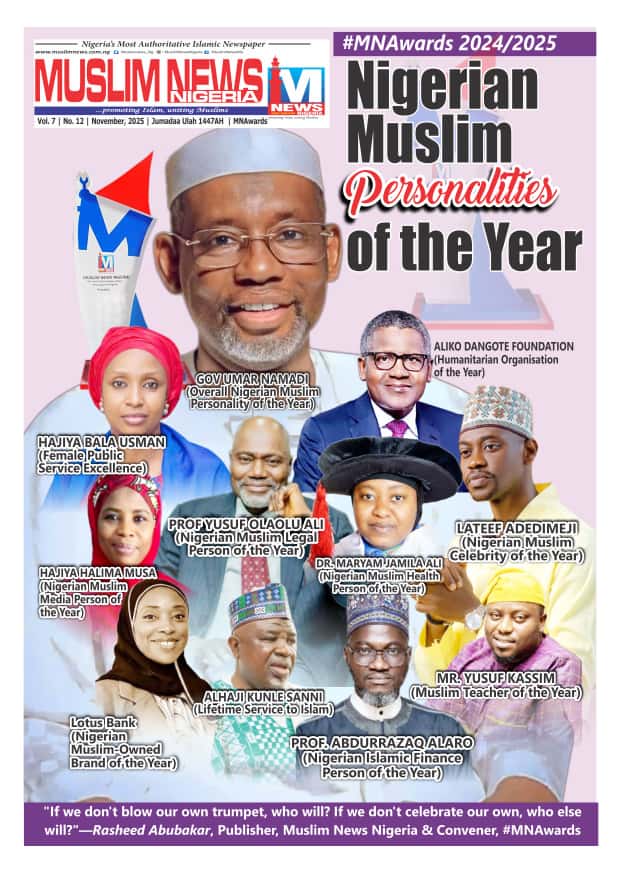
Nigerian Muslim Personalities of the Year 2024/2025
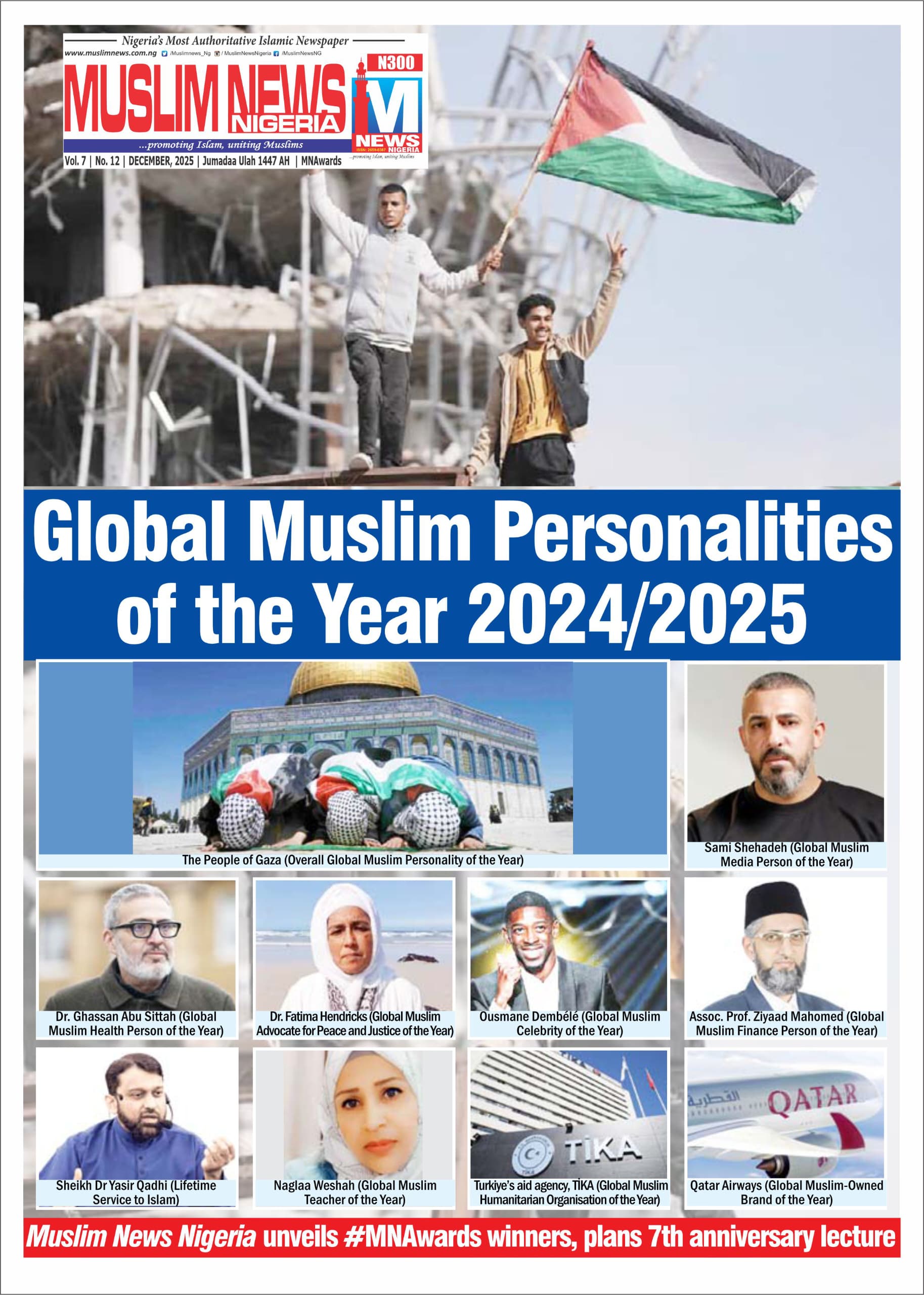
Global Muslim Personalities of the Year 2024/2025



Discover more from Muslim News Nigeria
Subscribe to get the latest posts sent to your email.