

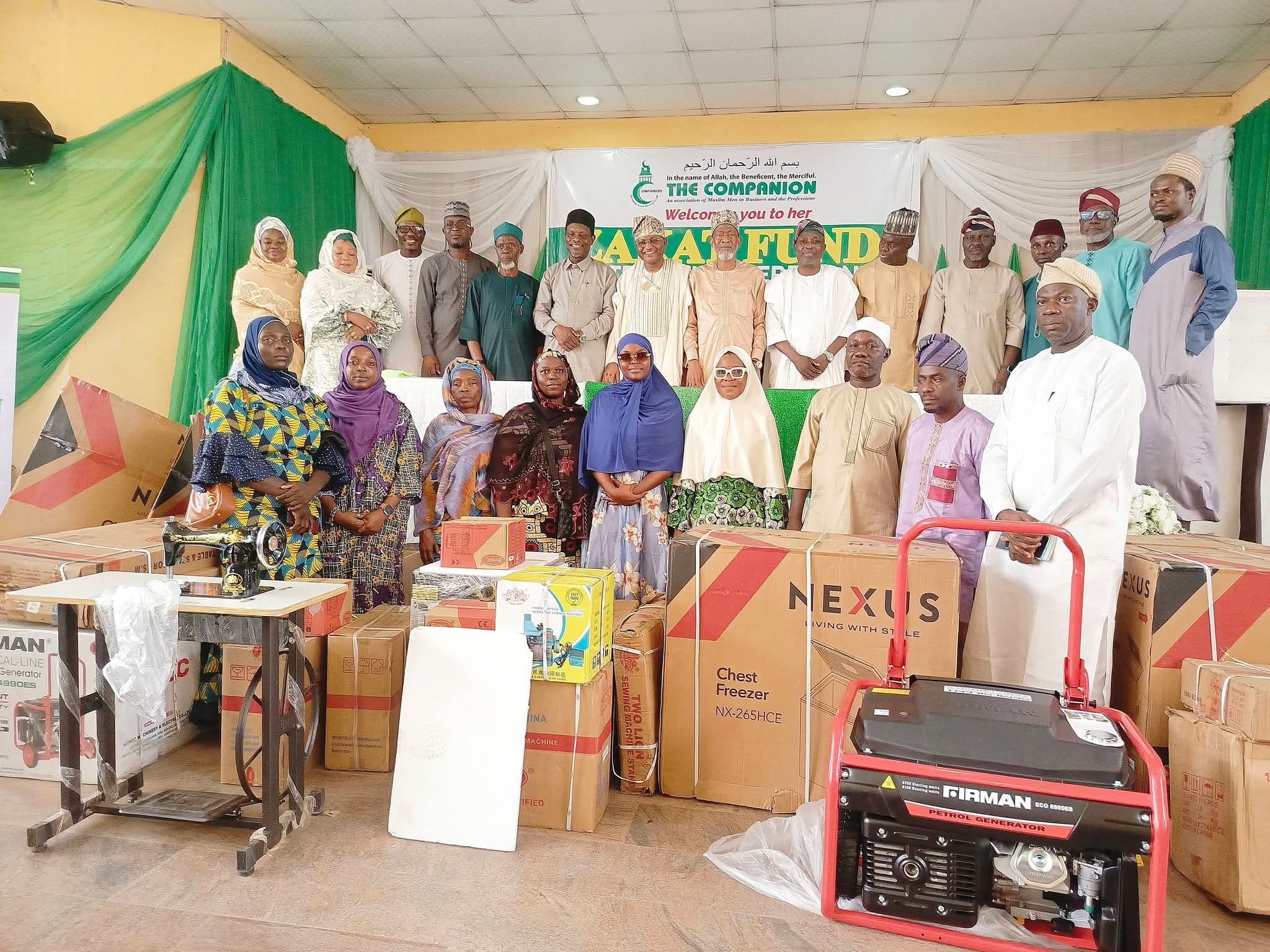
… as The Companion distributes N133m in Lagos, FCT, four other States
Muslim scholars and business executives have called for stronger government involvement in poverty alleviation, saying zakat and other welfare interventions can achieve greater impact when supported by structured public policies.
The call was made on Sunday at the 13th Annual Zakat Distribution exercise organised by The Companion, an association of Muslim men in business and the professions, through its Zakat and Sadaqat Foundation committee.
Muslim News gathered that the foundation recorded a total zakat collection of N133 million at the national level, with N47 million allocated to its Lagos District for local distribution.
No fewer than 260 beneficiaries in Lagos received support and interventions ranging from scholarships and business expansion grants to trade equipment, healthcare support, upkeep assistance and production equipment aimed at promoting long-term economic self-reliance.
Some beneficiaries also went home with items such as deep freezers, sewing machines, generators, food processing tools, among others.

Speaking at the event, the guest speaker, Director of the Arabic Village and Founder of the Love and Mercy Foundation, Imam Imran Adeniyi Rufai, said zakat institutions can play a more effective role in reducing poverty when integrated into broader public welfare systems.
Lessons from Umar ibn Abdul Aziz on effective welfare governance
Drawing lessons from the era of Umar ibn Abdul Aziz, the Umayyad Caliph often cited in Islamic history for social justice and equitable wealth distribution, Imam Rufai said poverty reduction is achievable when leadership is intentional, accountable and committed to structured welfare systems.
He recalled that during the Caliph’s administration, zakat distribution was reportedly so effective that officials struggled to find eligible recipients, describing it as a benchmark for effective governance and social welfare.

However, he said the present reality is different despite the existence of zakat institutions and sadaqat foundations in many Muslim societies.
“While efforts exist in many places today, they are not sufficiently coordinated or effective in achieving long-term impact,” he said.
Advocates integrated welfare system for sustainable poverty reduction
Imam Rufai explained that zakat affects the giver, the recipient and society at large, noting that while it purifies wealth and strengthens faith for donors, it is meant to provide sustainable empowerment for beneficiaries and promote social balance in society.
He attributed current challenges to weak government involvement in poverty alleviation, arguing that many states have left welfare responsibilities largely to private initiatives and religious organisations.
The Muslim scholar called for stronger synergy between government institutions, zakat organisations and individuals, noting that some countries have successfully integrated zakat administration into public welfare structures for improved efficiency.
He also stressed the need for structured monitoring and follow-up mechanisms to ensure that beneficiaries are guided towards long-term economic independence rather than receiving temporary relief.
Zakat designed for empowerment, not temporary relief, says Amir
Also speaking, the National Amir of The Companion, Imam Nojeem Jimoh, said although historical examples of poverty eradication may be difficult to replicate in modern societies, zakat institutions remain critical in making meaningful interventions in education, business support and social welfare.

“We may not realistically expect the level of poverty eradication reported in historical accounts, but we can continue to make meaningful impact within available resources and systems,” he said.
Imam Jimoh also highlighted the success stories recorded by the foundation over the past 13 years, recalling the case of a PhD candidate whose studies were revived with a N500,000 intervention from the zakat fund and another doctoral candidate supported with N700,000 this year.
He said such testimonies continue to motivate the leadership of the foundation to improve and expand its annual interventions.
Zakat designed for empowerment, not temporary relief – Amir Baruwa
Lagos District Amir of The Companion, Alhaji Abdulkabeer Baruwa, said the essence of zakat is to move beneficiaries from dependency to empowerment and ultimately to productive participation in society.
He explained that the annual intervention was designed not just to provide temporary relief, but to equip beneficiaries with the capacity to stand on their own and contribute meaningfully to economic development.

Alhaji Baruwa also confirmed that the current edition recorded improved participation compared to the previous year, saying the foundation witnessed increased confidence from donors, which translated into higher collections and wider reach.
He urged zakat committees to intensify public sensitisation so that more eligible Muslims can fulfil their obligation, while also expanding the beneficiary base for greater impact.
For beneficiaries, he encouraged prudent use of the support received, stressing that the objective is to ensure they eventually become contributors to the system rather than perpetual dependents.
Zakat key to social justice and sustainable empowerment: Former Amir
Former National Amir of The Companion and Managing Director of CRC Credit Bureau Limited, Dr Ahmed Tunde Popoola, also described zakat as a divine obligation that promotes social justice and economic equity.
According to him, the foundation’s interventions reflect the principle of empowering beneficiaries with tools for long-term independence rather than short-term handouts.

He further urged wealthy Muslims to consistently fulfil their zakat obligations, noting that increased participation would expand the reach and impact of empowerment initiatives.
Beneficiaries laud zakat intervention, say support boosted businesses
Meanwhile, beneficiaries expressed gratitude for the intervention, describing it as timely support that strengthened their businesses and livelihoods.

One of the beneficiaries, Hajia Mubarakah Tiamiyu, creative director of MB Aparel, said the support came at a critical moment for her business, noting that it provided relief that would have otherwise strained her personal capital.
She described the intervention as a significant boost to her operations and prayed for continued blessings upon the organisers and donors.



Sponsored

Nigerian Muslim Personalities of the Year 2024/2025

Global Muslim Personalities of the Year 2024/2025




Discover more from Muslim News Nigeria
Subscribe to get the latest posts sent to your email.