

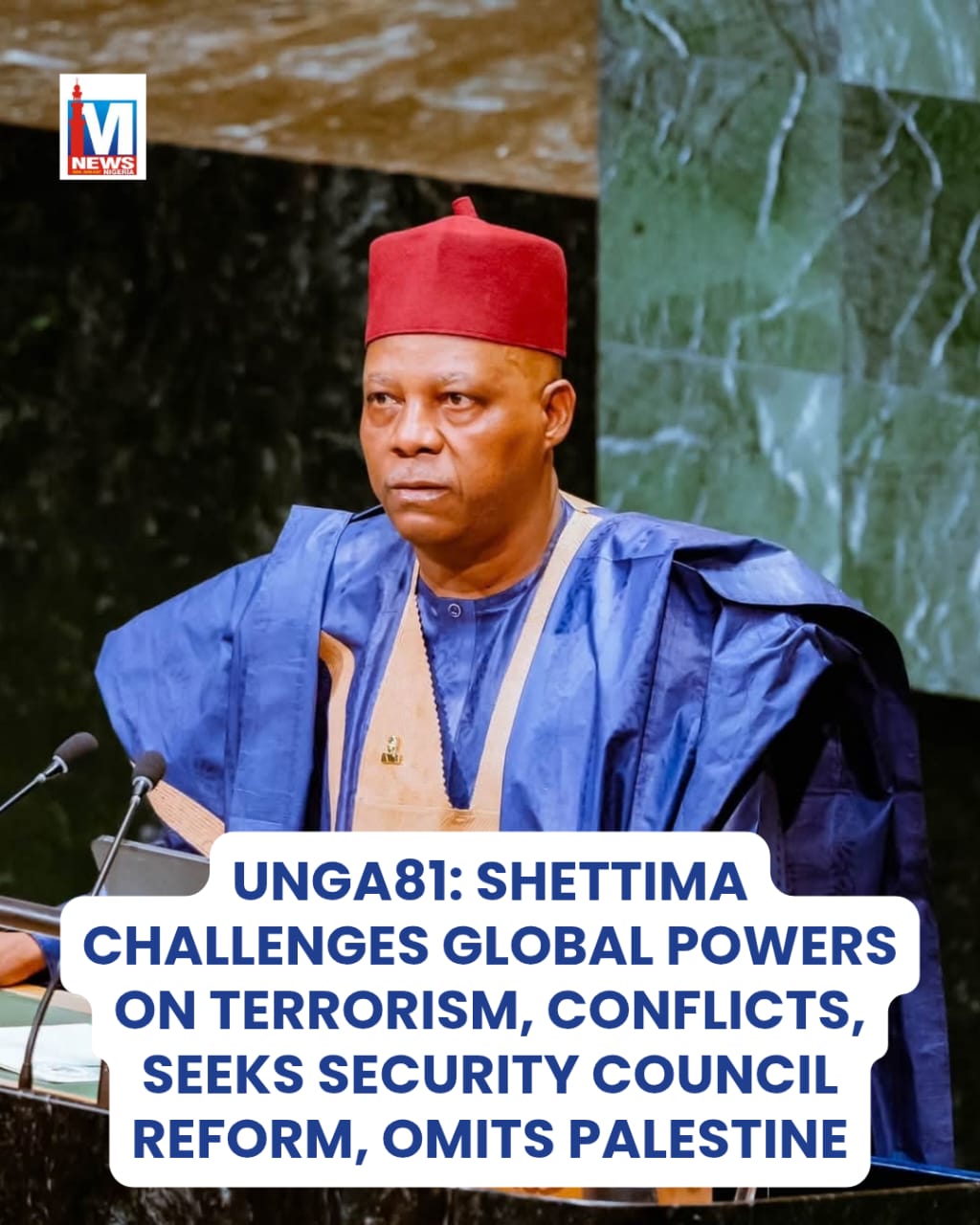
* Demands permanent African seats, urges stronger action against Sahel insecurity
Vice President Kashim Shettima has used Nigeria’s address to the 81st United Nations General Assembly to highlight terrorism, organised crime, cyberattacks, illicit finance and insecurity, while Palestine was not mentioned in the national statement delivered on behalf of President Bola Ahmed Tinubu.
Shettima delivered the statement at the General Debate of the 81st UNGA in New York on Thursday, September 24, 2026, where he represented Tinubu.
The 24-point address, delivered under the theme, “Restoring Trust, Managing Transformation: A United Nations That Delivers for All,” focused on reform of the UN Security Council, Africa’s representation in global institutions, climate action, artificial intelligence, development financing, the African Continental Free Trade Area, terrorism and international conflicts.
Muslim News, however, gathered that the statement contained no direct reference to Palestine, Gaza, Israel or the Israeli-Palestinian conflict.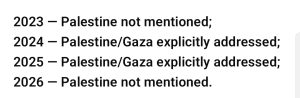
Nigeria seeks Security Council reform
A major component of the address was Nigeria’s renewed demand for reform of the UN Security Council, with Shettima arguing that the Council’s current structure no longer reflected the realities of the contemporary world.
He said the reform of the United Nations must begin with the reconstitution of the Security Council, arguing that “the world of 2026 cannot remain captive to the distribution of power in 1945.”
Shettima said Africa could no longer continue to feature prominently on the Council’s agenda while remaining absent from its permanent membership.
Nigeria consequently demanded at least two permanent seats for Africa, with the full rights and responsibilities of permanent membership, including veto power for as long as the veto exists.
The country also called for five non-permanent African seats, in line with the continent’s longstanding position on Security Council reform.
Shettima also highlighted Nigeria’s contributions to international peacekeeping, citing the country’s involvement in Liberia, Sierra Leone, Darfur, Mali and The Gambia.
He said Nigeria was prepared to assume greater responsibility in international affairs, citing its contributions to peace and security through ECOWAS, the African Union and Gulf of Guinea partnerships.
Security takes centre stage
In one of the strongest sections of the address, Shettima linked Nigeria’s experience with terrorism to the wider challenge of transnational insecurity.
“No nation, however formidable its defences, can secure itself completely against dangers sustained beyond its borders,” he said.
He identified terrorism, organised crime, cyberattacks and illicit finance as threats that exploit gaps between national responses and are strengthened by divisions that undermine collective action.
Shettima specifically cited Nigeria’s prolonged fight against Boko Haram, ISWAP and other armed groups, saying the experience had demonstrated that military victories alone were insufficient to establish lasting peace.
“Nigeria’s prolonged struggle against Boko Haram, ISWAP and other armed groups has taught us that military victories require enduring foundations in education, economic opportunity, accountable governance and communities whose rights and dignity are protected,” he said.
He added that development could not take root where violence repeatedly destroyed livelihoods, while peace could not endure where injustice and exclusion continued to create conditions for violent groups to recruit.
The Vice President subsequently called for greater international cooperation in intelligence sharing, institutional capacity building, disrupting the financing of violence and preventing weapons from crossing national borders.
Sahel insecurity and regional cooperation
Shettima also drew attention to the security situation in the Sahel, arguing that insecurity in one country could affect neighbouring states through displacement, disrupted commerce and weakened democratic governance.
“As a founding member of ECOWAS, Nigeria upholds regional solidarity and African leadership in resolving these challenges, reinforced by principled international partnerships,” he said.
He maintained that no country could claim lasting security while forces capable of destabilising it continued to find sanctuary, resources and recruits elsewhere.
Palestine absent from 2026 statement
The absence of Palestine is notable against the background of Nigeria’s previous UNGA statements under the Tinubu administration.
Tinubu’s first UNGA address in 2023, which contained 46 numbered points, did not mention Palestine, Gaza, Israel or the Israeli-Palestinian conflict.
The position changed in 2024 when Shettima, representing Tinubu at the 79th UNGA, made an explicit appeal for Palestinian independence. During that address, he said Palestinians deserved independence and territories recognised by the UN and international law, while reaffirming Nigeria’s support for a two-state solution.
Palestine was also directly addressed in the 2025 statement delivered by Shettima on Tinubu’s behalf. The statement referred to violence against civilians in Gaza and said Nigeria supported a two-state solution as the path to lasting peace for Palestinians.
Against that record, the 2026 statement represents a return to the position seen in Tinubu’s first UNGA address in 2023.
Sponsored

Nigerian Muslim Personalities of the Year 2024/2025
Global Muslim Personalities of the Year 2024/2025




Discover more from Muslim News Nigeria
Subscribe to get the latest posts sent to your email.
Not surprising. Nigeria has full diplomatic relations with Tel Aviv. Just sympathise with the Palestinian.