

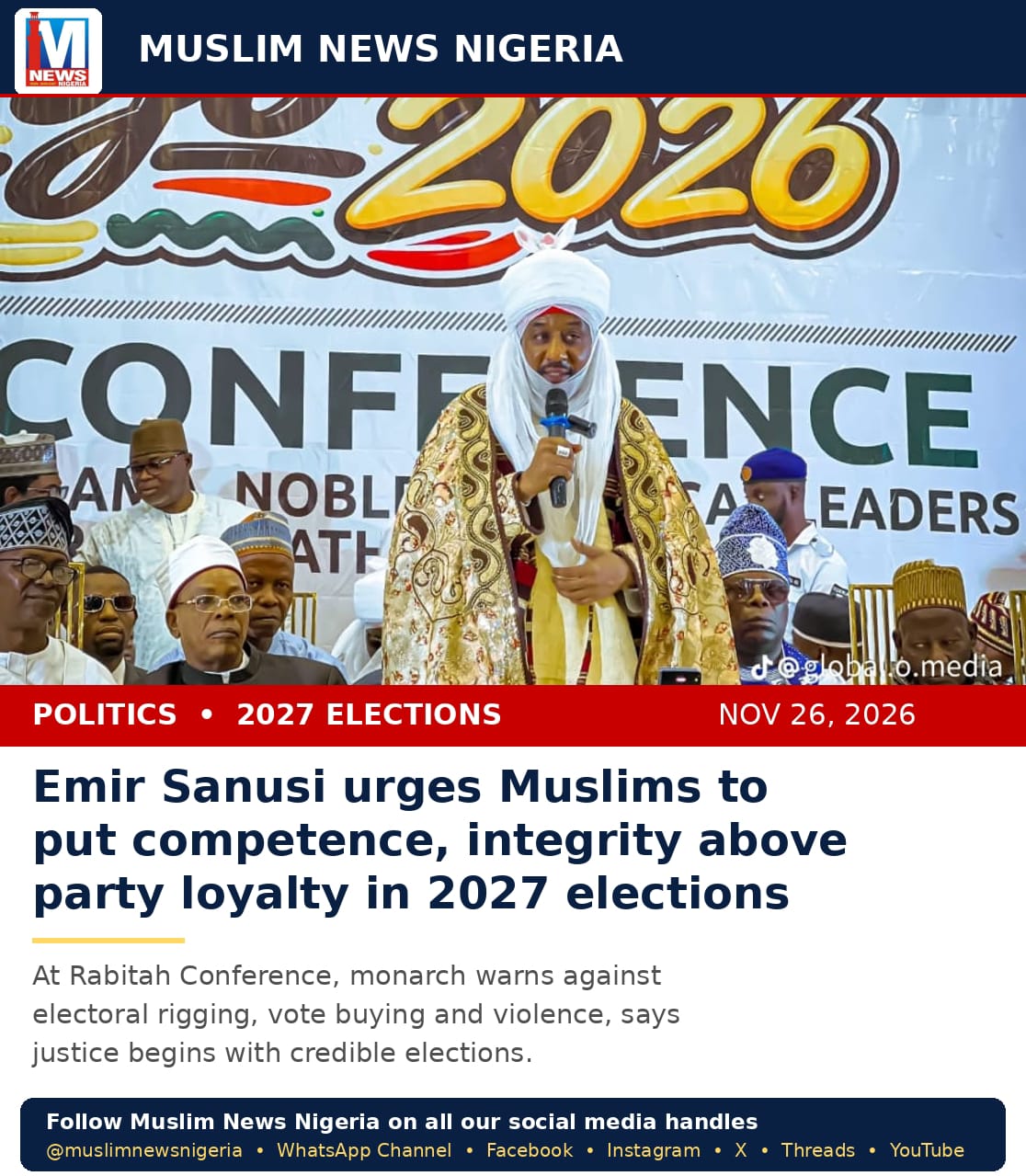
… At Rabitah Conference, monarch warns against electoral rigging, vote buying and violence, says justice begins with credible elections
The Emir of Kano, Muhammadu Sanusi II, has urged Nigerian Muslims to prioritise competence, integrity and accountability when choosing political leaders, warning against voting based on party loyalty, religious sentiments or immediate material benefits ahead of the 2027 general elections.
He also cautioned politicians against electoral malpractice, including vote buying, rigging and violence, saying leaders who emerge through unjust electoral processes cannot be expected to deliver justice to the people.
Emir Sanusi gave the advice on Sunday, November 15, the second day of the 2026 Rabitah Conference, held at the Jogor Centre, Oke-Ado, Ibadan, Oyo State.
Muslim News gathered that the three-day conference, held from November 14 to 16, marked the 62nd anniversary of the League of Imams and Alfas in Yorubaland, Edo and Delta states.
Delivering the keynote address on the theme, “The Responsibilities of Politicians and Electorate During and After Electoral Process,” the monarch described politics and governance as essential to establishing justice, maintaining social order and ensuring the continuity of society.
Sanusi: Justice begins with electoral process
Quoting a verse from Surah Al-Hadid (57:25) of the Qur’an, the Emir explained that government and political authority were necessary for establishing justice in society, noting that religious scholars could preach righteousness but needed effective governance to translate justice into reality.
He cited the interpretation of some scholars of Islamic political thought, who regard iron (Al-Hadid) mentioned in the verse as a metaphor for government and political authority.
According to him, government possesses the authority and strength to check injustice while also providing benefits to humanity.
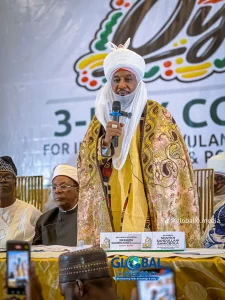
“The whole purpose is Liyaquman-nasu bil-qist (so that people may uphold justice),” he said.
Addressing politicians, Emir Sanusi maintained that justice must begin with the electoral process, warning that anyone who rigged elections, stole votes, deployed violence or bribed judges to secure political office could not be expected to govern justly.
“You cannot build something on nothing. You cannot rig elections. You cannot steal votes. You cannot use violence. You cannot bribe judges and get yourself into office and expect that after getting there, you will do justice,” he said.
He urged political actors to respect the Constitution and electoral laws enacted by the National Assembly, arguing that credible, peaceful and transparent elections would reduce electoral disputes, violence and prolonged court cases.
“Let us at least respect the laws that we have made for ourselves. Let us be fair to ourselves,” the Emir added.
Voters warned against bags of rice, monetary inducements
Turning to the electorate, Sanusi urged Nigerians to recognise the long-term implications of their votes, cautioning against exchanging their political choices for money, food items and other temporary benefits.
He explained that while a bag of rice distributed during an election could be consumed within weeks, the consequences of electing an unsuitable leader could affect citizens throughout a four-year tenure.
“That bag of rice is finished in a few weeks; for the next four years, you are hungry. The money that you are given, you spend in one week; for the next four years, you are looking for money,” he said.
Quoting Qur’an 28:26, which recounts the advice of one of Prophet Musa’s companions, the Emir said the two major qualities required in anyone entrusted with public responsibility were strength and trustworthiness.
He explained that strength, in this context, referred to the competence, capacity and expertise required to perform a particular responsibility, while trustworthiness encompassed integrity, piety and good character.
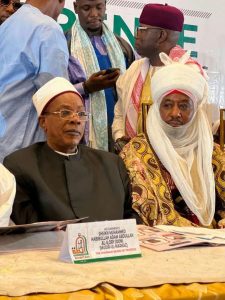
Sanusi noted that the relevant qualifications varied according to the nature of the assignment, explaining that a finance minister should possess financial expertise, while someone entrusted with religious responsibilities should have the necessary Islamic knowledge.
He urged voters to examine the ability of individuals seeking elective positions, including governors, presidents and legislators, rather than relying solely on their public display of religious identity.
“Is he strong enough? Is he competent? Is he capable? That is the first thing. And the second: is he trustworthy? Is he God-fearing? Is he virtuous?” he asked.
Citing the position attributed to renowned Islamic scholar Imam Ahmad ibn Hanbal on appointments to public responsibilities, Sanusi explained that where competence and personal piety did not coexist in one candidate, priority should be given to the person whose competence would benefit society.
He argued that an incompetent but personally religious leader could cause greater harm to the wider community through poor performance, even if the individual’s religious devotion benefited him personally.
Don’t vote based on religious appearance, Sanusi tells Muslims
The Kano monarch also cautioned Muslims against being swayed by politicians who adopt religious appearances during election campaigns to win public support.
He observed that some political aspirants grow beards, wear jalabiyas or turbans, recite Qur’anic verses and make promises to build mosques during election periods, but may lack the capacity to deliver effective governance.
He warned that electing incompetent leaders could negatively affect education, healthcare, infrastructure and the economy, irrespective of their outward religious disposition.
“If they are incompetent, your education will suffer, your healthcare will suffer, your infrastructure will suffer, your economy will suffer,” he said.
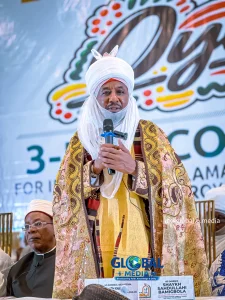
Emir Sanusi urged Muslim voters to be discerning and collectively examine the qualifications, character and records of candidates before making their electoral choices.
He also advised Nigerians against excessive attachment to political parties, describing them largely as platforms through which politicians seek elective offices.
According to him, politicians frequently move between parties in pursuit of political opportunities, making it necessary for voters to focus on individual candidates rather than party identities.
Using an illustration from his encounter with a politician in Kano, the Emir recalled how the individual, after failing to secure a party ticket, moved to another political platform to pursue his ambition of becoming a member of the House of Representatives.
The politician had explained his decision by comparing party membership to travelling to Abuja, saying that if he could not secure a seat on one airline, he would simply use another because his destination remained the same.
Emir Sanusi said the experience demonstrated why voters should not become unnecessarily attached to political parties when politicians themselves could change platforms for personal political interests.
“The political parties in Nigeria are just vehicles to get people to office,” he said.
He urged voters to assess candidates individually, noting that the most suitable candidate for governor in a state might belong to a different political party from the person best suited to represent the constituency in the House of Representatives.
“My advice is that we should study the individuals who are presenting themselves, and we should choose the best,” he said.
Emir highlights protection of religious freedom
Speaking on the responsibilities of government, Emir Sanusi also drew attention to the objectives of Islamic law, known as Maqasid al-Shari’ah, explaining that the Shari’ah was fundamentally established to promote human welfare and prevent harm.
He cited the Islamic principles of Jalb al-Masalih (bringing benefits) and Daf’ al-Mafasid (preventing harm), alongside the classification of human interests into necessities, needs and complementary benefits.
The Emir identified the protection of religion (Hifz al-Din) as one of the five essential objectives of Islamic law, stressing that Muslims should consider whether candidates and political leaders would safeguard their freedom to practise Islam without discrimination or persecution.
He clarified that the responsibility should not be assessed solely on the basis of whether a candidate was Muslim or non-Muslim, but on the individual’s willingness to respect religious rights and freedoms.
“He may be a Muslim, he may be a non-Muslim, I don’t know, but he must be somebody who is ready to respect our rights and our freedom to practise our deen freely and peacefully and without persecution,” Emir Sanusi said.
He urged Muslims to take an informed and responsible approach to political participation, emphasising the need to elect leaders who can protect citizens’ rights, promote justice and advance the collective welfare of society.
Sponsored
Sponsored

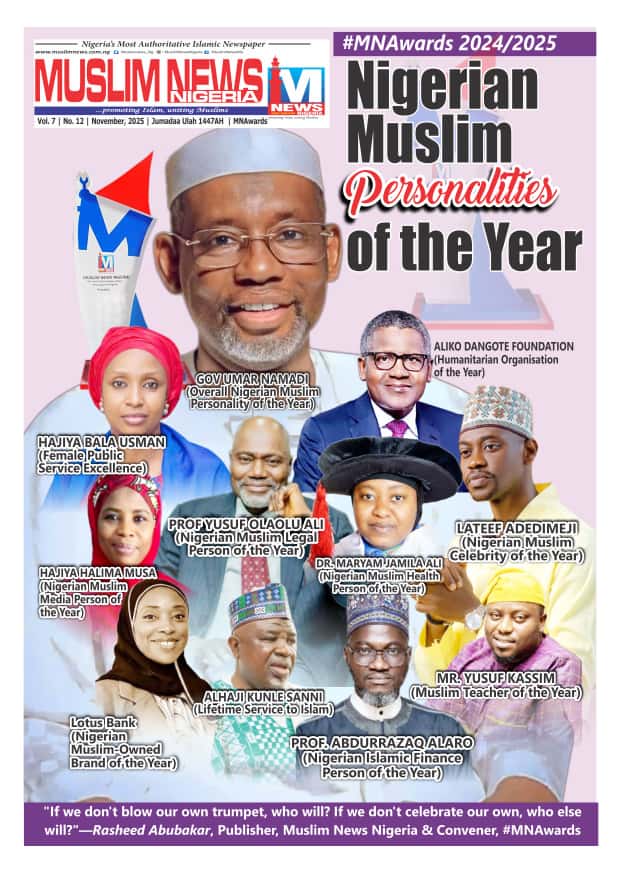
Nigerian Muslim Personalities of the Year 2024/2025
Global Muslim Personalities of the Year 2024/2025




Discover more from Muslim News Nigeria
Subscribe to get the latest posts sent to your email.