

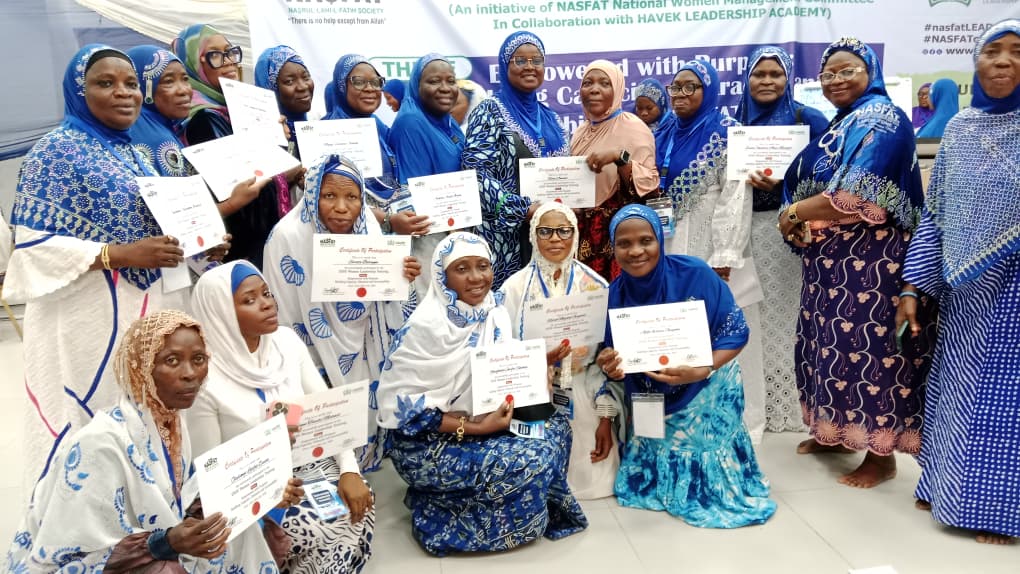
* Urges leaders to uphold sincerity, self purification and transparency in service to Allah
The Chief Missioner of the Nasrul-Lahi-l-Fatih Society, NASFAT, Imam Abdul Azeez Morufu Onike, has called on Muslim women to embrace leadership founded on sincerity, self purification and accountability, saying meaningful leadership begins with serving Allah and humanity with the right intention.
He made the call at the National Women Management Committee leadership training organised by NASFAT under the theme, “Building Capacity, Upholding Amanah, and Thriving in the Digital Age.”
Muslim News gathered that the four-day programme commenced on Thursday, July 23, at the NASFAT Islamic Centre, Asese, along the Lagos Ibadan Expressway in Mowe, Ogun State, and concluded on Sunday, July 26.
It brought together women leaders from across the Society for intensive sessions on spiritual development, leadership, financial management and organisational excellence.
Leadership begins with purpose
Presenting a paper titled “Empowered with Purpose: Niyyah and Tazkiyah, The Foundation of Transformational Muslim Women Leadership,” Imam Onike said leadership is not defined by titles or authority but by the ability to inspire others while remaining conscious of one’s accountability before Allah.
“Leadership is not the ability to command people. Leadership is the ability to positively influence people toward a shared purpose while remaining accountable to Allah,” he said.
According to him, genuine leaders take responsibility instead of making excuses and are always prepared to offer solutions rather than waiting for others to act.
Drawing inspiration from Prophet Yusuf, the respected Muslim scholar noted that the Prophet accepted public responsibility because he possessed the competence and integrity required to safeguard the interests of society.
“Sometimes, refusing to lead when you are the most qualified is not humility. It is abandoning an amanah,” he said.
Purify the heart before leading others
The NASFAT Chief Missioner reminded participants that the value of every action depends on intention, citing the Prophetic tradition that actions are judged by intentions.

He encouraged the women to regularly examine the reasons behind their service by asking themselves whether they would still volunteer if no one recognised or praised their efforts.
“If the answer is Allah, you have already begun succeeding,” he said.
He further stressed that effective leadership cannot flourish without tazkiyah, or purification of the soul.
According to him, unchecked ego, jealousy, rivalry and abuse of authority are products of impure hearts, while sincerity, patience, compassion, justice and humility are the fruits of spiritual refinement.
“Before building NASFAT, build yourself. Before changing your family, change yourself. Before correcting others, purify yourself,” he advised.
Using the illustration of a tree, Imam Onike explained that visible achievements are sustained by invisible spiritual qualities.
“The fruits everyone sees are speeches, projects, achievements and awards. But those fruits depend on invisible roots such as niyyah, taqwa, tazkiyah and sincerity. If the roots are rotten, eventually the fruits will disappear.”

He also highlighted the outstanding contributions of Muslim women throughout Islamic history, including Khadijah, Aishah, Umm Salamah and Ash Shifa bint Abdullah, urging participants to emulate their examples of scholarship, entrepreneurship, wisdom and public service.
The renowned Muslim scholar encouraged Muslim women to continue pursuing excellence in education, technology, healthcare, business and community development while remaining firmly rooted in Islamic values.
He also identified emotional intelligence, consultation, delegation, mentorship and careful verification of information as essential qualities of successful leaders.
Financial stewardship is a sacred trust
In another presentation titled “Amanah in Action: Financial Responsibility for NASFAT Women Affairs Programmes,” Alhaji Amao Jamia Akanbi, a stakeholder in the NASFAT National Finance Committee, urged women leaders to handle organisational resources with utmost honesty and accountability.
He described capacity, character and accountability as the three pillars of responsible leadership, explaining that financial integrity reflects the true character of every leader.
“Money has a way of revealing character. It is easy to be accountable when there is nothing to account for. But when resources are placed in our hands, contributions, donations and programme funds, that is when our integrity is tested,” he said.

Alhaji Akanbi explained that amanah represents every trust entrusted to believers by Allah, including leadership positions, time, knowledge and financial resources.
He urged participants to avoid waste, plan expenditures carefully, seek necessary approvals before spending and ensure every financial decision advances the objectives of the organisation.
“Financial excellence is not measured by how much money we spend. It is measured by the quality of the decisions we make,” he said.
Transparency strengthens confidence
Akanbi advised women leaders to maintain accurate records of all financial transactions, separate personal finances from organisational funds and render prompt financial reports supported with proper documentation.
He also encouraged leaders to compare quotations before procurement, maintain quality while seeking value for money and avoid allowing personal relationships to influence financial decisions.
According to him, transparent financial management strengthens members’ confidence and encourages greater support for organisational activities.
“People may not remember every programme we organise, but they will remember whether they could trust those who managed the resources,” he said.
He concluded by reminding participants that leadership is a trust rather than a privilege.
“As leaders, we are not owners of these resources. We are custodians. One day, every trust will be accounted for before Allah.”
The training featured practical sessions on leadership development, financial accountability, digital literacy, organisational governance and personal development as part of NASFAT’s efforts to equip women leaders with the knowledge, values and skills required for effective service within the Society and the wider community.
READ THE FIRST PART REPORT HERE
NASFAT concludes women leadership training, calls for service driven leadership
Sponsored

Nigerian Muslim Personalities of the Year 2024/2025

Global Muslim Personalities of the Year 2024/2025




Discover more from Muslim News Nigeria
Subscribe to get the latest posts sent to your email.
The article presents a compelling account of leadership rooted in sincerity, spiritual consciousness and accountability, emphasizing that true leadership is defined not by authority but by purpose, integrity and service, while also highlighting the importance of financial responsibility, transparency and amanah as essential pillars for effective and trustworthy leadership.