

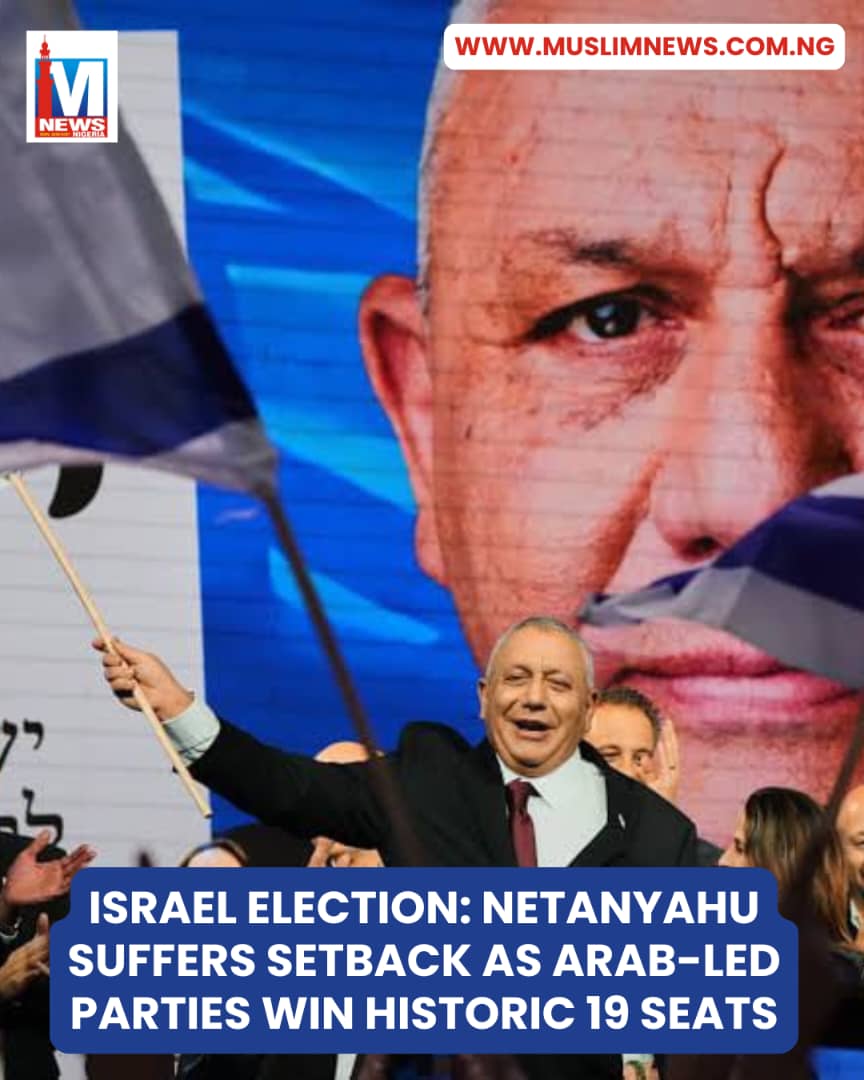
Can Arab-led parties determine who governs Israel after Prime Minister Benjamin Netanyahu’s bloc fell short of a parliamentary majority in the October 27 general election? And what could their emergence as potential kingmakers mean for Palestinians in the occupied Palestinian territories, particularly Gaza and the West Bank? Muslim News reports…
Israel’s October 27, 2026 general election has left the country facing another period of political uncertainty, with no political bloc securing the 61 seats required to form a government in the 120-member Knesset.
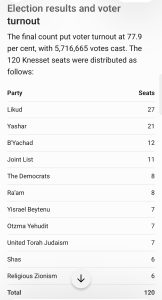
Results released by the Central Elections Committee after the vote count was completed on Friday, October 30, showed that Netanyahu’s bloc secured 53 seats, while the opposition bloc led by former military chief Gadi Eisenkot won 48.
Muslim News gathered that the Arab-led parties won a combined 19 seats, giving them a potentially decisive role in determining who forms the next government.
Although Likud emerged as the largest party with 27 seats, Netanyahu suffered an electoral setback amid mounting criticism over Israel’s genocidal war on Gaza.
However, analysts warn that his possible removal may not fundamentally change Israel’s policies towards Palestinians, as opposition leader Gadi Eisenkot also opposes Palestinian statehood and maintains hawkish positions on Gaza.
Arab-led parties record historic gains
The election produced a significant breakthrough for parties representing Palestinian citizens of Israel, who secured 19 seats through the Joint List and Ra’am.
The Joint List won 11 seats, while Ra’am, led by Mansour Abbas, secured eight. Their combined representation gives Arab political leaders greater potential influence in the formation of the next government, although the two parties have different political approaches and are not necessarily expected to act as a single bloc.
The gains are particularly significant because Palestinian citizens of Israel, who make up about one-fifth of the country’s population of approximately 10 million, have long faced political and social challenges, including discrimination, inadequate infrastructure, housing difficulties and rising crime.
The 19 lawmakers represent Palestinian citizens of Israel, who hold Israeli citizenship and participate in the country’s elections. They do not represent the approximately 5.3 million Palestinians living in the occupied West Bank and Gaza Strip, who are excluded from Israeli parliamentary elections and continue to face military occupation, illegal settlement expansion in the West Bank and devastating Israeli bombardment in Gaza.
How Palestinians became citizens of Israel
Following the 1948 Arab-Israeli war and the bloody establishment of Israel on Palestinian land, hundreds of thousands of Palestinians fled or were expelled from their homes in an event known as An-Nakba (the Catastrophe).
Those who remained within the territory that became Israel, estimated at about 150,000, became the Palestinian Arab minority in the new state.
Under Israel’s 1952 Nationality Law, many of them and their descendants acquired Israeli citizenship. This made them eligible to vote and stand for parliamentary elections.
Palestinian Arab citizens have participated in Israeli elections since 1949, when Arab representatives first entered the Knesset.
Today, they make up roughly one-fifth of Israel’s population. Unlike Palestinians in the occupied West Bank and Gaza, they hold Israeli citizenship and can elect representatives to the 120-member parliament.
Eisenkot faces coalition dilemma
The arithmetic suggests that an opposition government could potentially reach the required majority if it secured the support of the 19 lawmakers from the Arab-led parties. However, forming such an alliance will not be straightforward.
Eisenkot’s opposition camp includes parties whose leaders have expressed reservations about relying on Arab parties to form a government. The former military chief has also indicated that he wants a government based on Zionist parties, making cooperation with the Arab-led parties politically complicated.
Netanyahu has strongly opposed such an arrangement. During the election campaign, he described the possibility of forming a government with Arab parties as unacceptable.
However, Yair Golan, leader of The Democrats, has shown greater openness to cooperation. He met Ra’am leader Mansour Abbas after the election and urged opposition leaders not to waste the opportunity to bring about political change.
“This is a time for action. Our responsibility is not to miss the opportunity for change and the salvation of Israel,” Golan said.
Other opposition figures remain opposed to depending on Arab lawmakers. Yisrael Beytenu leader Avigdor Lieberman reiterated his position with the slogan, “Neither Bibi nor Tibi”, referring to Netanyahu and Arab politician Ahmad Tibi.
Joint List leaders, meanwhile, have called for an equal political partnership rather than an arrangement in which Arab lawmakers are merely expected to provide parliamentary support.
Yousef Jabareen said the election offered an opportunity to challenge exclusionary politics, stressing the need for “a true and equal partnership” between Jewish and Arab citizens.
Fraud allegations spark controversy
The election has also been followed by controversy over allegations of foreign interference and irregularities involving Arab voters.
Netanyahu and his political allies raised allegations of possible foreign funding and interference, including claims involving Qatar and Türkiye. However, these allegations have not established that the election results were manipulated.
The acting director-general of Israel’s Central Elections Committee, Dean Livne, rejected claims of widespread electoral fraud, saying the voting process was conducted lawfully and that there was no evidence of systematic violations.
“The Knesset elections were conducted lawfully. The integrity of the elections at polling stations was rigorously safeguarded, and to the best of our knowledge, there is no basis for allegations of systematic violations of election integrity,” Livne said.
Ra’am leader Mansour Abbas also denied any connection to the allegations, saying his party had no involvement in the affair.
The controversy has heightened political tensions, with opposition figures accusing Netanyahu of using the allegations to undermine the legitimacy of Arab political participation.
October 7 attacks and Gaza war shape political debate
The election was Israel’s first general election since the October 7, 2023 Hamas-led attacks and the subsequent Israel’s genocidal war on Gaza.
The attacks, the failure of Israel’s security establishment to prevent them, the fate of Israeli captives and the prolonged war in Gaza have shaped the wider political debate.
Netanyahu’s opponents have criticised his government’s handling of the security crisis and called for accountability over the failures surrounding October 7.
Eisenkot has also supported the establishment of a state commission of inquiry into the attacks.
However, Netanyahu’s electoral setback does not necessarily signal a major change in Israel’s policies towards Palestinians.
Opposition parties do not share a unified position on Palestinian statehood or the future of Gaza, and a new government could maintain significant elements of existing Israeli security and military policies.
Military service dispute adds to coalition challenge
Another major issue likely to complicate government formation is the long-running dispute over military service exemptions for ultra-Orthodox Jewish men.
Eisenkot has campaigned for legislation requiring eligible citizens to undertake military, national or civil service, a position that conflicts with the demands of ultra-Orthodox parties such as Shas and United Torah Judaism.
These parties have traditionally sought to preserve exemptions for religious students and could become important players in negotiations over the next government.
The disagreement presents a challenge for both major political camps, as any coalition arrangement involving ultra-Orthodox parties would have to address the question of compulsory service.
What happens next?
Under Israel’s parliamentary system, President Isaac Herzog is expected to consult political parties before assigning a lawmaker the task of forming a government.
The chosen candidate will initially have 28 days to secure the support needed to form a government, with a possible extension. If that attempt fails, another candidate may be given an opportunity.
A further 21-day period could follow during which lawmakers may recommend an alternative candidate. Failure to form a government could eventually lead to another election.
The completed results are expected to be formally submitted to Herzog on November 4, while the new Knesset is scheduled to be sworn in on November 10. Netanyahu will remain prime minister in a caretaker capacity until a new government is formed.
The main possibilities include an opposition government supported by Arab lawmakers, a national unity government involving parties from both major camps, Netanyahu attracting lawmakers from rival parties to rebuild his majority, or another election if negotiations collapse.
What the result means for Palestinians
The election has given Palestinian citizens of Israel an opportunity to exert greater influence through their parliamentary representation. However, their electoral success does not automatically translate into improved conditions for Palestinians in the occupied territories or a change in Israel’s policies towards Gaza and the West Bank.
The central question is whether the opposition can overcome its divisions and recognise Arab lawmakers as legitimate partners in government formation.
Sponsored
Sponsored

Nigerian Muslim Personalities of the Year 2024/2025
Global Muslim Personalities of the Year 2024/2025




Discover more from Muslim News Nigeria
Subscribe to get the latest posts sent to your email.