

*:HRAI clarifies permissible hijab length as examinations begin Saturday
The Muslim Rights Concern (MURIC) has urged Nigerian law schools in Abuja, Lagos and Yenagoa to allow female Muslim students wearing hijab to sit for the final Bar examination scheduled to begin on Saturday, October 31, 2026, faulting an alleged directive barring them from entering examination halls.
The organisation said the reported directive, allegedly issued verbally by the Director General of the Nigerian Law School, would unfairly penalise innocent Muslim candidates over an incident involving a student reportedly found with an earpod during an examination.
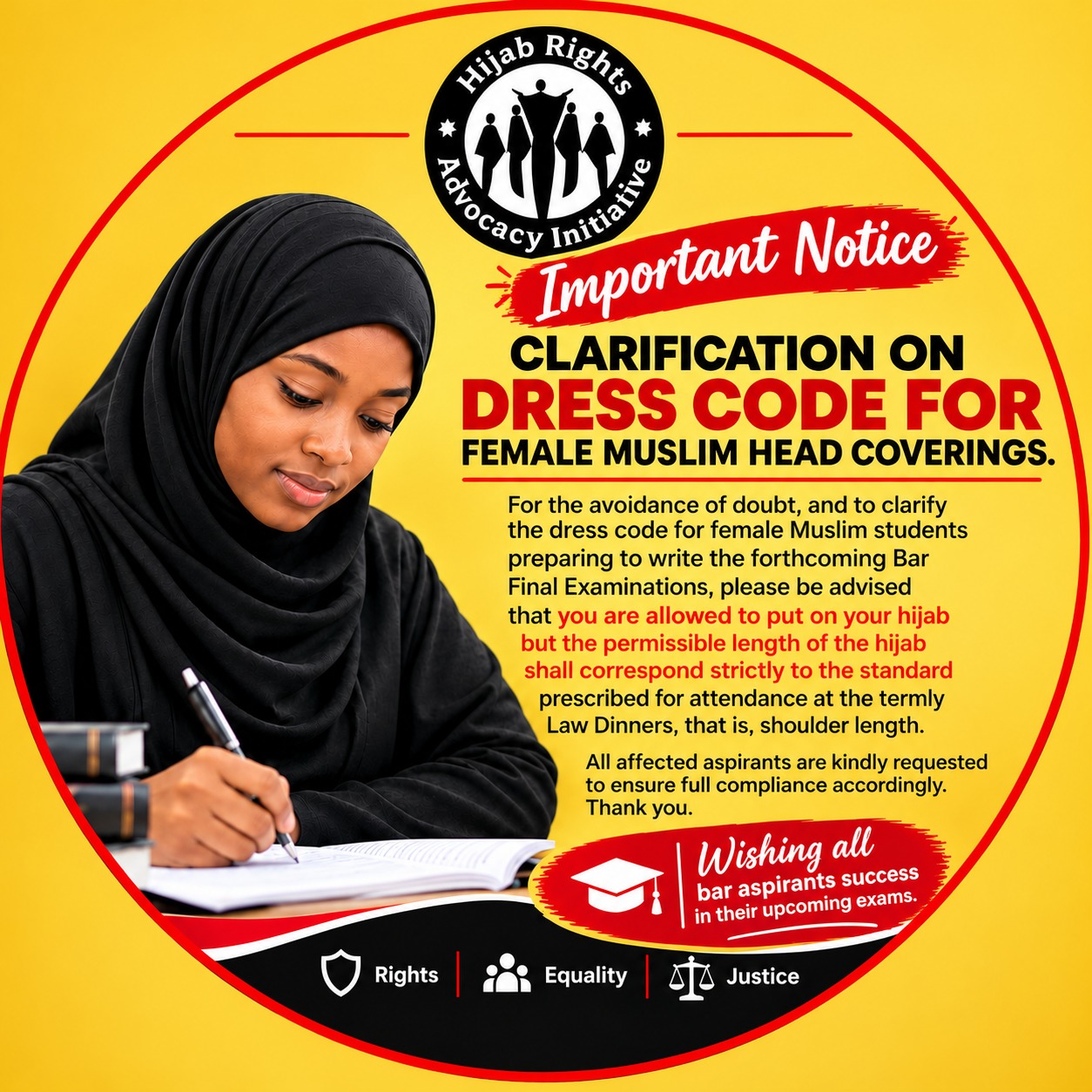
Similarly, the Hijab Rights Advocacy Initiative (HRAI) has separately issued a clarification on the dress code, stating that female Muslim candidates are permitted to wear hijab, provided its length does not extend beyond the shoulders.
In a statement issued late on Friday, October 30, MURIC’s Founder and Executive Director, Professor Ishaq Akintola, condemned the alleged blanket restriction, arguing that disciplinary measures should target individuals found guilty of misconduct rather than an entire group of students.
Bar final examinations begin October 31
The controversy comes as candidates prepare for the Nigerian Law School’s 2026 Bar Part II Final Examination, scheduled to run from Saturday, October 31, to Saturday, November 7, across the institution’s seven campuses.
The campuses are located in Abuja, Lagos, Enugu, Kano, Yola, Yenagoa and Port Harcourt.
According to the published examination timetable, the exercise will begin with the multiple-choice questions (MCQ) examination on Saturday, October 31, from 2 p.m. to 3 p.m.
The written examinations will follow from Tuesday, November 3, to Saturday, November 7.
Muslim News gathered that the schedule provides context for the urgency of MURIC’s appeal, particularly as the first examination is scheduled for Saturday, amid concerns over whether hijab-wearing candidates would be admitted to their examination halls.
The published academic calendar covers all seven campuses. However, the available information does not independently establish whether the alleged hijab directive was issued or implemented at each location.
Punish offenders, not hijab wearers — MURIC
Professor Akintola said the reported directive followed an incident in which a female Muslim student wearing hijab was allegedly found with an earpod during an examination.
According to him, the incident reportedly prompted the authorities to issue a directive preventing hijab-wearing candidates from entering examination halls.
While condemning examination malpractice, the MURIC leader said the alleged offence should be investigated and addressed through appropriate disciplinary procedures without infringing on the rights of other candidates.
“While we do not condone cheating or indiscipline in whatever guise and we recommend due punishment for the offence allegedly committed by the female Muslim student after proper investigation, we take the generalisation of the directive on hijab with a pinch of salt,” he said.
He maintained that the alleged restriction amounted to collective punishment and unfairly associated the Islamic head covering with examination misconduct.
“Hijab is therefore not the offender. It should not be banned from the examination hall. Taking it out on the other hijab wearers amounts to stereotyping,” Akintola stated.
The organisation urged the Nigerian Law School authorities to reconsider the alleged directive and ensure that all eligible candidates could participate in the examination without discrimination.
MURIC recalls Amasa Firdaus controversy
Akintola also recalled the case of Amasa Firdaus, whose refusal to remove her hijab during the 2017 Call to Bar proceedings sparked a nationwide debate over religious freedom and dress codes in the legal profession.
He said the controversy should serve as a reminder to the authorities about the implications of restricting Muslim women’s religious rights.
“In the first place, Law School should remember that it had taken this road before and it led to nowhere. The Amasa Firdaus hijab imbroglio which began in 2017 is still fresh in memory,” he said.
The MURIC director argued that preventing Muslim women from wearing hijab could violate their fundamental rights and cause psychological distress.
He called on the Law School to punish any candidate found culpable of examination misconduct while protecting the rights of other students who had committed no offence.
“No person, not even an institution, is above the law,” Akintola said.
He further argued that the alleged directive had unfairly singled out Islam and its female adherents for collective blame.
“Thirdly, the alleged directive has pigeonholed the religion of Islam by stereotyping hijab-wearing female Muslim candidates,” he stated.
Group cites collective punishment principle
To support its position, MURIC cited Article 33 of the Fourth Geneva Convention, which prohibits collective penalties against protected persons for offences they did not personally commit.
Akintola argued that the principle reinforced the organisation’s objection to penalising all hijab-wearing candidates over the alleged misconduct of one student.
He illustrated his argument with a hypothetical scenario involving candidates caught concealing examination notes on their thighs, questioning whether such an incident would justify prohibiting other students from exposing their thighs or entering the examination hall.
The MURIC leader maintained that the alleged misconduct of an individual should not be used to justify restrictions affecting an entire category of students.
“It is our humble opinion that the issues raised above are fundamental and the Law School, in its own wisdom, may want to side-step that directive. This is our very strong recommendation,” he said.
The organisation also referred to unverified reports that the Lagos campus had agreed to allow hijab-wearing candidates to write the examination, urging the authorities in Abuja and Yenagoa to adopt a similar position.
However, MURIC’s statement did not provide independent confirmation of the reported decision at the Lagos campus.
HRAI clarifies permissible hijab length
Meanwhile, the Hijab Rights Advocacy Initiative, in a notice signed by its Director, Hajia Mutiat Orolu-Balogun, clarified the dress code applicable to female Muslim candidates preparing for the Bar final examination.
The group stated that candidates were permitted to wear hijab, provided it complied with the length prescribed for attendance at the Law School’s termly Law Dinners.
“For the avoidance of doubt, and to clarify the dress code for female Muslim students preparing to write the forthcoming Bar Final Examinations, please be advised that you are allowed to put on your hijab but the permissible length of the hijab shall correspond strictly to the standard prescribed for attendance at the termly Law Dinners, that is, shoulder length,” the notice stated.
HRAI urged affected candidates to comply with the specified dress code and wished them success in the examination.
The clarification offers a more specific position on the permissible length of hijab, while MURIC’s statement focuses on the alleged blanket restriction and the rights of Muslim candidates.
Sponsored
Sponsored

Nigerian Muslim Personalities of the Year 2024/2025

Global Muslim Personalities of the Year 2024/2025




Discover more from Muslim News Nigeria
Subscribe to get the latest posts sent to your email.