

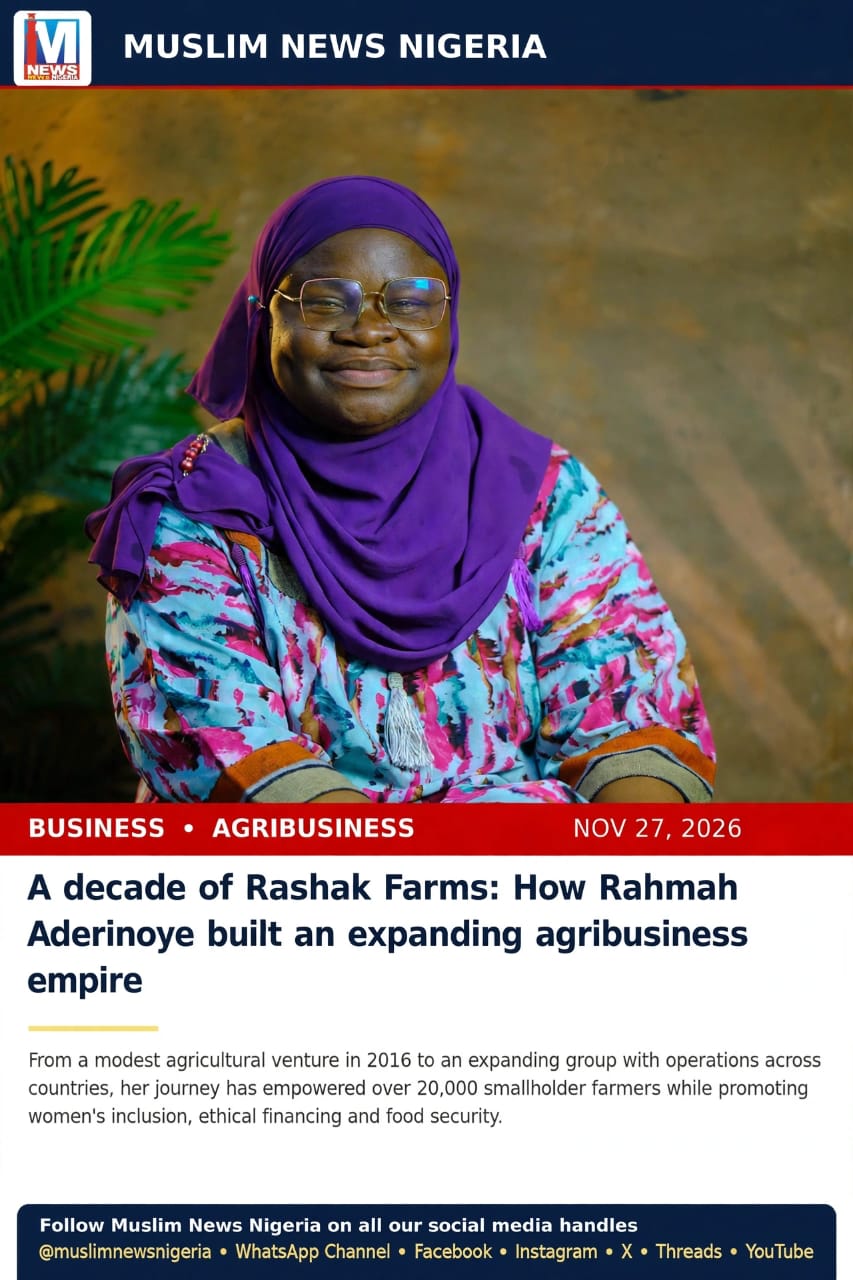
… From a modest agricultural venture in 2016 to an expanding group with operations across countries, her journey has empowered over 20,000 smallholder farmers while promoting women’s inclusion, ethical financing and food security
When Rahmah Aderinoye established Rashak Farms in 2016, she had a clear ambition: to use agriculture to address poverty and hunger in Africa. Ten years later, that vision has evolved into Rashak Group, an expanding agribusiness enterprise comprising four subsidiaries, with a workforce of over 100 and more than 20,000 smallholder farmers reached. With expansion into Zambia, Singapore, Malaysia and Qatar, the Muslim entrepreneur is marking a decade of building a business that combines commercial ambition with Islamic principles, inclusive development and a commitment to improving farmers’ livelihoods.
The journey from a fledgling agricultural venture to an expanding international business has not been without challenges. But Aderinoye, whose entrepreneurial decisions are strongly influenced by her Islamic faith, has remained committed to building an enterprise that demonstrates how business success and religious principles can coexist.
Her decision to pursue agriculture rather than health or biomedical sciences was driven by her desire to make a meaningful contribution to society.
“I would say it is my unflinching passion and desire to address poverty and hunger in Africa,” she said, explaining the motivation behind her choice.
“I know this is not a one-man’s job, but I believe investing in the agriculture sector will not only reach the very important demography of our society that produce the bulk of what we eat, I will be playing a part in improving their quality of life and contributing to a bigger cause, helping Africa to feed itself and the rest of the world.”
That conviction became the foundation of Rashak Farms, which she established in 2016 with a focus on supporting smallholder farmers through access to agricultural inputs, financing, training and markets.
Building a business through difficult beginnings
The early years were particularly demanding, with distrust, theft and financial losses threatening the survival of the young business. At the same time, Aderinoye was newly married, expecting her first child and learning to balance motherhood with the demands of building a company.
“They were tough. I learnt many lessons the hard way,” she recalled.
She described those years as some of the lowest moments of her life but acknowledged that the support of loyal customers and people who believed in the company’s vision helped it survive.
The experiences also influenced how she subsequently structured the business, strengthened its internal systems and selected partners.
“We survived, and much of what Rashak is today, from our systems to our discipline to the way we choose partners, was shaped by what we went through then,” she said.
From Rashak Farms to Rashak Group
One of the most significant milestones in Aderinoye’s ten-year journey is the transformation of Rashak Farms into Rashak Group.
The enterprise now comprises four subsidiaries, employs more than 100 people and has directly benefited over 20,000 smallholder farmers, according to the founder.
Its agricultural interventions provide farmers with access to quality inputs, extension services, training and reliable markets, helping them improve productivity and secure better returns from their harvests.
Aderinoye said the farmers reached by the company remain her greatest source of pride, particularly those in remote communities whose contributions to food production often go unnoticed.
She highlighted an all-women wheat outgrower programme in Jigawa State, which also included women living with disabilities, many of whom had never previously participated in organised agricultural production.
The initiative reflects the company’s commitment to expanding economic opportunities for groups often excluded from mainstream agricultural programmes.
Beyond Nigeria, Rashak’s expansion interests now extend to Zambia, Singapore, Malaysia and Qatar, marking an important stage in its ambition to become a significant player in Africa’s agricultural value chain and international commodity trade.
Aderinoye said the company intends to increase its reach from more than 20,000 farmers to 250,000 across Nigeria and other African countries over the next decade.
Putting women and underserved farmers at the centre
Women, young people and persons living with disabilities have remained central to Rashak’s agricultural development model.
Aderinoye believes these groups should be recognised as active economic participants rather than beneficiaries of charity.
She noted that women constitute a significant proportion of the agricultural workforce in Sub-Saharan Africa but continue to face barriers to accessing land, finance, quality inputs and markets.
“If we want to produce more food, we have to support the women who already grow so much of it. The people who keep us fed deserve to live well from their work,” she said.
The company’s interventions are therefore designed to connect farmers to the resources and opportunities required to participate meaningfully in the agricultural economy.
Building on Islamic principles
Beyond its commercial achievements, Rashak’s identity is strongly rooted in Islamic principles, particularly its commitment to interest-free financing and fair trade.
Aderinoye explained that avoiding riba was a personal religious conviction rather than a business strategy. She recalled declining an offer of conventional bank financing during the company’s early years because it involved interest.
“For me, it was never a business decision first. It was a matter of faith,” she said.
Quoting the Qur’anic injunction that Allah has permitted trade and forbidden riba, she maintained that she was unwilling to compromise her religious convictions for financial gain.
“My akhirah matters more to me than any worldly gain,” she said.
Rashak’s zero-interest input financing allows farmers to access agricultural resources and repay through arrangements tied to their harvests. Aderinoye described the model as a fair trade arrangement that shares the risks and rewards of agricultural production rather than placing farmers under the burden of interest-bearing debt.
She also said her faith influences how she recruits employees, treats farmers, conducts business and chooses partners.
“I am a product of my faith, and I am unapologetic about it. It shapes how I live, and it shapes how I lead Rashak,” she said.
Interestingly, she noted that the company’s ethical approach has attracted support from partners of different religious backgrounds, demonstrating that Sharia-compliant business practices can operate successfully within a diverse commercial environment.
Leading as a Muslim woman in a male-dominated industry
Aderinoye’s achievements have come against the backdrop of challenges associated with being a woman in an industry traditionally dominated by men.
She disclosed that some employees and vendors had questioned her authority because of her gender, while others had attempted to use religion to challenge her position as a Muslim woman in leadership.
Despite these experiences, she said she had remained focused on running the business, treating people fairly and allowing the company’s achievements to speak for themselves.
“I have never believed I have to choose between my identity and my ambition. I can be a Muslim woman, a wife, a mother and the CEO of an agribusiness group. These identities do not compete with one another,” she said.
Her experiences also inspired her book, Between Sujood & Strategy, which explores the relationship between faith, entrepreneurship, marriage, motherhood and professional ambitions.
The book draws from her personal experiences and offers insights for women who feel compelled to choose between their religious commitments, family responsibilities and professional aspirations.
She said her intention was to encourage Muslim women to pursue excellence without losing their identity or compromising their principles.
Walking away from deals that compromise her values
Aderinoye acknowledged that maintaining the company’s ethical standards has sometimes meant sacrificing attractive business opportunities.
She disclosed that Rashak had walked away from deals involving interest-based arrangements or transactions that did not align with its principles.
Although such decisions could affect a growing company’s access to capital and commercial opportunities, she said she had learnt to distinguish between what could be negotiated and what must remain non-negotiable.
“We have walked away from deals that looked very attractive on paper. Some involved interest, and others didn’t sit right with our ethics,” she said.
She maintained that the company’s reputation for trust and ethical conduct was more valuable than short-term financial gains.
The next ten years: Expanding to 250,000 farmers
With the first decade focused on establishing the business, Aderinoye said Rashak’s next phase would centre on expansion, integration and greater participation in international agricultural markets.
The company plans to increase its farmer network to 250,000 while investing in agro-processing, value addition, agricultural logistics, cross-border commodity trading and research into improved seed varieties and fertilisers.
Its international expansion into Zambia, Singapore, Malaysia and Qatar is also expected to support its ambitions, with Qatar serving as a potential gateway to the wider Gulf Cooperation Council market.
“Ultimately, I want Rashak to become a leading African agribusiness group, one that shows African businesses can build competitive, sophisticated and sustainable food systems,” she said.
She added that the priority was not merely to build a large company but to establish an institution capable of delivering lasting impact.
“I am more interested in building something that lasts than in building something that only looks big,” she said.
As Rashak marks its tenth anniversary, Aderinoye’s journey offers an example of a Muslim woman who has combined entrepreneurship, family life and religious convictions while building a business with ambitions beyond Nigeria.
Her message to young Muslim women who aspire to become entrepreneurs is equally clear: faith should not be a barrier to ambition.
“Your faith can be the foundation of your business, not a limit on it,” she advised.
She encouraged aspiring entrepreneurs to establish clear intentions, define their ethical boundaries and build businesses around values they would not have to abandon as they grow.
For Aderinoye, the first ten years have been about building the foundation. The next decade will test how far that vision can go.
Sponsored
Sponsored

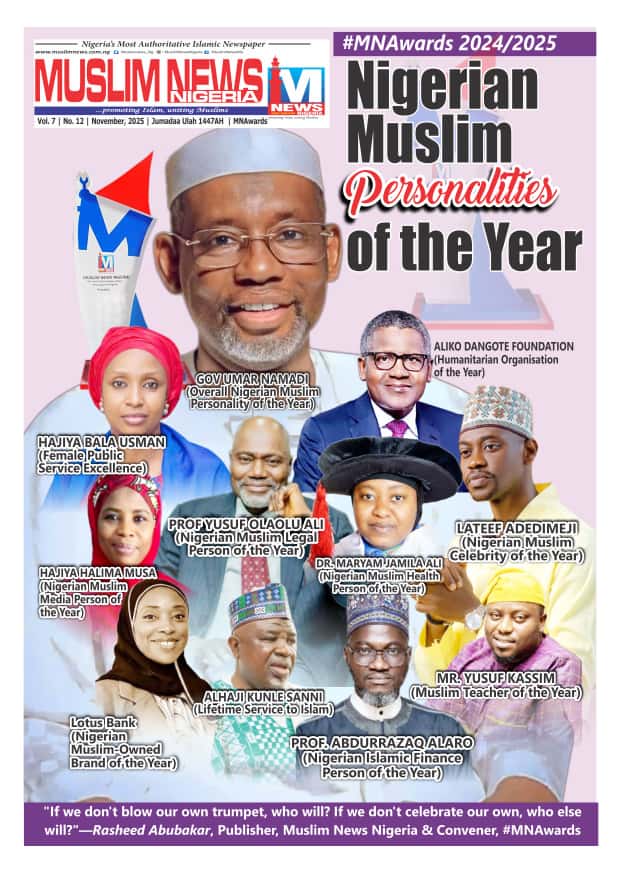
Nigerian Muslim Personalities of the Year 2024/2025
Global Muslim Personalities of the Year 2024/2025




Discover more from Muslim News Nigeria
Subscribe to get the latest posts sent to your email.