

* Call for respect across religious divides to safeguard national unity
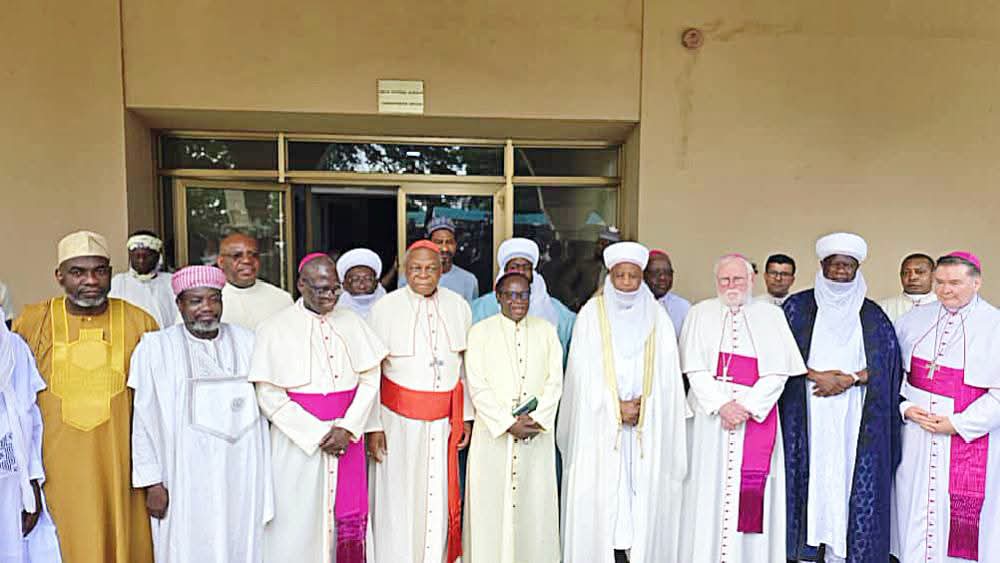
The Sultan of Sokoto and President-General of the Nigerian Supreme Council for Islamic Affairs (NSCIA), Alhaji Muhammad Sa’ad Abubakar III, has renewed the call for stronger collaboration among religious leaders to promote peace, mutual respect and national unity, saying hate speech and misinformation remain significant challenges to harmonious coexistence in Nigeria.
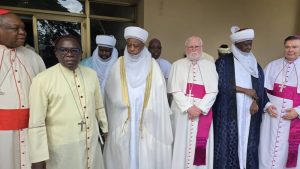
The renewed commitment followed a high-level engagement between the Sultan and a Papal delegation led by Archbishop Paul R. Gallagher, the Secretary for Relations with States and International Organisations of the Holy See, during a visit to the National Mosque in Abuja.
Addressing journalists on behalf of the Sultan after the meeting, the Deputy Secretary-General of the Nigerian Supreme Council for Islamic Affairs, Professor Salisu Shehu, said discussions focused on strengthening cooperation between faith communities, deepening mutual understanding and reinforcing the shared responsibility of religious leaders in advancing peace and security.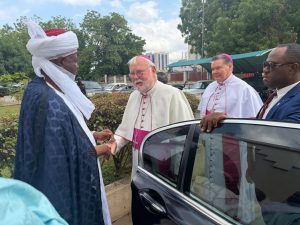
According to him, participants agreed that building stronger relationships across religious divides remains essential to sustaining peaceful coexistence and promoting stability both within Nigeria and beyond.
“One of the major issues discussed was the need to fight hate speech because, to a large extent, hate speech has been most injurious to peaceful coexistence in the country. It has created what may be described as perceptual and relational crises among faith communities in Nigeria.
“The essence of the visit was to promote mutual understanding and emphasise the need for cooperation across religious and faith communities in promoting peace and peaceful coexistence, while also working towards maintaining and improving the security situation, not just in Nigeria but across the world.”
Professor Shehu said the Sultan commended the Catholic community in Nigeria for its commitment to peaceful coexistence and its continued participation in interfaith initiatives designed to foster national harmony.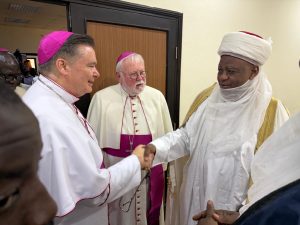
He noted that the Islamic leader acknowledged the readiness of the Catholic Church to continue partnering with him through established interfaith platforms and engagements aimed at strengthening peace and enhancing security across the country.
He explained that both delegations stressed the importance of encouraging respect among members of different religious traditions while discouraging actions capable of deepening divisions within society.
“Therefore, there was a strong call for all religious and faith communities to work together to combat hate speech, especially the growing and unfortunate phenomenon whereby some individuals openly insult religious leaders who are highly respected within their various faith communities. There was also a call to tame such behaviour and ensure that people refrain from insulting not only important religious figures but even ordinary individuals, who equally deserve respect.”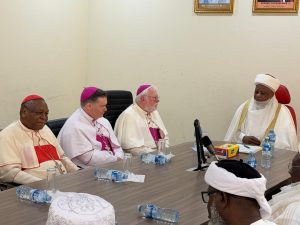
The NSCIA official said another major issue highlighted during the meeting was the growing spread of misinformation and its implications for national peace.
“Continuing, the Islamic leader said that there was the need to fight fake news. Fake news is another evil being used to precipitate a lot of trouble in the country, and therefore, it is something that we must collectively confront.”
He further disclosed that discussions also examined broader moral and social concerns confronting societies around the world, with participants emphasising the responsibility of faith leaders to provide moral guidance and encourage positive values.
“He further explained that There was also a discussion on the need to address the overall moral perversion that is holding sway in the world today. We are witnessing a great deal of moral degeneration and moral perversion globally, and it is the duty of religious leaders and faith workers to ensure that these challenges are confronted.”
Professor Shehu added that the meeting equally considered the need for greater engagement with young people on issues relating to faith and values.
“He added, there was a discussion on the need to fight atheism—the growing rejection of God among young people, both within the Muslim and Christian communities.”
Speaking after the engagement, Archbishop Gallagher described the discussions as open, constructive and encouraging, noting that both Christian and Muslim leaders shared common convictions on the responsibility of religious institutions to advance peace and national development.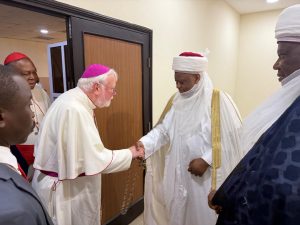
“We had a very frank and illuminating conversation, and it was good to hear that many of our positions regarding the role of religious leaders, both on the Catholic side and the Muslim side, coincide.
“For me, this is a reason for optimism regarding the religious cohesion of the country and our shared commitment to working for the good of all Nigerians.
“The observation is that there is a common view and a common conviction that Christians and Muslims, particularly their leaders, must work together for the common good of all Nigerians.”
Members of the Catholic delegation included Emeritus Archbishop of Abuja, Cardinal John Onaiyekan; the Catholic Archbishop of Abuja, Most Rev. Ignatius Kaigama; the Catholic Archbishop of Sokoto Diocese, Rev. Mathew Kukah, alongside other senior church leaders who participated in the interfaith engagement.
Sponsored

Nigerian Muslim Personalities of the Year 2024/2025
Global Muslim Personalities of the Year 2024/2025




Discover more from Muslim News Nigeria
Subscribe to get the latest posts sent to your email.