

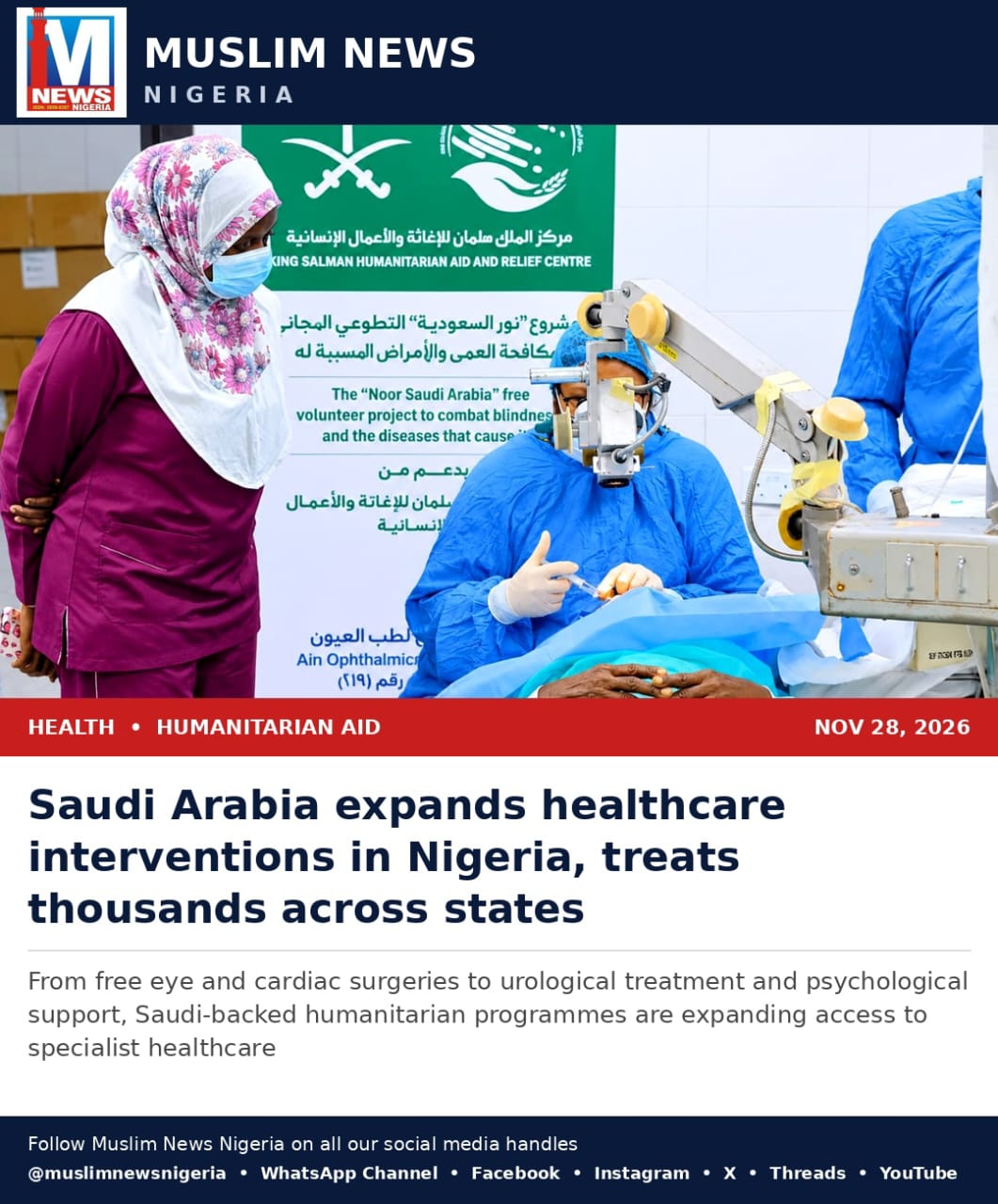
* From free eye and cardiac surgeries to urological treatment and psychological support, Saudi-backed humanitarian programmes are expanding access to specialist healthcare
The Kingdom of Saudi Arabia, under the leadership of the Custodian of the Two Holy Mosques, King Salman bin Abdulaziz Al Saud, and Crown Prince and Prime Minister Mohammed bin Salman bin Abdulaziz Al Saud, has stepped up its humanitarian healthcare interventions in Nigeria, supporting specialist medical programmes that have screened and treated thousands of people across several states.
The interventions, largely implemented through the King Salman Humanitarian Aid and Relief Centre (KSrelief), have covered eye care, cardiac treatment, urological procedures and psychological support, with activities recorded in Kano, Abuja, Adamawa, Ebonyi and Lagos.
Working with Nigerian health institutions and international humanitarian organisations, the Saudi-backed programmes have provided free medical services, specialist surgeries, medicines and professional support to patients who might otherwise struggle to afford such treatment.
Muslim News gathered that the interventions were carried out in collaboration with organisations including the Al-Basar International Foundation, Al-Balsam Association for Training and Health Development, the Muslim World League and the Al-Mawaddah Society for Family Development.
Thousands benefit from eye care in Kano
One of the recent interventions was the Saudi Noor Volunteer Programme, organised in Kano State from November 20 to 26, 2026, by KSrelief in collaboration with the Ain Ophthalmology Association.
The programme screened 4,120 people and facilitated 365 eye procedures, including 329 cataract surgeries, 20 glaucoma surgeries and 16 procedures for pterygium, a condition involving abnormal tissue growth on the eye.
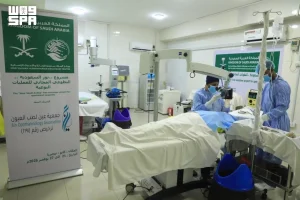
The intervention formed part of Saudi Arabia’s broader humanitarian health support in Nigeria, particularly in providing access to specialist eye care for people who cannot easily afford treatment.
Cardiac mission records 112 procedures in Abuja
In Abuja, a Saudi medical volunteer programme provided specialised cardiac care between October 13 and 19, 2026.
The initiative, implemented by KSrelief in partnership with the Al-Balsam Association for Training and Health Development, recorded 112 cardiac procedures, comprising 84 cardiac catheterisation procedures and 28 specialised cardiac surgeries.
The medical mission brought together 10 Saudi volunteers and 35 Nigerian healthcare professionals, with treatment provided at Nizamiye and Zenith hospitals.
The Saudi Ambassador to Nigeria, Yousef bin Mohammed Al-Balawi, visited the programme, underscoring the country’s support for humanitarian health interventions and cooperation with local medical institutions.
Urological treatment, training in Kano
Saudi Arabia also supported a specialist urological medical mission in Kano State from September 26 to October 3, 2026.
The programme was organised by KSrelief in collaboration with the Muslim World League and involved eight medical volunteers.
It carried out 81 surgical interventions on 53 patients, alongside endoscopic procedures and other specialised operations. The intervention also provided medicines and medical supplies while supporting capacity building among local healthcare workers.
Sixteen Nigerian health workers received training, while four training programmes were organised as part of efforts to strengthen local expertise and improve the delivery of urological services.
Beyond providing immediate treatment, the initiative was designed to support knowledge transfer and improve the capacity of Nigerian medical personnel to manage specialist conditions.
Psychological support reaches 1,140 people
Another Saudi-backed intervention in Kano focused on psychological support and rehabilitation.
The programme, conducted from October 10 to 16, 2026, by KSrelief in partnership with the Al-Mawaddah Society for Family Development, provided specialised counselling and guidance to 1,140 people.
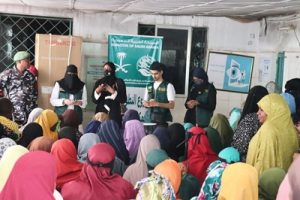
Three volunteers participated in the initiative, which extended Saudi humanitarian assistance beyond surgical and physical healthcare to include psychological wellbeing.
Adamawa, Ebonyi benefit from cataract interventions
In Adamawa State, the Al-Basar International Foundation, with Saudi humanitarian support, carried out a five-day free cataract surgery outreach at the Eye Centre of Specialist Hospital, Yola.
The exercise was officially brought to a close on November 15, 2026, by the state Commissioner for Health, Hon. Chubado Mohammad Jada.
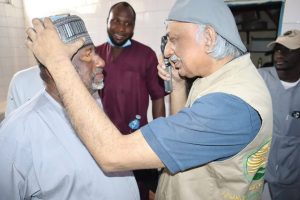
The programme had a target of facilitating 400 cataract surgeries, although a final figure of completed operations was not provided in the report announcing its closure.
A similar intervention was launched in Ebonyi State on November 16 through a partnership involving the Al-Basar International Foundation, Alex Ekwueme Federal University Teaching Hospital (AE-FUTHA) and the state government.
The programme was designed to provide free cataract treatment to eligible patients, with a target of between 400 and 800 surgeries, depending on the number of patients assessed and found suitable for the procedure.
The Regional Administrative Manager of Al-Basar, Bello Abdullahi Yuguda, said more than 600 people with cataract-related conditions had been identified during the exercise.
However, the Chief Medical Director of AE-FUTHA, Professor Robinson Onoh, said more than 20 patients had undergone surgery at the time of the report.
The intervention used the phacoemulsification technique, a modern approach to cataract surgery, while patients with less severe conditions were also assessed for appropriate support.
YABATECH, Al-Basar screen 2,442 people in Lagos
In Lagos, the partnership between Yaba College of Technology (YABATECH) and the Al-Basar International Foundation, with humanitarian support from KSrelief, has continued to provide free eye care through an annual medical outreach.
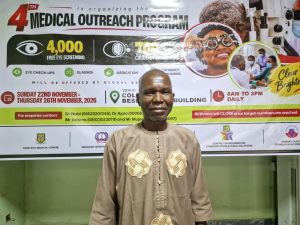
The sixth-day exercise, which marked the fourth edition of the programme, ran from November 22 to 27, 2026. It screened 2,442 people and identified 464 cataract cases, while 421 patients underwent cataract surgery.
The outreach had set targets of screening 4,000 people and facilitating 700 cataract surgeries. Screening activities were conducted at the college, while surgical procedures took place at the General Hospital, Gbagada, with Saudi specialists working alongside Nigerian medical personnel.
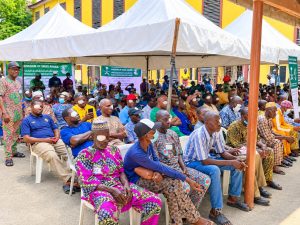
The programme also identified patients requiring further attention for glaucoma. According to Dr Ismail Badmus, Deputy Rector (Academics) of YABATECH, about 100 glaucoma patients were expected to be referred to the Al-Basar hospital in Ibadan for further assessment and possible surgical intervention.
The latest edition builds on three previous years of collaboration between the institutions.
Records show that the programme screened 3,261 people and facilitated 403 surgeries in 2023; screened 2,283 and carried out 316 surgeries in 2024; and screened 3,107 people, with 364 surgeries, in 2025.
With the 2026 figures, the four editions have recorded 11,093 screenings and 1,504 cataract surgeries.
Speaking on the impact of the programme, Dr Engr. Ajala Mosud Taiwo, Chief Lecturer in Industrial Maintenance Engineering and Director of the college’s Centre for Linkages, Partnerships and International Relations, said the intervention had helped beneficiaries access treatment that would otherwise be beyond their financial reach.
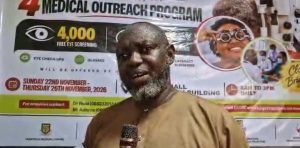
He noted that private cataract surgery could cost between N600,000 and N1m, making the free intervention particularly significant for low-income earners and people without the means to pay for specialist eye care.
One of the beneficiaries, Johnbull Isibo, a pensioner from Edo State, said the surgery had restored sight in his left eye after he had struggled with impaired vision.
He said the cost of treatment at private facilities, which he had been quoted between N750,000 and N1m, had made it difficult for him to proceed before the intervention.
Strengthening healthcare partnerships
The spread of the interventions across different states highlights the role of international humanitarian partnerships in addressing gaps in access to specialist healthcare in Nigeria.
Beyond the number of patients screened and treated, the programmes have also supported local health workers through training, collaboration with Nigerian medical institutions and the involvement of local professionals in specialist procedures.
Beneficiaries said the interventions had given them access to medical treatment they could not otherwise afford, while the partnerships had strengthened healthcare delivery through knowledge exchange and collaboration with Nigerian medical professionals.
As Saudi-backed humanitarian activities continue across Nigeria, the programmes demonstrate how international cooperation can complement local efforts to improve access to essential and specialised medical services.
Sponsored
Sponsored

Nigerian Muslim Personalities of the Year 2024/2025

Global Muslim Personalities of the Year 2024/2025




Discover more from Muslim News Nigeria
Subscribe to get the latest posts sent to your email.