

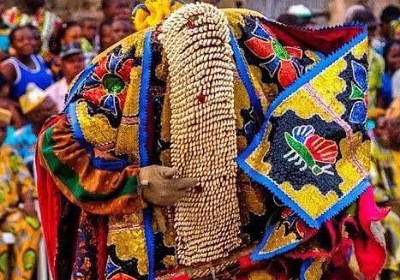
The annual Olóòlù masquerade festival in Ibadan has once again raised an important question that Nigeria can no longer avoid. Can a cultural practice that restricts the freedom of women continue to enjoy public support in a constitutional democracy?
According to the official programme, the Olóòlù masquerade will move through different parts of Ibadan from Monday, July 27, until Thursday, July 30. During these four days, women living, working or carrying out lawful activities in affected communities are expected to restrict their movement simply because of their gender. This is not merely a cultural matter. It is an issue of women’s rights, constitutional rights and human dignity.
The Olubadan of Ibadanland, Oba Rashidi Ladoja, also advised women to stay indoors in areas where the masquerade would pass, noting that it is forbidden for women to behold the Oloolu masquerade.
Whatever the historical origins of this tradition, the implication is clear. For four days, the constitutional rights of women in parts of Ibadan are expected to give way to a cultural practice observed by only a section of the population.
This should concern every Nigerian.
The issue is not whether people have the right to practise their culture or religion. They do. Nigeria’s diversity is one of its greatest strengths. The real question is whether any cultural practice should limit the rights and freedom of other citizens who neither believe in nor participate in it.
Section 41 of the Constitution guarantees every Nigerian the right to move freely throughout the country. Section 42 prohibits discrimination on the basis of sex. Any tradition that confines women indoors simply because they are women raises serious constitutional and human rights concerns.
The same concern arose earlier this month when the Lagos State Ministry of Basic and Secondary Education postponed the Basic Education Certificate Examination scheduled for July 1 because of the Oro festival in parts of Ikorodu Division. At the same time, women in parts of Ikorodu and Igbogbo Bayeku were expected to remain indoors due to restrictions associated with the festival.
When examinations, businesses, public activities and daily life are disrupted because of a traditional procession, government has a responsibility to ask whether the balance between preserving culture and protecting citizens’ rights is being maintained.
The practical consequences are equally troubling. What happens if a woman needs urgent medical attention while such restrictions are in force? What if she has to go to work, attend an examination, run her business or respond to a family emergency? Fundamental rights cannot simply be suspended because of a cultural event.
Another important question also deserves an answer. What exactly happens if a woman sees the Oloolu or Oro masquerade? Will she die? If not, what justifies restricting half of the population from moving freely? Traditions built on fear rather than law should have no place in a modern democratic society.
Culture should unite communities, not create fear or exclusion. A tradition that depends on confining women indoors or restricting the movement of others requires serious reflection.
If adherents insist on preserving such practices, they should be conducted in locations that do not interfere with the rights of the wider public. Public roads, markets and residential neighbourhoods belong to every citizen, regardless of religion, gender or cultural affiliation.
It is also worth noting that Oro processions were traditionally held at night. Increasingly, however, such activities now take place during the day in busy towns and cities, disrupting movement and affecting people who have no connection with the practice. That shift makes the human rights implications even more significant.
Nigeria is a constitutional democracy, not a theocracy or a traditional kingdom where customary rules automatically override fundamental rights. Respect for cultural heritage is important, but culture cannot be used to justify discrimination or deny citizens freedoms guaranteed by law.
International human rights principles, including those promoted by UNESCO, encourage the preservation of cultural heritage in ways that respect human dignity, equality and fundamental freedoms. Cultural preservation should never come at the expense of women’s rights or public safety.
This is an opportunity for traditional rulers, governments, civil society and community leaders to engage in honest dialogue about how cultural practices can evolve while preserving their identity. Traditions that endure are often those that adapt to changing realities without sacrificing human dignity.
In the 21st century, no woman should be told to remain indoors simply because a masquerade is passing through her community. Culture deserves respect, but constitutional rights deserve greater protection. When the two collide, the Constitution must prevail.
– Muslim News Nigeria editorial board
Sponsored

Nigerian Muslim Personalities of the Year 2024/2025

Global Muslim Personalities of the Year 2024/2025




Discover more from Muslim News Nigeria
Subscribe to get the latest posts sent to your email.