

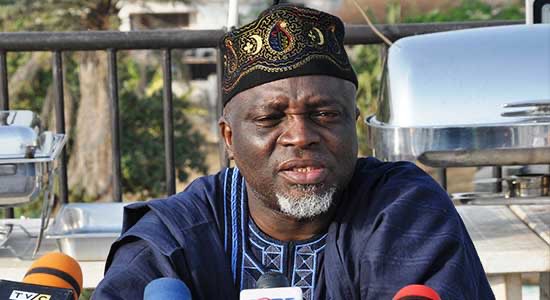
* Ex JAMB Registrar speaks on future plans, most painful experience in office
Prof. Ishaq Oloyede, who recently bowed out as Registrar of the Joint Admissions and Matriculation Board (JAMB) after two terms spanning 10 years, speaks with Dr Reuben Abati of Arise News about his childhood, faith, career, reforms at JAMB, his most painful experiences in office, future plans, politics, examination malpractice and the values that have guided his life. MUSLIM NEWS transcribes the interview. Read on.
___
Dr Abati: You have just left JAMB after 10 years. How do you feel?
Prof. Oloyede: Thank you very much. I think it is very relieving… I feel very relieved. I could sleep very well. I enjoy my sleep now and it was as if I had never slept before.
We thank Allah. We also thank all of you who stood by us to make sure we did what we were supposed to do. So, it was very, very exciting. Looking forward to this, and when it finally came, I felt relieved and happy.
Dr Abati: You have had a remarkable journey in education and public service. What do you attribute it to?
Prof. Oloyede: I think the grace of God and the support of all those who are around me. Like you said, I would not even be able to recognise who my mother was because I was too young when my mother died. My late father and grandmother took care of me, living between Somolu and Akoka, Lagos.
Then all those things that you are supposed to do started with my primary education. My father insisted on Islamic education. It was a mosque converted to a school on Friday. We only parked our benches for the mosque to pray. After the mosque, we turned it back to school. That was my primary education.
After primary education, I went to Arabic school. I attended different types of Arabic schools, but eventually ended up at an institution in Agege, Lagos, from where I moved to the University of Ibadan for my certificate course in Arabic and Islamic Studies in 1976.
From there, I moved again to the Kwara State College of Education, Ilorin, from where I got admission to the University of Ilorin…And that is how I started.
You could see that it was all about the grace of God, His blessing and guidance, and the insistence of my late father that I should be an Islamic student of Islam. That contributed to making me.
Along the line, many people came up to assist and to learn. I was monitored and raised by so many people who contributed to my development. We thank Almighty Allah, who has made the journey so far so good, and all those we met along the line who also contributed, one way or the other, to shape who I am today. I thank God.
Dr Abati: What values would you recommend to a young person who wants to make something remarkable out of life?
Prof. Oloyede: I would say very clearly that the person should be focused, prayerful and sincere. Once you are sincere, focused and you really understand God, I believe that there is no way you cannot overcome obstacles. You’d have obstacles, of course… But you are definitely sure that you will crush all the obstacles.
I believe that anybody who sets out to be sincere in what he is doing, who sets out to be focused and determined to do whatever he wants to do with passion and is prayerful, because even if you have all the wisdom of this world, if whatever you are doing is not blessed by God, it amounts to nothing.
And if you say you are prayerful, but you are not also sincere in the prayer, you are deceiving yourself. Being sincere in prayer means that you act what you preach. You do anything you want to do in a transparent form, in a manner that anything you will not be able to do in public, you are not doing in secret. So, it is just as simple as that.
And you are focused. Why do I say focused? Also, you have to strive to be competent in whatever you are doing. You are not going to be focused on emptiness. You have to be full. You have to be competent. You have to acquire skills. You have to study the environment in which you operate.
We thank God that Almighty Allah has made it possible for many people to succeed, to show that that is the path to go.
Therefore, for anybody who is a servant, anybody who can really study the situation will know that, in my own view, those are the three critical values that one should guide towards making whatever is going to be regarded as success, not in this world, but more importantly, in meeting the pleasure of God in the hereafter.
Dr Abati: What are your plans now that you have left JAMB?
Prof. Oloyede: Yes, many good people are in politics, and we cannot all go one way. I believe that I am not gifted in that area. I would rather be supporting those who are politically competent. Politics is out of it, completely out of it.
When you started this question, I was smiling because I read in some newspapers this morning that I said I was going to beg God. When I saw it, I was like, “Where did I say that?” I now remember where they quoted me out of context. They misinterpreted what I said.
It would have been that I would be more active in serving God, not begging God.
As a Muslim, if you want to be devoted to God, there are so many things you do, at least 12 hours a day. Some of those things I have missed in the last 10 years during my assignment.
Apart from the essentials of prayer, where would I have the time to fast on Monday and Thursday? There was no time. Even if I wanted to do it, I could not do it. There are many other non mandatory prayers that you are supposed to be involved in. I could not combine some of those things with this heavy responsibility that I had to carry.
That is what I mean when I say that I have to go and make up for the deficiencies I have.
One Christian friend of mine called me this morning, and he told me, “I heard you said you are going to beg God. The best way to go and beg is Makkah.”
So, “I will fund you to go to Umrah for one week.” I was excited. I said, “Good.” He said, “I will pay for everything.”
Oh, I thank those who put it out that I said I was going to beg God, because to go to Makkah and stay for one week, that had been solved by my brother who felt that that was the right thing to do.
On a very serious note, I believe that having spent over 70 years, God has been very gracious to me. And I believe that now that I have been able to finish that aspect of my life, the right thing for me to do is to try and make up, not just for 10 years, but about 50 years. Because my stay in UNILORIN as a Vice Chancellor was as occupying, engaging, as I was as the Registrar of JAMB.
So, I thank Almighty God, and I believe that the right thing to do for me is to give back, to get closer to God if He spares one’s life. Because God has done enough by allowing me to live to this age. If God still blesses me with life, I think what I need to do is to devote more time to spiritual development so that when I meet my God, it will be with ease.
So, that is what I meant.
And as regards the future, I believe that God determines the future of everything. It is just for us to plan. And my plan, by God’s grace, is that I will be going back to the classroom, because I have accepted to be an emeritus professor of Islamic Studies at the University of Ilorin.
So, as a result of that, I have a duty to go back to the classroom to make sure that I contribute. And again, it is a makeup.
Because while I was Registrar, I was still teaching occasionally, supervising one or two students, but not as intensely as I would love to do. So, I am eagerly looking forward to engaging my students, being myself and being able to build human capacity in the area of my discipline.
Dr Abati: Looking back after 10 years at JAMB, is there anything you would have done differently?
Prof. Oloyede: Frankly speaking, I have not seen any. I have reflected over it, and I want to thank God that I have been rightly guided throughout the period. I cannot remember anything that, if I became wiser now, I would have done differently.
I thank God.
Everything I did in that office, I did consciously.
And so far, I do not know what will happen tomorrow. But so far, I cannot think of anything, because none was done by accident. None was done because I had to do it. I did whatever I did because I believed that was the right thing to do. So, I do not see anything that I would have done differently.
Dr Abati: What were your most memorable or challenging moments at JAMB, including the snake incident and examination malpractice?
Prof. Oloyede: Some of them were false. Some of them were incomplete truths. Some of them were just shades, different shades of truths.
But before I go into that, permit me to answer a question that I appear not to have answered. That is the question of putting down my experience in the form of a memoir.
I have some restrictions. I have this strong belief that when you talk of autobiography, people writing, some of them are so detailed that I look at them as either the refurbished truth or something that looks like a drama that you must have acted.
Because some of them give to the minutest detail that you will now be thinking, “Was it written at the time the action was happening? Was it being recorded for later writing?” That is one aspect of it. Some of them you cannot even accurately report.
You cannot be sure that what you are saying 20 or 30 years after might be as accurate as you recall.
The second one is that unless one wants to either create confusion in society, create more enemies for society or cause trouble, there are many things you come to know that you better die with.
I believe that if one wants to be truthful and to narrate all you had come across, you will be waking the dead and you will be creating enmity or things that ought to be allowed to die. You will be waking them up.
I believe very strongly that those who write autobiographies, I respect them because they know what to write and what not to write. But by my own nature, if I must say it, I will say everything. And some…may not be good.
For now, I do not intend to put up any write up or to give a narration of what happened. Many things in this country have happened.
Recently, I was at an interview and I enumerated how I had to be with the late Kudirat Abiola, of blessed memory, in the last 24 hours before she was killed. I was narrating the experience of about 24 hours we were together before the unfortunate assassination of Kudirat Abiola. May God bless her soul.
So, there are so many things that I know and many people know, and it is better you do not go back to. And when you now talk about whether everything was exciting, you have mentioned some of them, but to me, the most troublesome, the most painful period of my experience in JAMB had to do with the level of involvement of parents in the organisation of examination malpractice.
They are introducing their wards, their children, to the world of crime. I have no difficulty, and I think most of the candidates are not problematic. They are not the problem.
The problem is the parents, and every time I was confronted with the reality of what parents were doing, most of the time I became very emotional about it because I asked myself, how on earth do people hate themselves, hate their future to this level?
Because it is like, even if you have deficiencies, you would not want to pass the deficiency to the next generation. But that is what many people do with their children.
So, to me, most of the things that people see, they probably see about us, and they are not important, like the Mmesoma case you referred to. Mmesoma was just sensationalised by a group of people who felt they wanted to defend her. We met more than 10 Mmesoma type cases. Even last year, somebody still attempted something like that. We dealt with such cases. We resolved them. It was a normal occurrence for us. Unfortunately, the publicity surrounding the Mmesoma case made it appear unique to people outside the institution.
On the snake incident, that did not happen during my tenure. It happened before I assumed office. I simply had the unfortunate responsibility of addressing it because I was the JAMB Registrar.
I thank God for the way I handled the matter because, while it was being investigated, I insisted that everything should be recorded on tape because the story was unbelievable.
There was no snake, but we found it astonishing that someone could make such a claim. Later, the person almost denied making the statement. If we had not recorded it, even I would have doubted myself. The recording preserved the account of what happened.
Some people still say, “Snakes were swallowing naira in JAMB,” even though they know it was simply a fabricated story. Many people took it literally and believed snakes could swallow money. That was part of the amusement. The reality is that it never happened.
Sponsored

Nigerian Muslim Personalities of the Year 2024/2025

Global Muslim Personalities of the Year 2024/2025




Discover more from Muslim News Nigeria
Subscribe to get the latest posts sent to your email.