

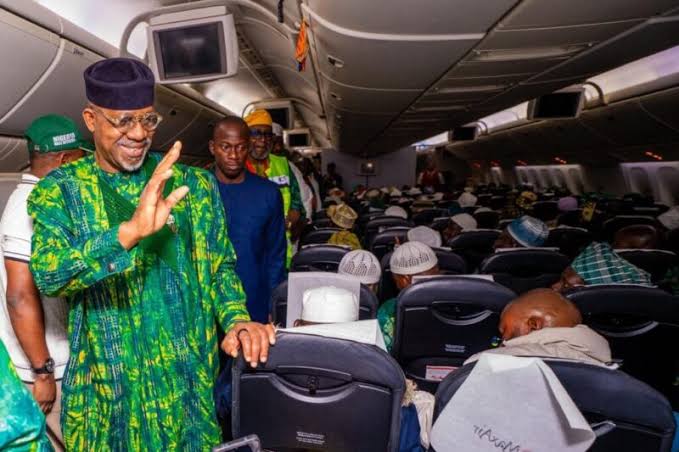
By Rasheed Abubakar
The controversy surrounding the 2026 Hajj airlift of Ogun State pilgrims from the newly commissioned Gateway International Airport, Iperu, has generated intense public debate, emotional reactions, and conflicting narratives from stakeholders.
However, beyond the politics and public relations exchanges, the development raises important questions about communication, coordination, and pilgrims’ welfare during one of the most spiritually significant journeys for Muslims.
From the accounts available in the public space, one fact appears undisputed: many Ogun pilgrims experienced delays, uncertainty, and discomfort during the airlift process. Some pilgrims reportedly spent days waiting at the Ogun State Muslim Pilgrims Welfare Board headquarters in Abeokuta before eventually being redirected to Lagos for departure.
Their frustrations were understandable. For intending pilgrims who had already bid farewell to their families and psychologically prepared for the sacred journey, prolonged uncertainty naturally created anxiety, exhaustion, and emotional distress. Some openly complained about financial strain, health challenges, and lack of clear communication.
At the centre of the controversy, however, is the interpretation of what exactly went wrong.
The initial public narrative was largely shaped by comments attributed to officials of the Ogun State Muslim Pilgrims Welfare Board and testimonies from affected pilgrims. The board’s Executive Secretary, Taiwo Ajibola, confirmed that Flynas, initially scheduled to operate from Iperu, informed authorities that it could not fly from the airport, citing what he described as “technical issues.”
That statement understandably created the public perception that the Saudi carrier had rejected operations from the airport itself.
However, subsequent clarifications from the National Hajj Commission of Nigeria (NAHCON) and the Ogun State Government introduced a different explanation. Both institutions rejected claims that Gateway International Airport was unsafe, unapproved, or rejected by Flynas.
According to NAHCON Chairman, Ambassador Ismail Abba Yusuf, the adjustment was purely operational and connected to scheduling logistics, aircraft rotation, and aviation coordination associated with Hajj operations.
Similarly, the Ogun State Government stated that the issue involved landing slot arrangements relating to Max Air operations rather than infrastructural deficiencies at the airport.
The Ogun Government further defended the airport’s capacity, citing regulatory approvals, international aviation compliance standards, and successful operations already conducted at the facility.
At this stage, the debate appears less about whether disruptions occurred and more about how those disruptions should be interpreted.
What remains undeniable, however, is that communication gaps significantly worsened public perception of the situation. In high-pressure exercises such as Hajj operations, delayed or unclear information often creates room for speculation, panic, and conflicting interpretations. Pilgrims waiting for days without certainty about departure naturally interpreted the silence as evidence of deeper operational problems.
This incident therefore highlights an important lesson for all Hajj stakeholders in Nigeria: pilgrims’ welfare extends beyond transportation alone. Timely communication, transparency, coordination, and humane handling of intending pilgrims are equally essential parts of successful Hajj administration.
Beyond the initial airlift, officials must also sustain regular communication with pilgrims throughout the remaining phases of the operation, including their stay in the Holy Land and their return journey after the successful completion of Hajj rites. Considering the huge amount of money pilgrims commit to undertake the sacred journey, which represents the fifth pillar of Islam, they deserve clarity, reassurance, and proper information at every stage of the exercise.
It is also important to avoid rushing into conclusions before all sides are heard. While the initial reports reflected the experiences and understanding of pilgrims and some officials on ground at the time, the later technical clarifications from NAHCON and the Ogun State Government added dimensions that were not initially available to the public. Ultimately, Nigerians and the Muslim community will draw their own conclusions.
In line with journalistic ethics, especially the principles of accuracy, balance, and fairness, reporters covering Hajj rites and operations are duty-bound to verify information from multiple credible sources before publication, give all relevant parties the opportunity to respond, and avoid presenting unverified claims as established facts.
This aligns with the Qur’anic guidance in Surah Al-Hujurat (49:6): “O you who believe, if a sinful person brings you news, verify it, lest you harm people in ignorance and then become regretful over what you have done.”
This verse and ethical obligation serve as a reminder that reporting on sensitive religious matters such as Hajj requires extra caution, responsibility, and commitment to truth, given its spiritual significance and the trust of the faithful.
Some may see the incident as a routine logistical challenge amplified by poor communication. Others may view it as evidence of coordination lapses surrounding a newly commissioned international airport undertaking a major religious airlift operation.
Whichever perspective prevails, one point should unite all stakeholders: the sacred journey of Hajj deserves careful planning, transparency, and the highest level of dignity for pilgrims whose primary concern is fulfilling a pillar of Islam in peace and spiritual comfort.
* Rasheed Abubakar is the publisher of MUSLIM NEWS NIGERIA. Email: muslimnewsng@gmail.com
Sponsored
Sponsored

Nigerian Muslim Personalities of the Year 2024/2025

Global Muslim Personalities of the Year 2024/2025




Discover more from Muslim News Nigeria
Subscribe to get the latest posts sent to your email.