

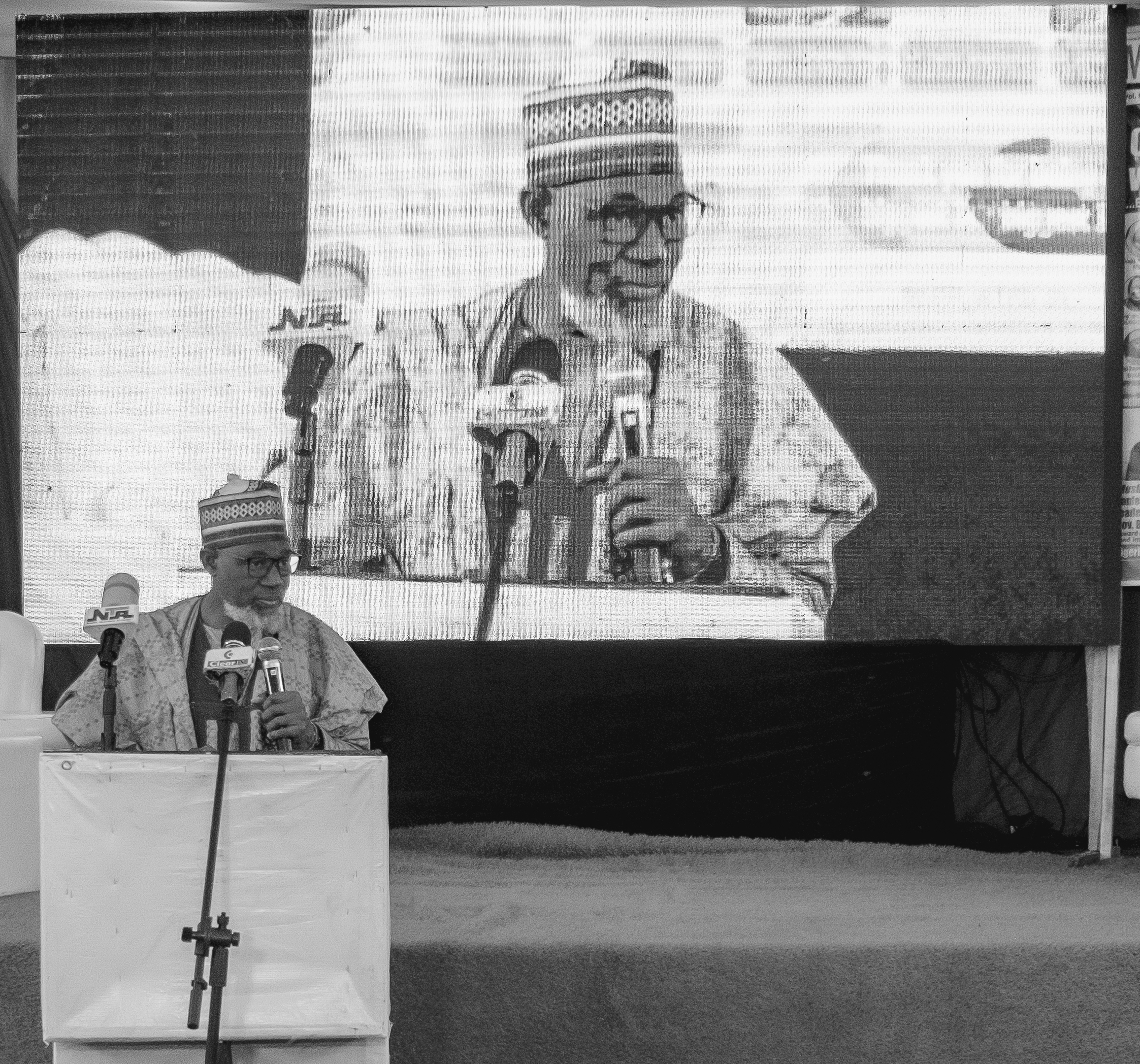
The National Missioner of the Ansar-Ud-Deen Society of Nigeria, Sheikh AbdulRahman Ahmad, has called on Muslims to invest strategically in the media to counter biased narratives, stereotypes and misinformation about Islam and Muslims.
Sheikh Ahmad made the call at the 7th Anniversary Lecture and MNAwards Presentation organised by Muslim News Nigeria on Sunday, June 14, 2026. The lecture, held in Lagos, was themed, “Framing the Faith in the Midst of Media Representation and Global Conflicts.”
In a remark, the respected scholar said Muslims had, for decades, failed to appreciate the strategic importance of media ownership and effective communication, leaving others to shape public perception of Islam and Muslims.
According to him, the need to challenge biased media narratives against Muslims dates back several decades.
How the Iranian Revolution and Maitatsine shaped a generation
Recalling his days as a student at the Kwara State College of Technology in 1981, Sheikh Ahmad said he and a group of Muslim students became increasingly concerned about the portrayal of Islam following the Iranian Revolution of 1979 and the Maitatsine uprising in northern Nigeria.
Iranian Revolution was a popular movement that overthrew the autocratic government of Shah Mohammad Reza Pahlavi in 1979 and established the Islamic Republic of Iran under Ayatollah Ruhullah Khomeini.
The Maitatsine uprising, on the other hand, was a series of violent insurgencies led by the radical preacher Mohammed Marwa, popularly known as Maitatsine, in parts of northern Nigeria between 1980 and 1985.
The National Missioner of a foremost Muslim organisation in Nigeria said the two events dominated international and local media coverage at the time, resulting in widespread suspicion and misconceptions about Islam and Muslims.
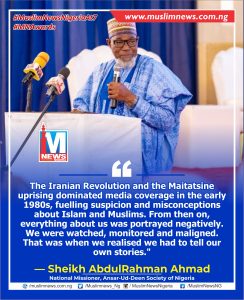
“Everything about us was negative. We were constantly being watched, monitored and maligned,” he recalled.
Recounts how four colleagues entered journalism to defend Islam
According to Sheikh Ahmad, the experience prompted him to encourage some of his colleagues, including veteran broadcaster AbdulRazaq Abdussalam; Aliu Akoshile, now Publisher and Editor in Chief of NatureNews Africa, and Tajudeen Adeyemi, to study Mass Communication as a strategic response to the misrepresentation of Islam in the media.
“I told them we had a responsibility before us. By the powers conferred on me as the Imam of the College, I directed them to study Mass Communication. They replied that I should also study it, and I agreed. That was how we began our own little project to combat stereotypes,” he said.
Sheikh Ahmad said their understanding of the challenge deepened after they gained admission into journalism school.
“When we got into journalism school, we realised we were up against very strong forces. The United States, the United Kingdom and Germany controlled major global news organisations.
“The average Northerner listened to the BBC Hausa Service, Deutsche Welle Hausa Service and the Voice of America Hausa Service. People trusted them because they reached them where they were.
“The four of us eventually studied Mass Communication and later served in different capacities within the media, making our contributions to the profession. I also worked in the media for some time before Allah directed me to the path of becoming the National Missioner of Ansar ud Deen Society of Nigeria,” he said.
Muslims have yet to make meaningful investments in the media
Sheikh Ahmad noted that despite the growth of digital media, the Muslim community had yet to make significant investments in media institutions capable of influencing public discourse.
“The stereotypes continued. The negative media continued. Up until today, there is no worthy investment in information, even in the digital age,” he said.
The Islamic scholar argued that the media had evolved beyond its traditional functions of informing, educating and entertaining.
Instead, he said, many influential media organisations now shape public opinion, influence political conversations and determine national and global agendas.
Reflects on The Concord’s past media influence
Drawing historical comparisons, Sheikh Ahmad cited the influence once wielded by the now defunct Concord newspaper established by the late Chief Moshood Kashimawo Olawale (MKO) Abiola.
He said the newspaper became one of the country’s most influential media organisations because of the enormous investment behind it, demonstrating the Agenda Setting power of a strong media institution.
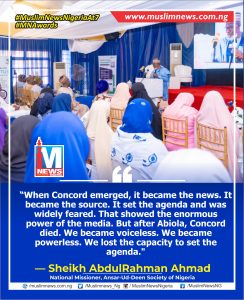
“When Concord emerged, it became the news. It became the source. It set the agenda and was widely regarded. That showed the enormous power of the media. But after Abiola, Concord died. We became voiceless. We became powerless. We lost the capacity to set the agenda,” he said.
Praises Muslim media professionals, seeks funding for Muslim media
Sheikh Ahmad praised several Muslim media professionals whom he said emerged from the vision conceived decades ago, including AbdulRazaq Abdussalam who later retired as a Director at the Voice of Nigeria, Aliu Akoshile and Tajudeen Adeyemi.
He equally commended the Publisher of Muslim News Nigeria, Rasheed Abubakar, for sustaining the platform despite numerous financial and operational challenges.
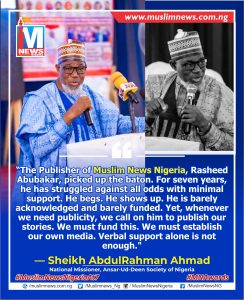
“Rasheed Abubakar picked up the baton. For seven years he has struggled against all odds with minimal support. He begs. He shows up. He is barely acknowledged and barely funded. Yet whenever we need publicity, we call on him to publish our stories,” Sheikh Ahmad said.
He also acknowledged the efforts of Muslim content creators and independent media platforms, saying many of their works deserved national prominence but often failed to receive the attention they merited because Muslims lacked influential media platforms.
He specifically recognised the contributions of the Chief Executive Officer of Arabel Exclusive Islamic Stores, Hajia Shareefah Abiola Andu, whom he described as consistently producing valuable educational content through Alif TV as an independent platform amplifying Muslim voices.
According to him, if similar content had been produced by other interests, it would have dominated newspaper headlines and public discourse.
Sheikh AbdulRahman Ahmad: Four Memorable Quotes on Media Ownership and Muslim Representation
At the 7th Anniversary Lecture and MNAwards Presentation of Muslim News Nigeria, the National Missioner of the Ansar-Ud-Deen Society of Nigeria, Sheikh AbdulRahman Ahmad, delivered a… pic.twitter.com/IEttBtQCcI
— Muslim News Nigeria (@muslimnews_NG) June 30, 2026
Sheikh Ahmad prayed for Allah’s continued protection and strength for Rasheed Abubakar and urged Muslims to move beyond verbal encouragement by providing financial support for Muslim media initiatives.
“We must fund this. We must establish our own media. Verbal support alone is not enough,” he said.
He concluded by urging wealthy Muslims, Islamic organisations and professionals to invest strategically in the media institutions, capable of accurately representing Islam and influencing public discourse.
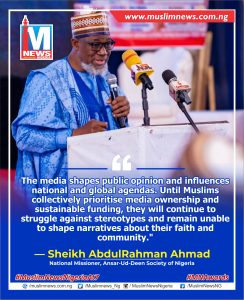
According to him, until Muslims collectively prioritise media ownership and sustainable funding, they will continue to struggle against stereotypes and remain unable to shape narratives affecting their faith and community.
Sponsored
Sponsored

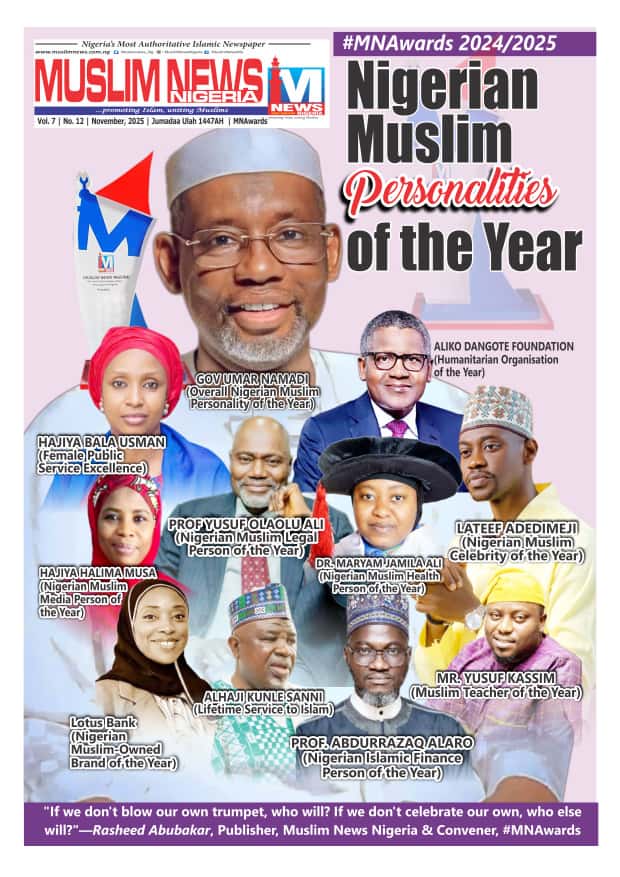
Nigerian Muslim Personalities of the Year 2024/2025
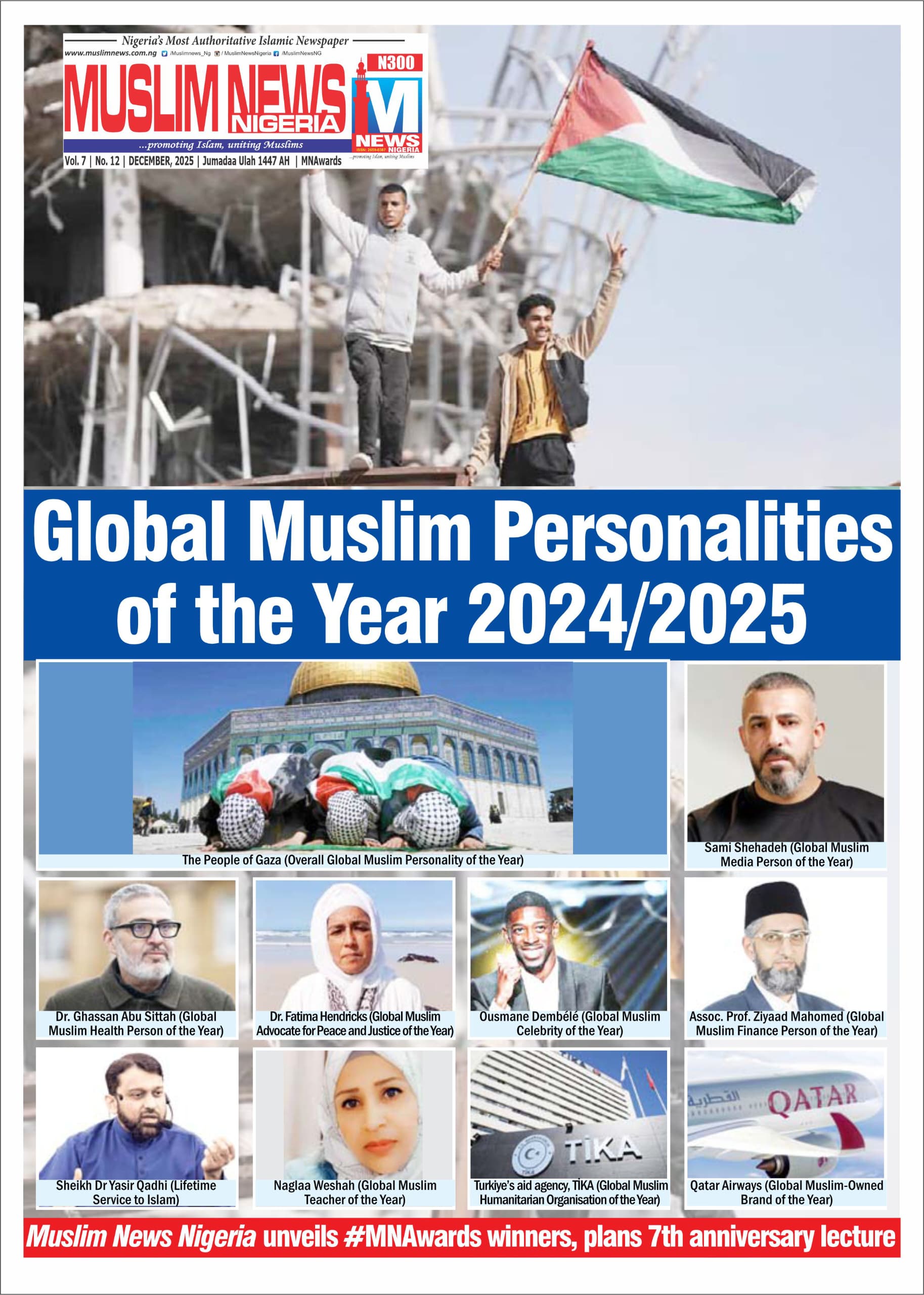
Global Muslim Personalities of the Year 2024/2025



Discover more from Muslim News Nigeria
Subscribe to get the latest posts sent to your email.